


 Preview
 Send
Send Share
Share
 Details
 Guide
Guide

 Download
 Similars
 X-Ray
X-Ray Diaporama
 Stats
StatsCalm
 Oil On Canvas
- WallArt
- Dutch Golden Age
 1650
1650 47.0 x 59.0 cm
 Wallraf-Richartz-Museum
 Read More
Giclée / Art Print
Museum-quality giclée or canvas print with fast production and flexible finish options. ( Buy Hand Made Painting Switch to Digital Image)




P118B $10

P118H $10

P118W $10

P438Z $10

P508JH $12

P508YH $12

P805H $10

P805Z $10

P919BZ $10

P919G $10

P919XJ $10

P959ZH $10

P968JZ $12

W106C $8

W218G $10

W218JH $8

W218Y $10

W307PJ $10

W316G $10

W316PJ $8

W316Y $10

W398PJ $8

W4111J $10

W500HY $15

W500JH $15

W692G $12

W849H $8

W940BG $15

W953PJ $8




Pick from our preset sizes that match the artwork's original proportions.

Type the width and the height you need, to fit your frame or your wall. A print can only be cut, never made bigger than the picture, so a size with a different shape loses a part of the image. We send you a digital mockup to approve before we print anything. The picture shown on this page does not show the real cut — only the mockup does.
Worldwide Delivery () in 2 weeks instead of standard 4/5 weeks. (23 October)

Free Worldwide Express Shipping

High-Quality Linen Canvas

Full Shipping Insurance

Customs Tax Refund Guarantee

True Color Matching Guarantee

100-Day Return Policy (Defects Only)

100% Money-Back Guarantee

Bulk Discount Offer
 Glass option is only available in size under 110 CM

Calm
Giclée / Art Print
Reproduction Size
-


Total Price
$ 63
A Stillness Captured: Jan van de Cappelle’s “Calm”
Jan van de Cappelle's "Calm," painted in 1650, isn’t merely a depiction of a coastal scene; it’s an invitation to a profound moment of tranquility. Often overlooked amidst the dramatic seascapes favored by his contemporaries, this work reveals a quieter, more introspective side to the artist’s remarkable talent. It's a painting that speaks not just of the visual beauty of a Dutch waterway but also of a carefully cultivated state of mind – a stillness reflected in every brushstroke and subtle hue.
The scene unfolds along a broad, gently curving river, its surface rendered with an almost unsettling smoothness. The water is devoid of visible waves or currents, mirroring the overcast sky above with remarkable fidelity. This isn’t the turbulent drama of a storm; it's a deliberate choice by van de Cappelle to evoke a sense of profound peace and contemplation. The composition is remarkably balanced, drawing the eye across the canvas towards a solitary fisherman wading into the shallow water on the right side of the frame. He stands as a small, almost insignificant figure against the vastness of the landscape, yet his presence anchors the scene and invites us to share in this quiet moment.
The Language of Light and Shadow
Van de Cappelle’s mastery lies not just in capturing the visual appearance of the water but also in conveying its atmosphere through a masterful use of light and shadow. The painting is bathed in a diffused, almost ethereal light – neither bright nor dark, but rather a soft, muted glow that seems to emanate from within the canvas itself. This subtle illumination creates an incredible sense of depth and volume, as if we could step directly into the scene and feel the cool dampness of the air. The artist employs a technique known as *chiaroscuro*, skillfully contrasting areas of light with deep shadows to heighten the drama and create a three-dimensional effect.
Notice how the distant boats are rendered in paler, almost ghostly tones – a deliberate device by van de Cappelle to suggest their distance and the atmospheric haze that softens their outlines. The foreground elements, particularly the fisherman and the boats closest to the viewer, are painted with greater detail and richness of color, drawing our attention and anchoring us within the scene. The brushwork itself is remarkably smooth and blended, contributing to the overall sense of serenity and stillness.
A Window into 17th-Century Dutch Life
"Calm" offers a fascinating glimpse into the daily life of 17th-century Holland – a society deeply connected to its waterways. The presence of fishing boats, the solitary figure of the fisherman, and the overall atmosphere of quiet industry all speak to this reality. However, van de Cappelle doesn’t simply depict a snapshot of everyday life; he elevates it into something more profound. He captures not just *what* is happening but also *how* it feels – the sense of peace, contentment, and connection with nature that characterized so many Dutch lives during that era.
Interestingly, van de Cappelle’s background as a textile merchant profoundly influenced his artistic vision. His intimate knowledge of color, texture, and pattern—skills honed in the demanding world of dyeing fabrics—translated seamlessly into his paintings. He sought to create works that were not just visually appealing but also emotionally resonant, evoking feelings of tranquility and contemplation.
Symbolism and Emotional Resonance
Beyond its technical brilliance, “Calm” is imbued with a subtle sense of symbolism. The stillness of the water can be interpreted as a metaphor for inner peace – a state of mind free from turmoil and anxiety. The solitary fisherman represents humanity’s connection to nature, reminding us of our place within the larger world. And the overcast sky, rather than suggesting gloom, evokes a feeling of quiet contemplation and introspection.
Ultimately, “Calm” is a painting that invites us to slow down, breathe deeply, and appreciate the beauty of stillness. It’s a testament to van de Cappelle's extraordinary talent and his ability to capture not just the visual appearance of the world but also its profound emotional essence. A reproduction of this work offers a chance to bring this sense of serenity into any space, serving as a constant reminder of the importance of finding moments of peace in our own lives.
Questions & Answers
What is the format of "Calm"?
The format of "Calm" is landscape. This is useful when planning where a reproduction will be placed.
What is "Calm" about?
The themes present in "Calm" by Jan van de Cappelle include maritime scene, calm waters, dutch coast, fishing boats, atmospheric light, tranquility, 17th century, reflection. Together they summarize the artwork's subject matter.
How do I preview a reproduction of "Calm" by Jan van de Cappelle?
To preview a reproduction of "Calm" by Jan van de Cappelle, open the artwork's Preview page.
Related Artworks


Artist Biography
The Mirror of Tranquility: The Life and Legacy of Jan van de Cappelle
Jan van de Cappelle stands as a singular, luminous figure within the pantheon of the Dutch Golden Age, an artist whose presence in the art historical canon is defined by a profound, meditative stillness. Unlike many of his contemporaries who produced vast quantities of work, Cappelle’s oeuvre remains remarkably small, yet each piece commands an extraordinary distinction. He was not merely a painter of the sea; he was a man of significant worldly stature, an industrial titan inextricably linked to the economic heartbeat of Amsterdam. As a successful figure in the textile industry and a collector of great taste, his life was a unique duality of commercial prowess and artistic sensitivity. This intersection of wealth and vision allowed him to cultivate a style that does not merely depict the maritime world but captures its very soul—a stillness that reflects both the surface of the water and the infinite heavens above.
Born in Amsterdam in 1624, Jan van de Cappelle followed an unconventional path toward artistic mastery. While many masters of his era were forged in the rigorous fires of formal guild training, Cappelle was largely self-taught, a fact that perhaps contributed to the singular, unburdened quality of his vision. His upbringing was steeped in the technical complexities of industry; his father, Franchoy van de Cappelle, operated a substantial dyeworks specializing in the production of crimson dye. This environment, demanding precision and an intimate understanding of color and chemistry, likely provided Jan with an invaluable foundation for his later explorations of light and atmosphere. While he may have been influenced by the stylistic sensibilities of Simon de Vlieger, whose compositions share a certain structural kinship with his own, Cappelle’s work eventually transcended mere influence to achieve a state of pure, atmospheric grace.
Mastery of Light and Atmospheric Perspective
The true genius of Jan van de Cappelle lies in his ability to manipulate the elements of air and water to create a sense of profound emotional depth. He is often celebrated as Holland’s outstanding marine painter of the 17th century, a title earned through his unparalleled mastery of atmospheric perspective. His technique is most famously realized in the way he mirrors sky formations onto calm, glass-like water surfaces. In works such as Ships at Anchor on a Quiet Sea, the viewer is not merely looking at a maritime scene but is invited into a moment of suspended animation. The subtle gradations of light and the meticulous rendering of clouds create a sense of immense space, where the boundary between the sea and the sky becomes beautifully blurred.
His artistic language draws inspiration from the realism of Willem van de Velde the Elder, yet it possesses a softness that is uniquely his own. Where others might focus on the chaotic energy of naval combat or the ruggedness of the storm, Cappelle sought the quietude found in the aftermath or the anticipation of movement. His compositions often feature:
- The interplay of light and shadow: Capturing the fleeting moments when sunlight pierces through cloud cover to illuminate a single vessel.
- Reflective surfaces: Using the water as a mirror to duplicate the majesty of the Dutch sky, creating a sense of symmetry and peace.
- Atmospheric nuance: A delicate handling of mist, haze, and clarity that gives his landscapes a palpable sense of temperature and humidity.
Historical Significance and Enduring Impact
The historical significance of Jan van de Cappelle extends beyond the aesthetic beauty of his canvases. He represents the pinnacle of the Dutch Golden Age's ability to find the extraordinary within the ordinary. Through his depictions of sailing boats, river scenes, and winter landscapes, he documented the maritime identity of a nation that was then the center of global commerce. Even in his more dynamic works, such as The State Barge Saluted by the Home Fleet, there remains an underlying sense of order and dignity that reflects the structured prosperity of his era.
Though his life ended in 1679, leaving behind a limited collection of masterpieces, his impact on the genre of marine art is immeasurable. He taught subsequent generations how to paint not just what is seen, but what is felt—the weight of the air, the stillness of the tide, and the quiet majesty of the horizon. Today, his works remain essential touchstones for anyone seeking to understand the delicate balance between man, nature, and the light that binds them together. His legacy is one of serenity, a lasting testament to an artist who found the infinite within the tranquil.

Jan van de Cappelle
1624 - 1679 , Netherlands
Quick Facts
- Full Name: Jan van de Cappelle
- Nationality: Dutch
- Date Of Birth: 1624
- Date Of Death: 1679
- Place Of Birth: Amsterdam, Netherlands
- Notable Artworks:
- Ships at Anchor on a Quiet Sea
- Vessels Moored off a Jetty
- A River Scene with Dutch Vessels Becalmed
- Artistic Movement Or Style: Golden Age
- Artists Who Influenced This Artist:
- Simon de Vlieger
- Willem van de Velde the Elder
- Artists Or Movements Influenced By This Artist: ['Rembrandt']
Related Articles

Willem van de Velde the Elder: Master of Maritime Painting & Chronicler of the Dutch Golden Age
Discover the captivating maritime paintings of Willem van de Velde the Elder, a master chronicler of the Dutch Golden Age. Explore his unparalleled realism and lasting influence on naval art history.

Pieter de Hooch: Illuminating Dutch Domestic Life & Golden Age Charm
Explore the captivating world of Pieter de Hooch, a master of Dutch Golden Age painting. Discover his innovative use of light, intimate domestic scenes, and lasting influence on art history. Learn more at ArtsDot.

Dutch Masters: 10 Golden Age Paintings That Still Inspire |
Journey into the Dutch Golden Age! Explore 10 iconic paintings by Rembrandt, Vermeer & Hals. Discover the stories behind these Baroque masterpieces and find museum-quality art reproductions to elevate your home decor on .

Rembrandt's Masterpieces: Explore 25 Iconic Paintings & Prints | ArtsDot
Journey through Rembrandt van Rijn's 25 most iconic paintings & etchings. Explore Dutch Golden Age masterpieces, dramatic chiaroscuro, and timeless portraits. Find museum-quality art reproductions to elevate your home decor on ArtsDot.com.
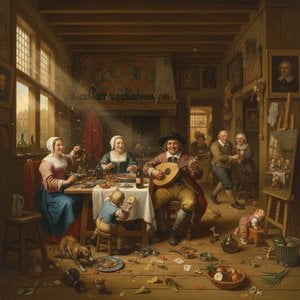
Jan Steen: A Master of Dutch Genre Painting & the Golden Age
Explore the life & art of Jan Steen, a leading Dutch Golden Age painter renowned for his humorous genre scenes & insightful social commentary. Discover his techniques, legacy, and collecting tips.


