
- Home

- Oil Painting Reproduction
- James Baker Pyne
- Scene On The Rhine

 Buy print
 Send
Send Share
Share
 Details

 Download
 Similars
 X-Ray
X-Ray Diaporama
Scene On The Rhine

Hand Made Oil Reproduction
Hand-painted oil on canvas in your size and frame, made to order by our artists.




P118B $10

P118H $10

P118W $10

P438Z $10

P508JH $12

P508YH $12

P805H $10

P805Z $10

P919BZ $10

P919G $10

P919XJ $10

P959ZH $10

P968JZ $12

W106C $8

W218G $10

W218JH $8

W218Y $10

W307PJ $10

W316G $10

W316PJ $8

W316Y $10

W398PJ $8

W4111J $10

W500HY $15

W500JH $15

W692G $12

W849H $8

W940BG $15

W953PJ $8




 Read more
Pick from our preset sizes that match the artwork's original proportions.

You may enter your own dimensions to fit a specific frame or space. If your selected size does not match the original image's proportions, we will either crop the artwork or extend the painting with additional hand-painted elements. A digital mockup will be sent for your approval before production begins.
Please note that the on-screen preview does not reflect the actual cropping or extension. Only the mockup will accurately show the final composition.
While custom sizes are available, we recommend selecting a dimension from the predefined list to preserve the original proportions.
After order, ArtsDot.com team will email client for instructions and provide a mockup preview
Worldwide Delivery () in 3/4 weeks instead of standard 5 weeks. (1 July). No compromise on quality.

Free Worldwide Express Shipping

High-Quality Linen Canvas

Full Shipping Insurance

Customs Tax Refund Guarantee

True Color Matching Guarantee

60-Day Return Policy (Defects Only)

100% Money-Back Guarantee

Bulk Discount Offer
 Glass option is only available in size under 110 CM

Scene On The Rhine
Reproduction Medium
Reproduction Size
-


Total Price
-
Related Artworks


Artist Biography
A Bristolian’s Journey: The Life and Art of James Baker Pyne
James Baker Pyne, born in the vibrant port city of Bristol in 1800, emerged as a significant figure in 19th-century British landscape painting. His artistic path was one of self-discovery and evolving influence, beginning within the close-knit community of the Bristol School before ultimately embracing the luminous style of J.M.W. Turner. Pyne’s early life presented an initial obstacle to his passion; his father, a pragmatic broker, steered him towards a legal apprenticeship, hoping for a more ‘respectable’ profession. However, the allure of art proved too strong to resist. Upon completing his articles at the age of twenty-one, he wholeheartedly dedicated himself to painting, joining the sketching expeditions and artistic dialogues that characterized the Bristol School in the 1820s. This formative period instilled in him a deep appreciation for depicting the atmospheric qualities of local scenery and crafting imaginative compositions—qualities evident in early works like *Imaginary Scene* (1828) and *View of the Avon from Durdham Down* (1829). These paintings reveal an artist already possessing considerable skill, skillfully employing the techniques and aesthetic sensibilities championed by Francis Danby, a leading light of the Bristol School.
From Local Views to Continental Grandeur
The year 1832 marked a turning point in Pyne’s career. He documented the tumultuous events of the Bristol Riots through his paintings, capturing a moment of civic unrest with stark realism. Shortly after, he embarked on a six-week sojourn to France alongside fellow artist Edward Villiers Rippingille, an experience that broadened his artistic horizons and fueled his ambition. Pyne continued to participate in the revitalized sketching activities of the Bristol School during 1832-33, but his style was already beginning to shift. A pivotal move to London around 1835 heralded a new phase in his development. It was here that he encountered the overwhelming influence of J.M.W. Turner. Pyne’s landscapes began to reflect Turner's masterful use of color and innovative compositional techniques, moving away from the more restrained palette and ‘poetical’ approach favored by Danby. *Clifton, Near Bristol, from the Avon* (1837), exhibited at the Royal Academy, stands as a testament to this transformation—a work brimming with Turnerian luminosity and atmospheric depth.
Recognition and Artistic Exploration
Pyne’s talent quickly gained recognition within London's art circles. He regularly exhibited at prestigious venues including the British Institution, the Royal West of England Academy in Bristol, and the Royal Academy between 1836 and 1841. His dedication to his craft led to his appointment as Vice-President of the Society of British Artists, solidifying his position within the artistic establishment. The mid-19th century saw Pyne expanding his geographical scope for inspiration. A journey to Germany, Switzerland, and Italy in 1846 exposed him to new landscapes and light conditions, enriching his palette and compositional vocabulary. He became particularly drawn to the scenic beauty of the Lake District, a region he revisited frequently, notably under commission from the esteemed art dealership Thomas Agnew and Sons in 1848. This relationship culminated in an extended three-year tour of Italy beginning in 1851, accompanied by Bristol watercolorist William Evans. These travels provided him with abundant material for his paintings, allowing him to capture the dramatic vistas and atmospheric nuances of both British and Italian landscapes.
Legacy and Influence
James Baker Pyne’s artistic legacy lies in his ability to synthesize diverse influences—from the grounded realism of the Bristol School to the ethereal brilliance of Turner—into a distinctive style that resonated with contemporary audiences. He was not merely an imitator, but rather an artist who absorbed and adapted the lessons of his predecessors, forging his own path within the landscape tradition. His paintings offer captivating glimpses into 19th-century Britain and beyond, showcasing both familiar scenes and imaginative visions. Beyond his artistic output, Pyne also played a role in nurturing the next generation of artists; among his pupils were George Arthur Fripp and James Astbury Hammersley, as well as William James Müller, though Müller ultimately developed a style distinct from that of his mentor. Pyne’s works are now held in numerous public collections, including The British Museum, the Victoria and Albert Museum, and the Tate, ensuring that his contribution to British art continues to be appreciated by audiences today. He passed away in London on July 29th, 1870, leaving behind a body of work that beautifully captures the spirit of an era and the enduring power of landscape painting.
Notable Works
- Saints’ Day at Venice: A romantic oil painting showcasing Venetian canals and architecture with loose brushwork and atmospheric beauty.
- Scene On The Rhine: Captivating river views and atmospheric skies rendered in a Romantic style.
- Snowdon From Capel Curig: A stunning depiction of Snowdonia, demonstrating masterful oil technique and atmospheric perspective.

James Baker Pyne
1800 - 1870 , United Kingdom
Quick Facts
- Artistic Movement Or Style: Landscape, Romanticism
- Artists Or Movements Influenced By This Artist: ['William J. Müller']
- Artists Who Influenced This Artist:
- Turner
- Francis Danby
- Date Of Birth: 1800
- Date Of Death: 1870
- Full Name: James Baker Pyne
- Nationality: English
- Notable Artworks:
- Saints’ Day at Venice
- Scene On The Rhine
- Snowdon From Capel Curig
- Place Of Birth: Bristol, UK
Related Articles

Evoking Emotion & Transcendence: Romantic Landscape Painting (18th-19th Century)
Explore the emotional depth of Romantic landscape painting (18th-19th century). Discover key artists like Friedrich & Cole, and the concepts of the sublime. Expert insights for art lovers & collectors.


James Sant: Capturing Victorian Childhood & the Evolving Landscape of British Genre Painting
Explore the life & art of James Sant (1820-1916), renowned Victorian portraitist to Queen Victoria. Discover his captivating depictions of childhood, landscapes, and aristocratic society. Learn about his legacy & find fine art reproductions.
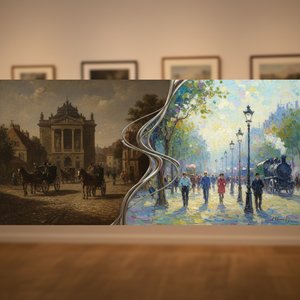
Echoes of 1873: Transition & Innovation in European Painting
Explore the pivotal year of 1873 in European painting! Discover Realism's final flourish & Impressionism’s rise with expert insights from ArtsDot.com. High-quality reproductions & art consultation.

James Ward: A Study in British Romantic Landscape and Animal Painting
Explore the captivating world of James Ward (1769-1859), a master of British Romantic landscape & animal painting. Discover his iconic 'Gordale Scar' and exquisite portraits – a timeless art investment. Learn about his influences, style, and enduring legacy.

Flowing Narratives: Rivers in Painting – A Historical Exploration
Explore the rich history of rivers in painting! Discover masterpieces from ancient times to Impressionism & beyond. Learn about symbolism, artists like Monet & Daubigny, and find your perfect serene artwork at ArtsDot.



