
- Home

- Oil Painting Reproduction
- jacopo carucci
- Ten thousand martyrs
 Buy print
 Send
Send Share
Share
 Details

 Download
 Similars
 X-Ray
X-Ray Diaporama
Ten thousand martyrs
 Oil On Canvas
- WallArt
- Mannerist Expression
 1529
1529 65.0 x 73.0 cm
 Galleria degli Uffizi
 Read More
Hand Made Oil Reproduction
Hand-painted oil on canvas in your size and frame, made to order by our artists.




P118B $10

P118H $10

P118W $10

P438Z $10

P508JH $12

P508YH $12

P805H $10

P805Z $10

P919BZ $10

P919G $10

P919XJ $10

P959ZH $10

P968JZ $12

W106C $8

W218G $10

W218JH $8

W218Y $10

W307PJ $10

W316G $10

W316PJ $8

W316Y $10

W398PJ $8

W4111J $10

W500HY $15

W500JH $15

W692G $12

W849H $8

W940BG $15

W953PJ $8




Pick from our preset sizes that match the artwork's original proportions.

You may enter your own dimensions to fit a specific frame or space. If your selected size does not match the original image's proportions, we will either crop the artwork or extend the painting with additional hand-painted elements. A digital mockup will be sent for your approval before production begins.
Please note that the on-screen preview does not reflect the actual cropping or extension. Only the mockup will accurately show the final composition.
While custom sizes are available, we recommend selecting a dimension from the predefined list to preserve the original proportions.
After order, ArtsDot.com team will email client for instructions and provide a mockup preview
Worldwide Delivery () in 3/4 weeks instead of standard 5 weeks. (1 July). No compromise on quality.

Free Worldwide Express Shipping

High-Quality Linen Canvas

Full Shipping Insurance

Customs Tax Refund Guarantee

True Color Matching Guarantee

60-Day Return Policy (Defects Only)

100% Money-Back Guarantee

Bulk Discount Offer
 Glass option is only available in size under 110 CM

Ten thousand martyrs
Reproduction Medium
Reproduction Size
-


Total Price
-
Artwork Description
The Harrowing Vision: Jacopo Pontormo’s “Ten Thousand Martyrs”
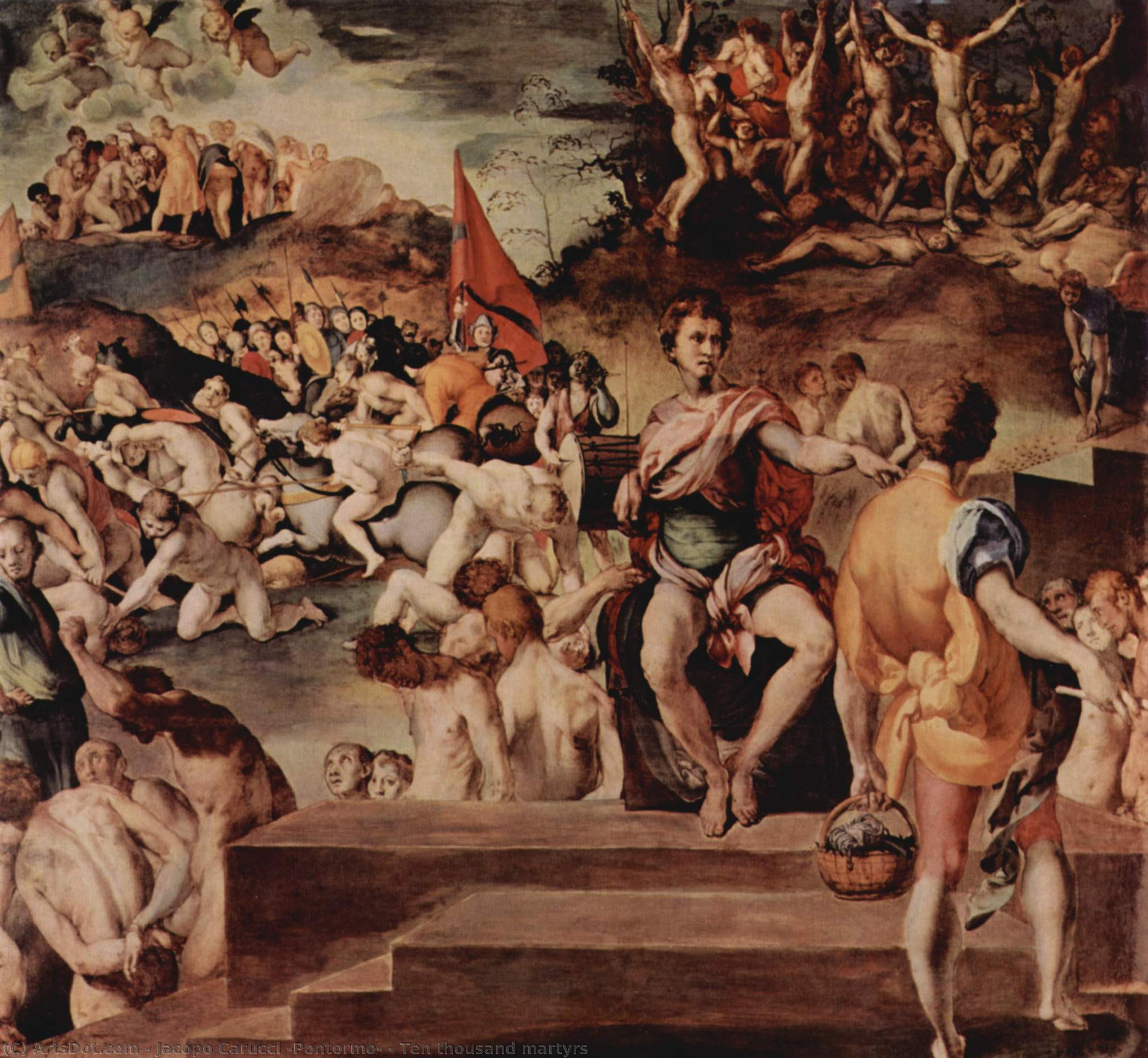
Jacopo Pontormo's "Ten Thousand Martyrs," painted in 1529, is not merely a depiction of historical suffering; it’s a visceral plunge into the heart of religious trauma and defiant resistance. This monumental fresco, now rendered in exquisite detail as a hand-painted reproduction by ArtsDot.com, captures a pivotal moment from early Christian history – the brutal execution of ten thousand soldiers who had converted to Christianity during the reign of Emperor Decius. Far removed from the idealized serenity often associated with Renaissance art, Pontormo’s masterpiece confronts us with an unsettling realism and a profound sense of human drama.
The scene unfolds outdoors, against a backdrop of a brooding sky and a distant, almost mournful hill. At the center stands a single figure – a martyr, identifiable by his flag held aloft in a gesture of unwavering defiance. This isn’t a heroic portrait; he is stripped bare, exposed to the elements and the impending violence. Around him, a vast crowd watches with varying expressions: some filled with horrified pity, others with detached curiosity, and a few with a chilling anticipation of the bloodshed to come. The inclusion of horses amongst the onlookers adds an element of primal chaos, reflecting the brutal nature of the event.
A Bridge Between Styles: Pontormo’s Mannerist Innovation
Born in Pontorme, Tuscany, around 1494, Jacopo Pontormo was a pivotal figure bridging the High Renaissance and the burgeoning Baroque era. Trained under the tutelage of masters like Domenico del Pollaiuolo and Michelangelo Buonarroti – artists known for their anatomical precision and sculptural forms – Pontormo deliberately pushed beyond these established conventions. He embraced emotional intensity and psychological complexity, prioritizing expressive distortion and unsettling perspectives over classical harmony and balance. This is most evident in “Ten Thousand Martyrs,” where figures are elongated, faces contorted with anguish, and spatial relationships deliberately skewed to heighten the dramatic effect.
Pontormo’s use of color is equally striking. He employs a palette dominated by somber browns, deep reds, and muted blues – colors that evoke both the darkness of death and the resilience of faith. The vibrant flag held by the martyr provides a crucial focal point, a symbol of hope and resistance against the overwhelming force of imperial power. The painting’s dynamism is further enhanced through his masterful manipulation of light and shadow, creating an atmosphere of palpable tension and impending doom.
Symbolism and Historical Context
The story depicted in “Ten Thousand Martyrs” draws upon a medieval legend – the tale of Roman soldiers who, after embracing Christianity, were crucified on Mount Ararat. While the historical accuracy of this event is debated, it served as a potent symbol of unwavering faith in the face of persecution. Pontormo’s painting powerfully conveys the emotional weight of this narrative, transforming a potentially dry historical account into a deeply moving meditation on sacrifice and endurance.
The flag itself holds significant symbolic weight. It represents not just individual defiance but also the collective spirit of resistance against tyranny. It's a visual declaration that even in the face of certain death, faith and conviction remain unyielding. The scene resonates with broader themes of religious persecution throughout history, offering a timeless reminder of the human cost of intolerance.
A Reproduction for the Soul
ArtsDot.com’s hand-painted reproduction captures the essence of Pontormo's original masterpiece with breathtaking fidelity. Every detail – from the tormented expressions on the faces to the dramatic lighting and unsettling spatial arrangements – is meticulously recreated, allowing you to experience the painting’s emotional power firsthand. This isn’t simply a print; it’s an immersive encounter with one of the most compelling works of the Italian Renaissance. Whether displayed in a grand salon or a smaller study, this reproduction will undoubtedly serve as a poignant reminder of human resilience and the enduring power of faith.
Explore the full detail and artistry of “Ten Thousand Martyrs” at https://en.ArtsDot.com/en/art/jacopo-carucci-ten-thousand-martyrs-dewjfc-en/ and bring this extraordinary work of art into your home.
Related Artworks


Artist Biography
Jacopo Pontormo (1494 – 1557/7): Bridging Renaissance and Baroque Expression
Jacopo Pontormo, born Jacopo Carucci in Pontorme, Tuscany, circa 1494, stands as a singular figure within the Florentine Mannerist movement—a painter who defied convention and forged his own path toward artistic innovation. Unlike many of his contemporaries striving for idealized beauty rooted in classical ideals, Pontormo embraced emotional intensity and psychological complexity, marking him as a pivotal conduit between the serene grandeur of the High Renaissance and the dramatic dynamism of the Baroque era. His life was marked by both prodigious talent and personal tragedy, shaping his oeuvre into a testament to artistic vision tempered by profound sorrow. Early Training and Influences: Pontormo’s formative years were spent under the tutelage of Domenico del Pollaiuolo and Michelangelo Buonarroti—artists whose mastery of anatomical realism and sculptural form profoundly impacted his stylistic development. While acknowledging the Renaissance legacy, Pontormo swiftly distanced himself from its rigid formalism, gravitating toward a more expressive approach informed by Northern European art traditions. Notably, he studied engravings by Albrecht Dürer, absorbing techniques for conveying emotion through stylized imagery and compositional innovation. This exposure to Northern Mannerism would prove instrumental in shaping his distinctive visual language. The Mannerist Style: Pontormo’s artistic breakthrough arrived around 1515 with the commission of “Visitation,” a monumental altarpiece for Santissima Annunziata in Arezzo—a painting that immediately established him as a champion of Mannerist aesthetics. Characterized by elongated figures, flattened perspectives, and swirling draperies imbued with vibrant color palettes, Pontormo’s style rejected the Renaissance obsession with anatomical accuracy and harmonious proportions. Instead, he prioritized conveying psychological states—despair, grief, ecstasy—through distorted forms and ambiguous spatial relationships. This deliberate departure from established conventions signaled a radical rethinking of artistic representation, anticipating the dramatic innovations that would define the Baroque period. Notable Works and Legacy: Pontormo’s output encompassed a diverse range of subjects—religious scenes, portraits, and mythological compositions—each imbued with his characteristic Mannerist sensibility. Among his most celebrated paintings are “Joseph’s Coat Sold to the Egyptians,” “The Deposition,” and “Saint Francis Receiving Stigmata”—works that exemplify his masterful manipulation of color, light, and texture to evoke profound emotional resonance. His portraits, particularly those depicting members of Florence's Medici court, reveal an astute understanding of psychological nuance and a subtle engagement with Mannerist stylistic conventions. Pontormo’s influence extended beyond his own artistic achievements; he mentored younger artists—including Agnolo Bronzino—who carried forward his innovative vision into the subsequent generation of Florentine painters. His legacy resides not merely in his individual masterpieces but also in his role as a catalyst for artistic experimentation and a harbinger of stylistic change—a testament to his enduring contribution to European art history. Further Exploration: Pontormo’s oeuvre continues to fascinate scholars and connoisseurs alike, prompting ongoing debates about the nature of Mannerist aesthetics and its relationship to broader cultural trends. Museums worldwide showcase reproductions of his paintings—including those housed in the Uffizi Gallery in Florence—allowing visitors to experience firsthand the transformative power of his artistic vision. For a deeper understanding of Pontormo’s life and work, consult resources such as ArtsDot.com/jacopo carucci and Wikipedia: Jacopo.
jacopo carucci
1494 - 1557 , Italy
Quick Facts
- Artistic Movement Or Style: Mannerism
- Artists Or Movements Influenced By This Artist:
- Michelangelo
- Rosso Fiorentino
- Artists Who Influenced This Artist:
- Leonardo da Vinci
- Andrea del Sarto
- Date Of Birth: 1494
- Full Name: Jacopo Pontormo
- Nationality: Italian
- Notable Artworks:
- Visitation
- Deposition
- Halberdier
- Place Of Birth: Pontorme, Italy
Related Articles

Maerten van Heemskerck: Bridging Mannerism & Renaissance Ideals
Explore the captivating world of Maerten van Heemskerck, a pivotal Dutch Renaissance painter bridging Mannerism & Italian influence. Discover his masterpieces and legacy with ArtsDot.

Renaissance Mannerism: Style, Subtlety & the Transition from Harmony to Artifice
Explore the captivating world of Renaissance Mannerism! Discover its key characteristics, pioneering artists like Pontormo & Bronzino, and its pivotal role in art history. Expert insights & museum-quality reproductions at ArtsDot.

Mannerism: Bridging Renaissance Harmony & Baroque Drama – A Study of Style & Affectation
Explore the fascinating world of Mannerism! Discover its key characteristics, pioneering artists like Pontormo & Bronzino, and its pivotal role in bridging Renaissance harmony to Baroque drama. A comprehensive guide for art enthusiasts.

Mannerism's Masters: 10 Artworks That Redefined Renaissance Style | ArtsDot
Explore 10 defining Mannerism masterpieces – from Pontormo to El Greco. Discover the stories behind these Renaissance paintings, their unique style & symbolism. Find museum-quality art reproductions at ArtsDot.com and elevate your home decor.

The Golden Age Reforged: Dramatic Realism & Religious Zeal in Spanish Baroque Art
Explore the dramatic world of Spanish Baroque art! Discover masters like Zurbarán & the powerful influence of religious zeal on painting techniques – a guide for collectors and enthusiasts.



