

- 41.0 x 31.0 cm


The picture follows your choices: , .
Collectible Description
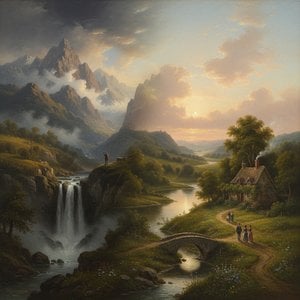
Hubert Robert’s haunting Ruin Capriccio transports viewers into a Romantic landscape brimming with melancholic beauty—a masterful depiction of crumbling stone architecture bathed in ethereal light, capturing the spirit of antiquity and inviting contemplation.
 Read More
Artist Biography
A master of Romantic capriccio ruins like The Port of Rome. Discover his evocative landscapes and architectural visions today.
Hand Made Oil Reproduction
Hand-painted oil on canvas in your size and frame, made to order by our artists. ( Switch to Print Switch to Digital Image)
More about this painting
 Preview
 Send
Send Share
Share
 Details
 Guide
Guide

 Download
 Similars
 X-Ray
X-Ray Diaporama
 Q&A
Q&A Stats
StatsOrder your painting in four simple steps
Take your time. You can change any answer; the price in your order card follows each choice.
1 Step one of four
Which size would you like?
These sizes keep the proportions of the original painting. The drawing shows your choice on a wall, above a two-metre sofa.
Or give your own measurements
Pick from our preset sizes that match the artwork's original proportions.

Type the width and the height you need, to fit your frame or your wall. This is hand-painted, so for a size with a different shape the artist can paint a bit more around the picture, or cut a bit — you choose. We send you a digital mockup to approve before the painting starts. The picture shown on this page does not show the real result — only the mockup does.
2 Step two of four
How should it be prepared: rolled, stretched or framed?
The prices below are for the size you chose in step one.
Choose the edges of the stretched canvas
Choose your frame

White $1

Blurside $1

Extended $1

P118B $10

P118H $10

P118W $10

P438Z $10

P508JH $12

P508YH $12

P805H $10

P805Z $10

P919BZ $10

P919G $10

P919XJ $10

P959ZH $10

P968JZ $12

W106C $8

W218G $10

W218JH $8

W218Y $10

W307PJ $10

W316G $10

W316PJ $8

W316Y $10

W398PJ $8

W4111J $10

W500HY $15

W500JH $15

W692G $12

W849H $8

W940BG $15

W953PJ $8

H24-GOLD $30

H24-SILVER $30

H36-GOLD $45

H36-SILVER $45
Framed
Moulding: . Overall size with the frame: .
3 Step three of four
Would you like anything changed in the painting?
Most people answer no. Because each painting is made by hand, our artist can also adapt it for you.
After order, ArtsDot.com team will email client for instructions and provide a mockup preview
4 Step four of four
A few finishing options
All of them are optional. The answers already selected cost nothing extra.
Who paints it?
Worldwide Delivery () in 3/4 weeks instead of standard 5 weeks. (10 November). No compromise on quality.
A nameplate, as in a museum?
Engraved Bronze Plaque Details
This elegant plaque features the artist's name and the title of the artwork, finely engraved for a timeless presentation.
It is made from bronze with a refined, elegant finish. The text is precisely laser-engraved for a sharp and permanent result. Measuring 9x2 cm, the plaque is compact yet easy to read. It's built to be durable and scratch-resistant, offering a professional, museum-quality look. Mounting is simple thanks to the included adhesive backing.
Transparent Acrylic Plaque Details
The plaque includes essential engraved details such as the artist's name, the title of the artwork, the date it was created, the type of media used-like oil on canvas or watercolor-a brief description of the piece, and a QR code that links to the complete artwork information.
It is crafted from clear acrylic, offering a sleek, modern appearance. The text is UV-engraved in black to ensure strong visual contrast. With a size of 10x15 cm, it ensures optimal readability. It comes equipped with two metal hooks for secure wall mounting. The plaque is designed to be weather-resistant, making it suitable for various environments, and it includes interactive features that work seamlessly with smartphone scanning.
Black Acrylic Plaque Details
This elegant plaque includes engraved information such as the artist's name, the title of the artwork, the date it was created, the type of media used (like oil on canvas or watercolor), a short description of the artwork, and a QR code for quick access to more information.
The plaque itself is made from refined black acrylic with a premium finish. The text is laser-engraved in white for high contrast and readability. Its size is 10x15 cm, designed to be easy to read. It comes with two metal hooks for professional mounting. The design is sleek and fits any interior style. It is also weather-resistant and durable, with built-in digital integration for mobile compatibility.
A protective varnish?
When do you need it?
✓ Check and order
Your painting, as you ordered it

Ruin Capriccio
Reproduction Medium
Reproduction Size
-

Elite Senior Artist
More detail, finesse, and extra production time
-

Reproduction Frame
-
-
For artworks or reproductions larger than 105 cm (approximately 41 inches) on any side, the frame will be shipped as a kit, disassembled. This method ensures safe delivery and prevents damage during transport.
Professional assembly required - this is not a DIY product.
The kit must be assembled and the canvas stretched by an experienced professional framer, using wood glue (not supplied), a canvas stretching plier and clamps to hold the bars square while the glue dries. Incorrect assembly or uneven canvas tension can permanently damage the artwork and is not covered by our warranty.
 For artworks or reproductions larger than 105 cm (approximately 41 inches) on any side, the frame will be shipped as a kit, disassembled. This method ensures safe delivery and prevents damage during transport.
All solid wood bars are included, precisely cut to size.
Assembled with the screws provided, plus wood glue for the corner joints, which is not supplied and must be sourced by your framer.
Professional tools are required and not included: a canvas stretching plier (tensioner) and clamps to hold the bars square while the glue dries.
Important:
The corner joints require wood glue, the bars must be held with clamps until the glue is fully dry, and tightening the canvas on the assembled frame requires a canvas stretching plier. None of these are included in the kit. Please arrange an experienced professional framer before ordering this size.

Nameplate
-
-

Protective Varnish
Glossy Varnish (enhances colors, protects against light/moisture)
-

Customize My Artwork
Examples of what can be changed: Replace face with customer photo; Add pet (e.g., replace cat with dog); Include hidden message in background; Change background landscape or elements.
-

Urgent
Worldwide Delivery () in 3/4 weeks instead of standard 5 weeks. (10 November). No compromise on quality.
-
Express Shipping
Worldwide Delivery () in 5 weeks. (17 November).
Included
Total Price
$ 263
Glass option is only available in size under 110 CM
Included with every order
- Free Worldwide Express Shipping
- High-Quality Linen Canvas
- Full Shipping Insurance
- Customs Tax Refund Guarantee
- True Color Matching Guarantee
- 100-Day Return Policy (Defects Only)
- 100% Money-Back Guarantee
- Bulk Discount Offer


Hubert Robert: The Poet of Ruins
Hubert Robert (1733-1808) stands as an emblem of the Romantic spirit—a painter who transcended mere documentation, transforming observation into visionary imagination to conjure scenes imbued with both nostalgic longing and anticipatory wonder. Born in Paris amidst a period of dramatic artistic upheaval—from the opulent Rococo’s playful frivolity to the burgeoning Neoclassicism—Robert navigated these stylistic currents, ultimately establishing himself as a pivotal figure in shaping the aesthetic landscape of his era. He wasn't merely depicting decay; he was crafting narratives of time and memory, elevating ruins into symbols of grandeur lost and beauty enduring.- Early Life & Artistic Training: Robert’s formative years were marked by exposure to influential artistic mentors like Michel-Ange Slodtz, who recognized his innate talent but skillfully steered him toward painting—a decision that proved decisive in unlocking Robert's true creative potential. This guidance instilled a foundational understanding of perspective and composition, skills he would hone throughout his prolific career.
- Roman Reveries: Robert’s journey to Rome in 1754 represented more than just a geographical relocation; it signified an immersion into the intellectual fervor of the Enlightenment and a profound fascination with the vestiges of antiquity. His time amongst fellow artists, notably Giovanni Paolo Panini and Giovanni Battista Piranesi—whose techniques he meticulously studied—fueled his artistic vision and cemented his reputation as a master of architectural capricci.
- The Capriccio Genre: Robert’s signature style resided in the genre of capriccio—a technique that deliberately juxtaposed disparate elements—ancient ruins, fantastical landscapes, and idealized figures—to evoke an atmosphere of sublime beauty and melancholy contemplation. This approach distinguished him from his contemporaries who favored more restrained representations of nature, prioritizing emotional resonance over literal accuracy.
- A Painter of Emotion: Robert’s paintings are characterized by a masterful manipulation of light and color, capturing fleeting moments of atmospheric drama with breathtaking sensitivity. He sought to convey not just what he saw but how he felt—a profound awareness of the passage of time and the inevitability of decay—themes that resonated deeply with the Romantic sensibility.
- Legacy & Influence: Robert’s enduring legacy extends beyond his individual artworks; he profoundly impacted subsequent generations of painters, inspiring them to embrace imaginative storytelling and to explore the expressive power of landscape painting. His influence can be discerned in the works of Eugène Delacroix and Caspar David Friedrich—artists who similarly championed the Romantic ideal of sublime beauty and emotional intensity.
Ruin Capriccio: A Study in Light and Memory
“Ruin Capriccio,” executed circa 1786, exemplifies Robert’s artistic philosophy with remarkable clarity. The painting depicts a monumental stone building—likely inspired by the grandeur of Roman ruins—dominated by towering columns and arches bathed in ethereal light. This dramatic illumination serves not merely to illuminate the architectural structure but also to imbue it with an aura of timelessness and melancholy beauty. Scattered throughout the scene are figures—primarily human forms—who appear dwarfed by the scale of the ruin, emphasizing the insignificance of human existence against the backdrop of geological time.Robert’s meticulous attention to detail—evident in the rendering of textures, drapery folds, and atmospheric haze—underscores his commitment to capturing not just visual appearances but also emotional impressions. The artist skillfully employs chiaroscuro—the interplay between light and shadow—to heighten dramatic tension and to create a sense of depth that draws the viewer into the scene’s contemplative mood.
Symbolism & Context: Echoes of Antiquity and Romantic Idealism
The choice of ruins as subject matter was deliberate, reflecting Robert's fascination with the vestiges of classical civilization—a preoccupation that mirrored the broader intellectual currents of the Enlightenment. Ruins served as potent symbols of grandeur lost, reminding viewers of the impermanence of earthly achievements and prompting reflection on mortality. Simultaneously, Robert’s depiction aligns perfectly with the tenets of Romantic idealism—a movement characterized by an emphasis on emotion, imagination, and the sublime—values that championed the beauty of untamed nature and the contemplation of profound spiritual truths.Technical Mastery & Artistic Innovation
Robert's technique was distinguished by its virtuosity—particularly his command of perspective and atmospheric effects. He achieved remarkable realism through painstaking observation, meticulously recreating textures and colors with unparalleled accuracy. Yet, he never sacrificed artistic expression for mere imitation; rather, he skillfully manipulated visual elements to convey emotional resonance and to evoke a sense of wonder. His innovative approach to landscape painting solidified Robert’s position as one of the foremost artists of his time—a testament to his unwavering dedication to pushing the boundaries of artistic convention.Questions & Answers
Which period of Hubert Robert's career does "Ruin Capriccio" belong to?
Within Hubert Robert's career, "Ruin Capriccio" falls in the Mature Period. The phase helps compare it with the artist's other works.
Is a download available for "Ruin Capriccio"?
A download is available for "Ruin Capriccio": the artwork's Download page offers a high-resolution digital image download.
How does the subject of "Ruin Capriccio" relate to Hubert Robert's usual themes?
Among Hubert Robert's recorded themes - italian ruins, romantic vision, architectural fantasy, sublime landscape, artist’s legacy - "Ruin Capriccio" brings its own focus on ruins, landscape, architecture, twilight, atmosphere, romanticism, detail.
Related Artworks


Hubert Robert
1733 - 1808, France
Artist Biography
Early Life, Family and Artistic Training
Born in Paris in 1733, Hubert Robert entered a world where his family's social standing was tied to the service of others. His father, Nicolas Robert, held a position within the household of a prominent figure, a connection that would eventually facilitate the young man's movement through the upper echelons of French society. This early stability provided the foundation for a formal education, which he pursued through the structured environment of the Collège de Navarre. By 1751, he had completed his studies under the Jesuits, gaining a disciplined intellectual background before turning his attention to the visual arts.
His initial path was not intended for the canvas. He entered the atelier of the sculptor Michel-Ange Slodtz, where his training focused on the rigorous principles of design and perspective. While the tactile nature of sculpture was his starting point, Slodtz possessed a keen eye for the boy's specific inclinations. Recognizing a different potential, the mentor encouraged him to abandon the chisel in favor of the brush. This shift from the three-dimensional weight of sculpture to the atmospheric possibilities of painting would define the trajectory of his life.
The Formative Years in Rome
In 1754, Robert left France for Rome, traveling in the entourage of Étienne-François de Choiseul. This move was more than a simple change of scenery; it was a decade-long immersion into the heart of antiquity. During his eleven years in Italy, he resided at the Académie de France, a period that allowed him to absorb the architectural grandeur of the city. He did not merely observe these monuments from a distance; he lived among them, developing a profound connection to the physical remains of the past.
His development was further shaped by his time in the studio of Giovanni Paolo Panini. Through this association, Robert began to refine his ability to interpret the classical world. He moved beyond the simple documentation of existing structures, learning instead to manipulate light and shadow to suggest a sense of history. His presence in the city was so deeply felt that, in 1767, he reportedly carved his name into the walls of the Colosseum, a small, humanizing act of permanence against the very ruins he spent his life studying.
Success and Royal Patronage in Paris
Upon his return to Paris in 1765, Robert found a city eager for the perspectives he had gathered during his years in Italy. His ascent within the French artistic establishment was swift. In 1766, he was received by the Académie royale de peinture et de sculpture, presenting a Roman capriccio that signaled his arrival. This formal recognition opened doors to the highest circles of French society, where his ability to blend architectural precision with imaginative landscapes met a growing public appetite for the picturesque.
His professional life became increasingly intertwined with the French crown. He secured prestigious appointments that reflected the state's trust in his technical skill and aesthetic judgment. He served as the Designer of the King's Gardens and later held the position of Keeper of the King's Pictures. These roles allowed him to influence the visual landscape of the monarchy, moving between the creation of new designs and the stewardship of existing collections. His influence extended into the very institutions that would define French art for the next century.
As the political landscape shifted, his responsibilities grew in weight and complexity. He was appointed Keeper of the Museum and Councilor to the Academy, a position that placed him at the center of the nation's cultural administration. His life was no longer merely that of a painter, but of a guardian of history. Even as the structures of the old regime began to fracture, his presence within the halls of the Louvre remained a constant, marking him as a central figure in the transition of French institutional art.
Technique and Distinctive Artistic Style
Robert’s hand was as versatile as the landscapes he sought to capture. He moved with ease between the precision of a draftsman and the fluid touch of a painter, employing a wide array of media. His technical repertoire included etching, pen and ink, black chalk, red chalk, and watercolor, alongside the traditional application of oil on canvas. He often utilized the alla prima technique, applying paint in a direct, spontaneous manner that lent a sense of immediacy to his compositions. This technical breadth allowed him to navigate the complexities of architectural form and the softness of a changing sky with equal facility.
His method relied on a delicate balance between the seen and the imagined. While his works were grounded in meticulous detail and a rigorous understanding of perspective, they were never mere topographical records. Instead, he used atmospheric perspective to soften distant horizons, creating a palpable sense of depth and light. He possessed a particular mastery of illusion, using light and shadow to manipulate the viewer's perception of space. By blending careful observation with a heightened imagination, he constructed scenes where the physical reality of a stone arch or a crumbling column was heightened by a carefully orchestrated, almost theatrical, sense of atmosphere.
- The Port of Rome (Roman capriccio)
- The Ponte Solario (c. 1775)
- The Old Bridge (c. 1775)
- The Footbridge (c. 1775)
The Capriccio and Themes of Decay
The moniker "Robert des Ruines" was more than a mere nickname; it was a recognition of a man who found his most profound expression in the crumbling remains of the past. He moved through the artistic landscape of the late 18th century as a painter in the school of Romanticism, a position that allowed him to look beyond the literal documentation of architecture. Instead of simply recording the state of a building, he sought the poetry within its disintegration. His work often presented semi-fictitious, picturesque depictions of ruins, finding subjects in both the ancient landscapes of Italy and the changing urban fabric of France.
Central to this vision was his mastery of the capriccio. In these compositions, he deliberately juxtaposed disparate elements—ancient monuments, fantastical landscapes, and idealized figures—to create scenes that existed in the tension between reality and imagination. He did not merely paint what was there; he constructed atmospheres of melancholy and wonder. By blending factual architectural details with imagined settings, he created a sense of history that felt both tangible and dreamlike. This approach allowed him to explore the passage of time through the lens of stone and shadow.
- The Port of Rome (Roman capriccio)
- Ruin Capriccio
- Roman Capriccio
Political Upheaval and Later Years
The shifting tides of the French Revolution brought sudden and personal peril to Robert. During the Reign of Terror, he faced a period of brief imprisonment, an experience that left its mark on his output through a series of drawings documenting his confinement. Despite the volatility of the era, his professional standing remained significant. He was appointed curator of the newly established Muséum Central des Arts, the institution that would eventually become the Musée du Louvre, where he worked to organize and catalog the nation's growing collection.
His connection to the Louvre was profound and enduring. From 1778 until 1802, he made his home within its walls, living amidst the very halls he had helped to decorate and preserve. This long residency placed him at the center of a changing France, witnessing the transition from the old monarchy to the Napoleonic era. He remained a prolific creator until his health finally failed him. Robert died in Paris from a stroke on 15 April 1808.
Notable Works and Artistic Achievements
The sheer scale of Robert's output reflects a life spent in constant dialogue with the past. His prolific hand produced approximately 1,000 paintings and 10,000 drawings, a volume that allowed him to explore the nuances of light and architectural decay through countless iterations. His early success was anchored by The Port of Rome, a Roman capriccio that established his reputation within the French artistic establishment. This work demonstrated his ability to move beyond mere topographical recording, instead constructing a vision of antiquity that resonated with the sensibilities of his era.
As his career progressed, his subjects shifted from the purely classical to the integration of historical structures within more varied landscapes. In about 1773, he produced The Portico of a Country Mansion, a work that showcased his command of perspective and atmosphere. Later, his interest in the grandeur of ancient engineering was captured in The Pont du Gard, painted about 1787. These works illustrate a technical mastery of both the monumental and the intimate, often utilizing thin glazes to build a sense of tonal depth and luminosity.
His later years saw him documenting the very institutions he helped manage. Around 1795, he produced The Grande Galerie, a work that captured a specific, transformative moment in Parisian history. This period of his life saw him navigating the tension between the preservation of cultural memory and the reality of a changing nation. His ability to render these spaces, whether through oil on canvas or through the precise lines of pen and ink, ensured his place in the history of French landscape painting.
- The Port of Rome
- The Portico of a Country Mansion
- The Pont du Gard
- The Grande Galerie
Where to See His Works Today
The preservation of Robert’s prolific output is spread across several major international institutions, reflecting the reach of his influence during the late eighteenth century. The most significant concentration of his paintings remains in Paris, where The Louvre holds 43 of his works. Visitors to this collection can encounter his detailed architectural studies and his dramatic depictions of the Grande Galerie, including a view of the hall in ruins and another showing the gallery under restoration about 1798 or 1799.
Beyond France, his presence is felt in several other prominent collections. The Hermitage Museum in Saint Petersburg maintains four of his paintings, such as Inhabited Ruins and Painters. In the United States, the Metropolitan Museum of Art in New York houses three works, including The Portico of a Country Mansion and Wandering Minstrels. His reach extends to Germany and Switzerland as well, with the Staatliche Kunsthalle Karlsruhe in Germany holding three pieces, including a Roman Capriccio.
- The Ponte Solario, National Gallery of Art, Washington
- The Old Bridge, National Gallery of Art, Washington
- The Footbridge, Thyssen-Bornemisza Museum, Madrid


Related Articles

Evocations of Place: A Historical Journey Through Landscape Art
Explore the rich history of landscape art with ArtsDot. Discover renowned artists, movements like Impressionism & Romanticism, and expert guidance for collecting timeless pieces. Find your perfect serene escape today!
The Sublime and the Picturesque: Exploring Emotion & Nature in Romantic Landscape Painting
Explore the emotional power of Romantic landscape painting! Discover the sublime & picturesque aesthetics, key artists like Friedrich & Cole, and lasting influence on art history. Find your perfect piece at ArtsDot.

Romantic Landscapes: 10 Masterpieces for Your Home | ArtsDot
Journey through 10 Romantic landscape masterpieces by Friedrich, Turner & Cole. Explore emotional art, sublime nature scenes & iconic 19th-century paintings. Find museum-quality reproductions for your home at ArtsDot.com – discover the full collection online!