

- 43.0 x 34.0 cm


The picture follows your choices: , .
Collectible Description
An intimate scene of two reclining women captured in the bold Expressionist style of Hermann Max Pechstein invites you to explore this evocative masterpiece and bring its soulful atmosphere into your collection.
 Read More
Artist Biography
Explore the Expressionist art of Hermann Max Pechstein (1881-1955). A key member of Die Brücke, his paintings feature bold colors, nudes, landscapes & scenes reflecting post-WWI Germany. Discover his legacy today!
Hand Made Oil Reproduction
Hand-painted oil on canvas in your size and frame, made to order by our artists. ( Switch to Print Switch to Digital Image)
More about this painting
 Preview
 Send
Send Share
Share
 Details
 Guide
Guide

 Download
 Similars
 X-Ray
X-Ray Diaporama
 Q&A
Q&A Stats
StatsOrder your painting in four simple steps
Take your time. You can change any answer; the price in your order card follows each choice.
1 Step one of four
Which size would you like?
These sizes keep the proportions of the original painting. The drawing shows your choice on a wall, above a two-metre sofa.
Or give your own measurements
Pick from our preset sizes that match the artwork's original proportions.

Type the width and the height you need, to fit your frame or your wall. This is hand-painted, so for a size with a different shape the artist can paint a bit more around the picture, or cut a bit — you choose. We send you a digital mockup to approve before the painting starts. The picture shown on this page does not show the real result — only the mockup does.
2 Step two of four
How should it be prepared: rolled, stretched or framed?
The prices below are for the size you chose in step one.
Choose the edges of the stretched canvas
Choose your frame

White $1

Blurside $1

Extended $1

P118B $10

P118H $10

P118W $10

P438Z $10

P508JH $12

P508YH $12

P805H $10

P805Z $10

P919BZ $10

P919G $10

P919XJ $10

P959ZH $10

P968JZ $12

W106C $8

W218G $10

W218JH $8

W218Y $10

W307PJ $10

W316G $10

W316PJ $8

W316Y $10

W398PJ $8

W4111J $10

W500HY $15

W500JH $15

W692G $12

W849H $8

W940BG $15

W953PJ $8

H24-GOLD $30

H24-SILVER $30

H36-GOLD $45

H36-SILVER $45
Framed
Moulding: . Overall size with the frame: .
3 Step three of four
Would you like anything changed in the painting?
Most people answer no. Because each painting is made by hand, our artist can also adapt it for you.
After order, ArtsDot.com team will email client for instructions and provide a mockup preview
4 Step four of four
A few finishing options
All of them are optional. The answers already selected cost nothing extra.
Who paints it?
Worldwide Delivery () in 3/4 weeks instead of standard 5 weeks. (9 November). No compromise on quality.
A nameplate, as in a museum?
Engraved Bronze Plaque Details
This elegant plaque features the artist's name and the title of the artwork, finely engraved for a timeless presentation.
It is made from bronze with a refined, elegant finish. The text is precisely laser-engraved for a sharp and permanent result. Measuring 9x2 cm, the plaque is compact yet easy to read. It's built to be durable and scratch-resistant, offering a professional, museum-quality look. Mounting is simple thanks to the included adhesive backing.
Transparent Acrylic Plaque Details
The plaque includes essential engraved details such as the artist's name, the title of the artwork, the date it was created, the type of media used-like oil on canvas or watercolor-a brief description of the piece, and a QR code that links to the complete artwork information.
It is crafted from clear acrylic, offering a sleek, modern appearance. The text is UV-engraved in black to ensure strong visual contrast. With a size of 10x15 cm, it ensures optimal readability. It comes equipped with two metal hooks for secure wall mounting. The plaque is designed to be weather-resistant, making it suitable for various environments, and it includes interactive features that work seamlessly with smartphone scanning.
Black Acrylic Plaque Details
This elegant plaque includes engraved information such as the artist's name, the title of the artwork, the date it was created, the type of media used (like oil on canvas or watercolor), a short description of the artwork, and a QR code for quick access to more information.
The plaque itself is made from refined black acrylic with a premium finish. The text is laser-engraved in white for high contrast and readability. Its size is 10x15 cm, designed to be easy to read. It comes with two metal hooks for professional mounting. The design is sleek and fits any interior style. It is also weather-resistant and durable, with built-in digital integration for mobile compatibility.
A protective varnish?
When do you need it?
✓ Check and order
Your painting, as you ordered it

Two lying Nudes
Reproduction Medium
Reproduction Size
-

Elite Senior Artist
More detail, finesse, and extra production time
-

Reproduction Frame
-
-
For artworks or reproductions larger than 105 cm (approximately 41 inches) on any side, the frame will be shipped as a kit, disassembled. This method ensures safe delivery and prevents damage during transport.
Professional assembly required - this is not a DIY product.
The kit must be assembled and the canvas stretched by an experienced professional framer, using wood glue (not supplied), a canvas stretching plier and clamps to hold the bars square while the glue dries. Incorrect assembly or uneven canvas tension can permanently damage the artwork and is not covered by our warranty.
 For artworks or reproductions larger than 105 cm (approximately 41 inches) on any side, the frame will be shipped as a kit, disassembled. This method ensures safe delivery and prevents damage during transport.
All solid wood bars are included, precisely cut to size.
Assembled with the screws provided, plus wood glue for the corner joints, which is not supplied and must be sourced by your framer.
Professional tools are required and not included: a canvas stretching plier (tensioner) and clamps to hold the bars square while the glue dries.
Important:
The corner joints require wood glue, the bars must be held with clamps until the glue is fully dry, and tightening the canvas on the assembled frame requires a canvas stretching plier. None of these are included in the kit. Please arrange an experienced professional framer before ordering this size.

Nameplate
-
-

Protective Varnish
Glossy Varnish (enhances colors, protects against light/moisture)
-

Customize My Artwork
Examples of what can be changed: Replace face with customer photo; Add pet (e.g., replace cat with dog); Include hidden message in background; Change background landscape or elements.
-

Urgent
Worldwide Delivery () in 3/4 weeks instead of standard 5 weeks. (9 November). No compromise on quality.
-
Express Shipping
Worldwide Delivery () in 5 weeks. (16 November).
Included
Total Price
$ 263
Glass option is only available in size under 110 CM
Included with every order
- Free Worldwide Express Shipping
- High-Quality Linen Canvas
- Full Shipping Insurance
- Customs Tax Refund Guarantee
- True Color Matching Guarantee
- 100-Day Return Policy (Defects Only)
- 100% Money-Back Guarantee
- Bulk Discount Offer


An Intimate Encounter in Color
In the quiet, shadowed corners of early twentieth-century German Expressionism, few works capture the profound stillness of shared solitude as poignantly as Hermann Max Pechstein’s Two Lying Nudes. This evocative painting invites the viewer into a private sanctuary, where the boundaries between sleep and wakefulness, and between two souls, seem to blur. The composition centers on two women resting within the embrace of a bed, their forms rendered with a delicate yet raw vulnerability. One figure lies turned away, lost in the depths of slumber, while the other rests with a hand pressed softly against her face, suggesting a moment of quiet contemplation or perhaps the lingering traces of a dream. The room itself, furnished with the heavy presence of chairs and couches, wraps around the subjects like a protective cocoon, creating an atmosphere of profound intimacy that transcends the mere depiction of bodies.
The technique employed by Pechstein is a masterclass in the Die Brücke style, characterized by its emotive use of color and bold, rhythmic brushwork. Rather than seeking photographic realism, the artist utilizes a palette that breathes with life and psychological depth. The interplay of light and shadow across the skin of the subjects creates a sense of weight and warmth, making the scene feel tangibly present. There is a deliberate lack of sharp, clinical lines; instead, the edges of forms bleed softly into their surroundings, mirroring the fluid, dreamlike state of the subjects. For the discerning collector or interior designer, this piece offers a sophisticated balance of structural strength and ethereal softness, making it a centerpiece capable of anchoring a room with its quiet, commanding grace.
A Legacy of Expressionist Emotion
To understand the emotional resonance of Two Lying Nudes, one must look to the historical heartbeat of Pechstein’s era. As a pivotal figure in the German Expressionist movement, Pechstein sought to move beyond the superficiality of Impressionism to capture the "inner necessity" of the human experience. This painting serves as a window into that pursuit, stripping away the external noise of post-WWI Germany to focus on the primal, universal themes of rest, intimacy, and the human form. The symbolism here is not found in overt metaphors, but in the very arrangement of the figures—their closeness suggesting a deep, unspoken connection that resonates with anyone who has sought solace in the presence of another.
For those looking to integrate fine art into a modern living space, this reproduction offers more than just decoration; it offers a narrative. The painting’s ability to evoke a sense of calm and introspection makes it an ideal selection for bedrooms, private studies, or curated galleries where the goal is to foster a mood of reflection. It stands as a testament to Pechstein's enduring legacy, bringing the bold spirit of the Die Brücke movement into the contemporary home through a timeless exploration of the human condition.
Questions & Answers
What luminance does "Two lying Nudes" by Hermann Max Pechstein have?
"Two lying Nudes" by Hermann Max Pechstein has a bright balance luminance. Luminance describes how much light the colors appear to reflect.
How is "Two lying Nudes" by Hermann Max Pechstein proportioned, and how big is it?
The format of "Two lying Nudes" is landscape, and the original measures 43 x 34 cm. Both are useful when planning a reproduction.
What feeling is "Two lying Nudes" associated with?
"Two lying Nudes" by Hermann Max Pechstein conveys a romantic emotional tone.
Related Artworks


Hermann Max Pechstein
1881 - 1955, Germany
Artist Biography
The Vibrant Pulse of German Expressionism
Born in the industrial heart of Zwickau in 1881, Hermann Max Pechstein emerged from a working-class background to become one of the most commanding figures of the early twentieth-century avant-garde. His journey into the soul of modern art began not with grand academic pretension, but through a grounded connection to craftsmanship and the raw textures of life. As the son of a textile worker, Pechstein’s early sensibilities were shaped by the rhythmic, tactile world of industry, a foundation that would later manifest in his bold, uninhibited use of line and color. His formal education at the Royal Academy of Applied Arts and the Royal Academy of Fine Arts in Dresden provided him with a technical rigor that set him apart from many of his contemporaries; he was, uniquely, the only member of the legendary Die Brücke group to have undergone such comprehensive academic training.
The trajectory of Pechstein’s career was irrevocably altered in 1906 when a chance encounter at a Dresden exhibition introduced him to Erich Heckel and the burgeoning collective known as Die Brücke. This fellowship of artists sought to bridge the gap between the past and a new, visceral modernity, stripping away the polite veneers of academicism to reveal the emotional truth beneath. Pechstein’s work during this period began to vibrate with a newfound energy, shedding the lingering decorative influences of Art Nouveau in favor of something far more primal. His travels through Italy and France acted as a powerful catalyst, where the sun-drenched palettes of the Fauves and the structural clarity of the Renaissance masters merged within his mind, resulting in a style characterized by simplified forms and an intense, unmixed application of pigment.
A Legacy Forged in Color and Conflict
As his reputation grew, Pechstein’s canvases became windows into the shifting spirit of post-WWI Germany. His art was never merely decorative; it was a profound exploration of human existence, captured through scenes of lively dancers, tranquil landscapes, and intimate portraits. In works such as Girl at a Table, one can witness his mastery of expressive lines and a sophisticated use of color that breathes life into the subject, often utilizing models like Lotte Kaprolat to ground his visionary abstractions in human warmth. His ability to capture the vitality of everyday life—from the rhythmic movement in his Dancers series to the vibrant, sun-soaked atmospheres of his island scenes—cemented his status as a master of the Expressionist idiom.
However, the brilliance of Pechstein’s vision was met with profound darkness during the rise of the Nazi regime. His commitment to emotional honesty and formal experimentation led the state to label his work as Degenerate Art. This period of persecution saw more than 300 of his paintings stripped from German museums, a devastating blow to both the artist and the cultural fabric of his nation. Despite this systematic attempt to erase his contribution, Pechstein’s spirit remained unbroken. He continued to paint through the turbulence of war and political upheaval, leaving behind a legacy that serves as a testament to the resilience of the creative impulse. Today, we recognize Max Pechstein not just as a painter, but as a pioneer who dared to use color as a language of liberation, ensuring that the vibrant pulse of German Expressionism continues to resonate through the halls of art history.


Related Articles

The Eloquent Form: A Historical & Aesthetic Exploration of the Nude in Art
Explore the captivating history of the nude in art! From ancient Greece to modern masters, discover its evolving symbolism, techniques & enduring beauty. Expert insights for collectors and enthusiasts.
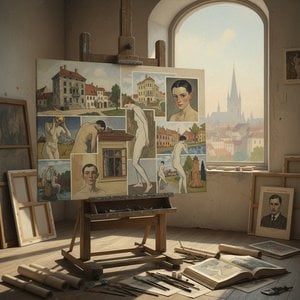
Unveiling Raw Emotion: The Top 25 Masterpieces by Egon Schiele
Explore 25 raw Expressionist masterpieces by Egon Schiele. Discover the full collection online at ArtsDot.com.

Expressionist Painting: 10 Masterpieces That Defined a Movement | ArtsDot
Explore 10 Expressionist paintings that revolutionized art! Discover Munch, Kirchner & Kandinsky's iconic works. Find museum-quality reproductions and vibrant canvas prints to elevate your home decor on ArtsDot.com.