- Home

- Print on canvas
- henry bernard chalon
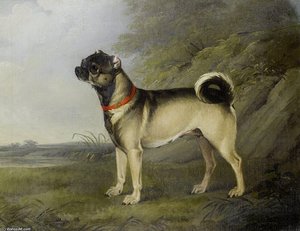
- Two Pointers In A Landscape

 Buy Painting
 Send
Send Share
Share
 Details

 Download
 Similars
 X-Ray
X-Ray Diaporama
Two Pointers In A Landscape
 Read More
Giclée / Art Print
Museum-quality giclée or canvas print with fast production and flexible finish options.




































Pick from our preset sizes that match the artwork's original proportions.

You may enter your own dimensions to fit a specific frame or space. If your selected size does not match the original image's proportions, we will either crop the artwork or extend the image with a mirrored or solid-fill edge. A digital mockup will be sent for your approval before production begins.
Please note that the on-screen preview does not reflect the actual cropping or extension. Only the mockup will accurately show the final composition.
While custom sizes are available, we recommend selecting a dimension from the predefined list to preserve the original proportions.
Worldwide Delivery () in 2 weeks instead of standard 4/5 weeks. (18 July)

Free Worldwide Express Shipping

High-Quality Linen Canvas

Full Shipping Insurance

Customs Tax Refund Guarantee

True Color Matching Guarantee

60-Day Return Policy (Defects Only)

100% Money-Back Guarantee

Bulk Discount Offer
 Glass option is only available in size under 110 CM

Two Pointers In A Landscape
Giclée / Art Print
Reproduction Size
-


Total Price
-
Related Artworks


Artist Biography
Henry Bernard Chalon: A Pioneer of British Equestrian Art
Henry Bernard Chalon (1770 – 1849) stands as a significant figure in the annals of British art history, particularly renowned for his meticulous depictions of horses and sporting scenes during the late Georgian and Victorian eras. Born in London, he emerged from a family steeped in artistic tradition—his father was also a painter—establishing him within a milieu that fostered creativity and observation. While biographical details remain somewhat sparse compared to contemporaries like Turner or Constable, Chalon’s contribution to the burgeoning field of animal painting is undeniable, securing his place amongst the Royal Academy artists who championed realism and scientific accuracy.- Early Life & Training: Little is known about Chalon's formative years beyond his familial connection to art. However, he received a formal artistic education at Somerset House, honing his skills in drawing and painting under influential instructors focused on classical principles.
- Academic Career & Royal Academy Membership: Chalon’s dedication to his craft culminated in membership of the Royal Academy in 1803—a prestigious honor reflecting the esteem held for his artistic talent. This affiliation provided him with invaluable access to resources and opportunities for professional development, shaping his artistic trajectory.
- Style & Technique: Chalon's distinctive style characterized by meticulous detail and subdued color palettes distinguished him from many of his peers. He embraced a neoclassical approach, prioritizing anatomical correctness and capturing the essence of animal behavior with remarkable precision. His canvases often featured horses engaged in sporting pursuits—hunting scenes, polo matches—executed with painstaking realism that mirrored scientific observation.
- Notable Works: Among Chalon’s celebrated paintings are ‘A Spaniel In A Landscape,’ ‘Three Terriers With Two Dead Rats,’ and ‘Dark Bay Hunter.’ Each piece exemplifies his mastery of technique and artistic vision, demonstrating a profound understanding of equine anatomy and the subtleties of naturalistic representation. These works continue to captivate viewers with their serene beauty and technical brilliance.
- Legacy & Influence: Chalon’s influence extended beyond his own lifetime, inspiring subsequent generations of animal painters who sought to emulate his commitment to realism and scientific accuracy. He helped solidify the Royal Academy's reputation for portraying animals in a truthful manner, contributing to the broader artistic discourse surrounding observation and representation.
Exploring Chalon’s Artistic Vision: Influences & Inspirations
Chalon’s artistic sensibilities were undoubtedly shaped by the prevailing intellectual currents of his time—the Enlightenment and Romanticism—though he resisted overtly expressive tendencies, favoring instead a restrained aesthetic rooted in classical ideals. Like many artists of his era, he drew inspiration from scientific discoveries concerning animal anatomy and physiology, reflecting the growing interest in natural history during the Regency period. Furthermore, Chalon’s meticulous attention to detail can be traced back to the artistic traditions of Flemish painters like Rubens and Rembrandt, who championed realism and dramatic lighting—elements that subtly permeated Chalon's oeuvre.Major Achievements & Recognition
Chalon achieved considerable acclaim during his lifetime for his exceptional skill as an animal painter and his unwavering dedication to upholding academic standards. His membership in the Royal Academy cemented his position among Britain’s leading artists, affording him access to influential circles and fostering collaborations with fellow luminaries. Beyond his artistic accomplishments, Chalon served as a respected teacher at Somerset House, nurturing young talent and disseminating knowledge of anatomical drawing—a testament to his commitment to artistic education and scholarship.Chalon's Paintings: A Reflection of Victorian Era Aesthetics
His paintings embody the Victorian fascination with natural history and scientific observation, mirroring the broader cultural shift toward empirical inquiry. Unlike Impressionists who sought to capture fleeting moments of light and color, Chalon prioritized anatomical accuracy and detailed rendering—a stylistic choice that aligned perfectly with the Royal Academy’s emphasis on classical principles. The muted tones and subtle textures characteristic of his canvases convey a sense of tranquility and contemplation, reflecting the Victorian ideal of moral seriousness and refined sensibility.
henry bernard chalon
1770 - 1849 , United Kingdom
Quick Facts
- Artistic Movement Or Style: Neoclassical
- Artists Who Influenced This Artist: ['John James Masquerier']
- Date Of Birth: 1770
- Full Name: Henry Bernard Chalon
- Nationality: British
- Notable Artworks:
- A Spaniel In A Landscape
- Three Terriers With Two Dead Rats
- Dark Bay Hunter
- Place Of Birth: London, United Kingdom