

 Preview
 Send
Send Share
Share
 Details
 Guide
Guide

 Download
 Similars
 X-Ray
X-Ray Diaporama
 Q&A
Q&A Stats
Statsuntitled (5092)


 Read More
Giclée / Art Print
Museum-quality giclée or canvas print with fast production and flexible finish options. ( Buy Hand Made Painting Switch to Digital Image)




P118B $10

P118H $10

P118W $10

P438Z $10

P508JH $12

P508YH $12

P805H $10

P805Z $10

P919BZ $10

P919G $10

P919XJ $10

P959ZH $10

P968JZ $12

W106C $8

W218G $10

W218JH $8

W218Y $10

W307PJ $10

W316G $10

W316PJ $8

W316Y $10

W398PJ $8

W4111J $10

W500HY $15

W500JH $15

W692G $12

W849H $8

W940BG $15

W953PJ $8




Pick from our preset sizes that match the artwork's original proportions.

Type the width and the height you need, to fit your frame or your wall. A print can only be cut, never made bigger than the picture, so a size with a different shape loses a part of the image. We send you a digital mockup to approve before we print anything. The picture shown on this page does not show the real cut — only the mockup does.
Worldwide Delivery () in 2 weeks instead of standard 4/5 weeks. (10 November)

Free Worldwide Express Shipping

High-Quality Linen Canvas

Full Shipping Insurance

Customs Tax Refund Guarantee

True Color Matching Guarantee

100-Day Return Policy (Defects Only)

100% Money-Back Guarantee

Bulk Discount Offer
 Glass option is only available in size under 110 CM

untitled (5092)
Giclée / Art Print
Reproduction Size
-


Total Price
$ 63
A Symphony of Color: Unpacking Henri Matisse’s Untitled (5092)
Henri Matisse, a name synonymous with joyous vibrancy and masterful simplification, gifted us with “Untitled (5092),” a deceptively serene still life that belies its profound artistic significance. Painted sometime between 1913 and 1914 during the height of Fauvist experimentation—a movement he spearheaded—this artwork transcends mere representation; it embodies Matisse’s core philosophy: to liberate color from the constraints of naturalism and express emotion directly onto canvas. The photograph accompanying this piece showcases a meticulously crafted composition featuring an assortment of fruits – apples and oranges – arranged upon a tabletop alongside two bottles and three spoons, demonstrating Matisse's keen eye for detail and his ability to distill complex visual information into striking forms.The Fauvist Vision: Bold Strokes and Emotional Resonance
Matisse’s embrace of Fauvism stemmed from a desire to reject the academic conventions prevalent in Parisian art circles at the time. Influenced by Cézanne's exploration of form and Picasso’s pioneering cubist innovations, Matisse sought to prioritize color above all else—to treat it as an independent element capable of conveying feeling rather than merely imitating reality. “Untitled (5092)” exemplifies this approach brilliantly. The dominant hues – reds, yellows, and oranges – pulsate with energy, creating a visual experience that is both stimulating and emotionally resonant. These colors aren’t blended subtly; they are applied in bold, unmodulated strokes, resulting in an effect akin to stained glass—illuminating the canvas with radiant brilliance. This technique deliberately eschews traditional shading and perspective, prioritizing expressive gesture and color harmony over illusionistic accuracy.Compositional Harmony: Balance and Visual Rhythm
Despite its apparent spontaneity, “Untitled (5092)” reveals a carefully considered compositional strategy. The arrangement of the fruit bowl—centered on the canvas—immediately draws the viewer’s eye, establishing a focal point that anchors the entire scene. The bottles flank this central element, providing vertical counterbalance and contributing to the overall sense of stability. Furthermore, the spoons strategically positioned around the table create visual rhythm, guiding the gaze across the surface and reinforcing the impression of an ordered yet dynamic space. Matisse's meticulous attention to detail—evident in the depiction of the fruit skins and bottle necks—underscores his commitment to capturing the essence of everyday life with remarkable precision.Symbolism Beyond Representation
While ostensibly a still life, “Untitled (5092)” operates on multiple symbolic levels. The fruits themselves – apples representing knowledge and innocence, oranges symbolizing optimism and vitality—suggest themes of fecundity and renewal. The bottles could represent aspiration or perhaps the vessel for conveying emotion. More broadly, Matisse’s deliberate simplification of form speaks to a humanist impulse rooted in the belief that art should communicate universal truths rather than merely mirroring external appearances. As evidenced by its inclusion in the MoMA exhibition "Selected works from the exhibition: Selected works from the exhibition | MoMA," this piece continues to captivate audiences with its enduring beauty and profound artistic statement.Bringing Matisse’s Vision Home
A high-quality reproduction of “Untitled (5092)” allows you to experience the transformative power of Matisse's Fauvist aesthetic in your own living space. ArtsDot offers exceptional reproductions crafted with archival inks on premium canvas, ensuring that you can preserve this iconic artwork’s vibrancy and luminosity for generations to come. Explore our collection today and immerse yourself in the captivating world of Henri Matisse!Questions & Answers
How is the palette of "untitled (5092)" by Henri Matisse described?
The palette of "untitled (5092)" by Henri Matisse is described as earthy. It is a compact description of the work's colors.
From which country does the Fauvist Expression work "untitled (5092)" come?
"untitled (5092)" connects the Fauvist Expression movement with France through its creator's birthplace.
What placement suits the format of "untitled (5092)" by Henri Matisse?
With its landscape shape, a reproduction of "untitled (5092)" is suggested for a restaurant (casual).
Artist Biography
The Early Life of Henri Matisse
Henri Matisse arrived on December 31, 1869, in a weaver's cottage on rue du Chêne Arnaud. This small house in Le Cateau-Cambrésis, France, was the starting point for a life that would eventually move far from the quietude of the Nord department. He was the oldest son of a wealthy grain merchant, born into a family that dealt in the steady, practical trade of the land. His early years were spent in Bohain-en-Vermandois, Picardie, France, a place where the rhythms of life were dictated by the seasons and the needs of the family business.
The environment of his upbringing was far from the studio. Growing up in the Picardie region, he was surrounded by the practicalities of a merchant's household. There was no early indication of the brush or the pigment in those first years. Instead, his existence was shaped by the expectations of his family and the steady, unhurried life of a grain merchant's son in a northern French town.
Early Education and Legal Studies
After finishing secondary school, Matisse moved to Paris to study law. He spent time there in 1887, focusing on the rigid structures of legal theory. This period was marked by the quiet, disciplined work required of a student in the city. He did not immediately find his way to a studio, but instead followed a path of professional training that seemed far removed from the canvas.
His life eventually led him back to Le Cateau-Cambrésis. There, he worked as a court administrator, handling the administrative weight of the local legal system. He also spent time as a legal clerk for a notary, a role that demanded precision and a steady hand. These years were spent among documents and official duties, far from the colors he would later embrace. He was a man of the law before he became a man of the brush.
Artistic Training and Early Influences
The transition from the study of law to the studio required a formal grounding in the classical traditions of Paris. He enrolled at the Académie Julian to begin this process. Later, he moved to the École Nationale des Beaux-Arts. During these years, he sat in the classrooms of William-Adolphe Bouguereau and Gustave Moreau. These teachers provided the technical foundation that would support his later departures from tradition. He spent his time absorbing the methods of these instructors, learning the discipline of draughtsmanship and the structure of form.
His eye was drawn to the quietude of earlier masters. He looked closely at the works of Jean-Baptiste-Siméon Chardin, Nicolas Poussin, and Antoine Watteau. These artists offered a different way of seeing, one that focused on the arrangement of objects and the weight of a composition. He studied the way they handled light and the subtle textures of their subjects. This period was less about the sudden explosion of color and more about understanding the underlying logic of a well-constructed image. He was building a vocabulary of line and shape through these observations.
The Discovery of Color and Fauvism
The shift toward the brush began with a period of stillness. In 1889, an attack of appendicitis forced a long recovery, and it was during this confinement that the act of painting first took hold. What started with a simple set of art supplies from his mother turned into a way of seeing that replaced his earlier interest in law. He moved from the quiet of convalescence into a search for a new visual language, one that would eventually move far beyond the traditional methods he had studied in Paris.
A change in his palette arrived in 1896 during a visit to Belle Île. There, he met the Australian painter John Russell, who introduced him to the light of Impressionism and the expressive, heavy application of color found in the work of Vincent van Gogh. These encounters stripped away the need for muted, earth-toned realism. He began to use color as a direct tool for expression, favoring hues that responded to feeling rather than the literal appearance of a subject. By around 1905, this approach had coalesced into the Fauvist movement. He and a small group of others used intense, non-naturalistic colors that shocked those accustomed to more restrained, academic styles.
- Woman with a Hat (1905)
- The Joy of Life (1906)
Style and Artistic Techniques
His hands moved between many different forms. He worked as a draughtsman, a printmaker, and a sculptor, often shaping clay that would later be cast in bronze. In his earlier years, he experimented with the Divisionist technique, a method he adopted after reading an essay by Paul Signac. This approach allowed him to build up color through distinct, separate applications rather than smooth blending.
As his practice changed, so did his tools. When working with etchings, he utilized the chine-collé technique to layer materials. Later, his method of creating cut-paper collages involved the pochoir stencil process to achieve specific effects. These choices show a constant shift in how he handled the surface of his work, moving from the precision of printmaking to the physical act of cutting and arranging shapes.
- Goldfish (1911)
- Luxe, Calme, et Volupté (1904)
- The Dance (1910)
- Blue Nude III (1952)
The Later Years and Cut-Paper Works
In 1941, a diagnosis of abdominal cancer changed the physical demands of his work. Following two major operations in 1941 and 1942, the ability to stand and paint at an easel became difficult. He found a new way to work by using scissors and colored paper. This method, known as cut-paper collage, allowed him to manipulate shapes and colors while seated. He would paint large sheets of paper and then cut them into organic forms, such as leaves or figures, to create new compositions.
These works often revisited the themes and motifs from his earlier paintings, but they were presented with a different kind of structural clarity. In 1947, he published a book titled Jazz, which featured these colorful cut-paper collages. The process was a way to continue his exploration of form and color even when his physical strength was limited. He focused on the relationship between the shapes and the space around them, finding a way to express movement through the simple act of cutting and arranging.
- Jazz (1947)
- Blue Nude III (1952)
Where to See His Masterpieces Today
Walking through the halls of the Hermitage Museum in Saint Petersburg, one can find his work held within the collection. This includes the large-scale 1909 work, The Dance, which was commissioned by a Russian collector. The presence of his paintings in the Musée d’Orsay in Paris allows for a close look at the way he handled color and form during his early years in the city.
In New York City, the Museum of Modern Art holds several of his pieces. These works offer a way to see how his style shifted over the decades. Similarly, the National Gallery in London contains his paintings, providing a different perspective on his development. His presence in these institutions allows for a quiet observation of how he used pigment to define space.
- The Dance (1909)
- Goldfish (1911)
- Luxe, Calme, et Volupté (1904)

Henri Matisse
1869 - 1954 , France
Quick Facts
- Artistic Movement Or Style: Fauvism, Post-impressionism, Cubism
- Artists Or Movements Influenced By This Artist: ['Modernism']
- Artists Who Influenced This Artist:
- Vincent van Gogh
- William-Adolphe Bouguereau
- Gustave Moreau
- Full Name: Henri Émile Benoît Matisse
- Nationality: French
- Notable Artworks:
- Woman with a Hat
- The Joy of Life
- The Dance
- Goldfish
- Blue Nude III
- Place Of Birth: Le Cateau-Cambrésis, France
- Date Of Birth: 1869
- Date Of Death: 1954
Related Articles

Color & Soul: The Top 25 Masterpieces by Henri Matisse
Explore 25 iconic Henri Matisse masterpieces and the soul of Fauvism. Discover the full collection online at ArtsDot.com.
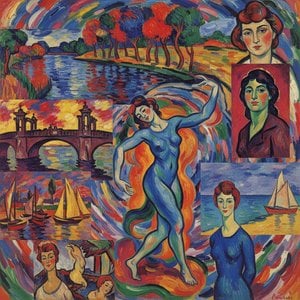
Fauvism's Boldest Visions: 10 Masterpieces That Revolutionized Modern Art | ArtsDot
Explore 10 Fauvist masterpieces by Matisse, Derain & Vlaminck that ignited Modern Art! Discover bold colors, expressionist landscapes & the history of this revolutionary movement. Find museum-quality prints at ArtsDot.com.

The Bountiful Still Life: Symbolism & Artistic Representation of Fruit Across Art History
Explore the rich history of still life painting & the symbolism of fruit across art movements. Discover masterpieces from Caravaggio to Cézanne with ArtsDot – expert guidance & museum-quality reproductions.
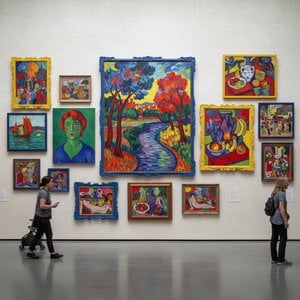
Fauvism's Bold Vision: 10 Masterpieces That Revolutionized Modern Art |
Explore the revolutionary world of Fauvism! Discover 10 masterpieces by Matisse, Derain & Vlaminck that defined this bold art movement. Find museum-quality reproductions and vibrant canvas prints to elevate your home decor at .

Clyfford Still's Abstract Expressionism: A Study of Color, Form & the Existential Landscape
Explore the profound world of Clyfford Still's Abstract Expressionism with ArtsDot. Discover his unique style, existential themes & investment potential. Expert analysis for discerning collectors.


