


The picture follows your choices: , .
Collectible Description
 Read More
Artist Biography
Fauvism master Henri Matisse revolutionized art with vibrant colors like The Dance. Discover his iconic paintings and cut-paper collages now.
Hand Made Oil Reproduction
Hand-painted oil on canvas in your size and frame, made to order by our artists. ( Switch to Print Switch to Digital Image)
More about this painting
 Preview
 Send
Send Share
Share
 Details
 Guide
Guide

 Download
 Similars
 X-Ray
X-Ray Diaporama
 Q&A
Q&A Stats
StatsOrder your painting in four simple steps
Take your time. You can change any answer; the price in your order card follows each choice.
1 Step one of four
Which size would you like?
These sizes keep the proportions of the original painting. The drawing shows your choice on a wall, above a two-metre sofa.
Or give your own measurements
Pick from our preset sizes that match the artwork's original proportions.

Type the width and the height you need, to fit your frame or your wall. This is hand-painted, so for a size with a different shape the artist can paint a bit more around the picture, or cut a bit — you choose. We send you a digital mockup to approve before the painting starts. The picture shown on this page does not show the real result — only the mockup does.
2 Step two of four
How should it be prepared: rolled, stretched or framed?
The prices below are for the size you chose in step one.
Choose the edges of the stretched canvas
Choose your frame

White $1

Blurside $1

Extended $1

P118B $10

P118H $10

P118W $10

P438Z $10

P508JH $12

P508YH $12

P805H $10

P805Z $10

P919BZ $10

P919G $10

P919XJ $10

P959ZH $10

P968JZ $12

W106C $8

W218G $10

W218JH $8

W218Y $10

W307PJ $10

W316G $10

W316PJ $8

W316Y $10

W398PJ $8

W4111J $10

W500HY $15

W500JH $15

W692G $12

W849H $8

W940BG $15

W953PJ $8

H24-GOLD $30

H24-SILVER $30

H36-GOLD $45

H36-SILVER $45
Framed
Moulding: . Overall size with the frame: .
3 Step three of four
Would you like anything changed in the painting?
Most people answer no. Because each painting is made by hand, our artist can also adapt it for you.
After order, ArtsDot.com team will email client for instructions and provide a mockup preview
4 Step four of four
A few finishing options
All of them are optional. The answers already selected cost nothing extra.
Who paints it?
Worldwide Delivery () in 3/4 weeks instead of standard 5 weeks. (10 November). No compromise on quality.
A nameplate, as in a museum?
Engraved Bronze Plaque Details
This elegant plaque features the artist's name and the title of the artwork, finely engraved for a timeless presentation.
It is made from bronze with a refined, elegant finish. The text is precisely laser-engraved for a sharp and permanent result. Measuring 9x2 cm, the plaque is compact yet easy to read. It's built to be durable and scratch-resistant, offering a professional, museum-quality look. Mounting is simple thanks to the included adhesive backing.
Transparent Acrylic Plaque Details
The plaque includes essential engraved details such as the artist's name, the title of the artwork, the date it was created, the type of media used-like oil on canvas or watercolor-a brief description of the piece, and a QR code that links to the complete artwork information.
It is crafted from clear acrylic, offering a sleek, modern appearance. The text is UV-engraved in black to ensure strong visual contrast. With a size of 10x15 cm, it ensures optimal readability. It comes equipped with two metal hooks for secure wall mounting. The plaque is designed to be weather-resistant, making it suitable for various environments, and it includes interactive features that work seamlessly with smartphone scanning.
Black Acrylic Plaque Details
This elegant plaque includes engraved information such as the artist's name, the title of the artwork, the date it was created, the type of media used (like oil on canvas or watercolor), a short description of the artwork, and a QR code for quick access to more information.
The plaque itself is made from refined black acrylic with a premium finish. The text is laser-engraved in white for high contrast and readability. Its size is 10x15 cm, designed to be easy to read. It comes with two metal hooks for professional mounting. The design is sleek and fits any interior style. It is also weather-resistant and durable, with built-in digital integration for mobile compatibility.
A protective varnish?
When do you need it?
✓ Check and order
Your painting, as you ordered it

Odalisques
Reproduction Medium
Reproduction Size
-

Elite Senior Artist
More detail, finesse, and extra production time
-

Reproduction Frame
-
-
For artworks or reproductions larger than 105 cm (approximately 41 inches) on any side, the frame will be shipped as a kit, disassembled. This method ensures safe delivery and prevents damage during transport.
Professional assembly required - this is not a DIY product.
The kit must be assembled and the canvas stretched by an experienced professional framer, using wood glue (not supplied), a canvas stretching plier and clamps to hold the bars square while the glue dries. Incorrect assembly or uneven canvas tension can permanently damage the artwork and is not covered by our warranty.
 For artworks or reproductions larger than 105 cm (approximately 41 inches) on any side, the frame will be shipped as a kit, disassembled. This method ensures safe delivery and prevents damage during transport.
All solid wood bars are included, precisely cut to size.
Assembled with the screws provided, plus wood glue for the corner joints, which is not supplied and must be sourced by your framer.
Professional tools are required and not included: a canvas stretching plier (tensioner) and clamps to hold the bars square while the glue dries.
Important:
The corner joints require wood glue, the bars must be held with clamps until the glue is fully dry, and tightening the canvas on the assembled frame requires a canvas stretching plier. None of these are included in the kit. Please arrange an experienced professional framer before ordering this size.

Nameplate
-
-

Protective Varnish
Glossy Varnish (enhances colors, protects against light/moisture)
-

Customize My Artwork
Examples of what can be changed: Replace face with customer photo; Add pet (e.g., replace cat with dog); Include hidden message in background; Change background landscape or elements.
-

Urgent
Worldwide Delivery () in 3/4 weeks instead of standard 5 weeks. (10 November). No compromise on quality.
-
Express Shipping
Worldwide Delivery () in 5 weeks. (17 November).
Included
Total Price
$ 263
Glass option is only available in size under 110 CM
Included with every order
- Free Worldwide Express Shipping
- High-Quality Linen Canvas
- Full Shipping Insurance
- Customs Tax Refund Guarantee
- True Color Matching Guarantee
- 100-Day Return Policy (Defects Only)
- 100% Money-Back Guarantee
- Bulk Discount Offer


A Dance of Light and Sensuality: Henri Matisse’s *Odalisques*
Henri Matisse's *Odalisques*, a series of paintings begun in 1924, represent a pivotal moment in the artist’s career – a bold exploration of color, form, and the very essence of female beauty. These aren’t simply depictions of reclining women; they are carefully constructed theatrical vignettes, imbued with a potent blend of sensuality, exoticism, and Matisse's signature joyful abstraction. The series, comprised of six paintings, offers a fascinating study in how Matisse wrestled with representation, ultimately prioritizing the emotional impact of color and line over strict adherence to realism.
The Exotic Backdrop and the Power of Color
The *Odalisques* emerged during a period when Matisse was deeply influenced by his time in Tahiti. The vibrant hues of the South Pacific – the intense blues of the water, the fiery oranges of the sunsets, the lush greens of the vegetation – found their way onto his canvases. This influence is immediately apparent in these paintings. The backgrounds are deliberately hazy and undefined, almost dreamlike, creating a sense of distance and mystery. They’re not landscapes to be observed, but rather atmospheric screens upon which the figures emerge as luminous presences. Matisse masterfully employs color not just for decorative effect, but as a primary means of conveying mood and emotion. The dominant palette – rich reds, deep blues, vibrant yellows, and shocking pinks – pulsates with energy, drawing the viewer into the intimate world of the women.
Deconstructing Form: Line and Composition
Matisse’s approach to depicting the human form in *Odalisques* is revolutionary. He deliberately simplifies shapes, reducing figures to their essential geometric forms – circles, triangles, and rectangles. This simplification isn't a rejection of beauty; rather, it’s an elevation of its underlying structure. The women are not rendered with meticulous detail but with bold, confident strokes of paint. The lines themselves become the subject matter, creating a dynamic interplay between form and space. Notice how the figures seem to float within their surroundings, partially obscured by the hazy background, further emphasizing their ethereal quality. The composition is carefully balanced, drawing the eye across the canvas through a series of overlapping planes and contrasting colors.
Symbolism and the Allure of the Orient
The term “Odalisque” itself carries significant historical weight, referring to female slaves in Ottoman harems. While Matisse never explicitly stated his intentions regarding this association, it’s undeniable that the paintings evoke a sense of exotic allure and veiled sensuality. The women are presented as figures of contemplation and repose, inviting the viewer to imagine their inner lives. The presence of objects – vases, bowls, bottles – adds layers of meaning, suggesting a space of leisure and quiet intimacy. These aren’t merely props; they contribute to the overall atmosphere of luxurious relaxation and unspoken connection between the women. The arrangement feels deliberately staged, like a still life infused with human drama.
A Legacy of Joyful Abstraction
*Odalisques* stands as a testament to Matisse’s lifelong pursuit of capturing the essence of beauty through color and line. These paintings represent a crucial step in his development, moving away from earlier, more naturalistic works towards a bolder, more expressive style. They are not simply beautiful images; they are windows into Matisse's artistic vision – a world where form and color dance together to create an experience of pure joy and sensual delight. A high-quality reproduction allows one to appreciate the intricate details of his technique and the profound emotional resonance of this iconic series, bringing a touch of Matisse’s vibrant spirit into any space.
Questions & Answers
What is the format of "Odalisques"?
The format of "Odalisques" is landscape. This is useful when planning where a reproduction will be placed.
What is the emotional tone of "Odalisques" by Henri Matisse?
"Odalisques" by Henri Matisse conveys a romantic emotional tone.
Is "Odalisques" by Henri Matisse in the public domain, and why?
"Odalisques" by Henri Matisse is in the public domain - its copyright has expired. Copyright terms are measured from the artist's death, and Henri Matisse died in 1954.
Related Artworks


Henri Matisse
1869 - 1954, France
Artist Biography
The Early Life of Henri Matisse
Henri Matisse arrived on December 31, 1869, in a weaver's cottage on rue du Chêne Arnaud. This small house in Le Cateau-Cambrésis, France, was the starting point for a life that would eventually move far from the quietude of the Nord department. He was the oldest son of a wealthy grain merchant, born into a family that dealt in the steady, practical trade of the land. His early years were spent in Bohain-en-Vermandois, Picardie, France, a place where the rhythms of life were dictated by the seasons and the needs of the family business.
The environment of his upbringing was far from the studio. Growing up in the Picardie region, he was surrounded by the practicalities of a merchant's household. There was no early indication of the brush or the pigment in those first years. Instead, his existence was shaped by the expectations of his family and the steady, unhurried life of a grain merchant's son in a northern French town.
Early Education and Legal Studies
After finishing secondary school, Matisse moved to Paris to study law. He spent time there in 1887, focusing on the rigid structures of legal theory. This period was marked by the quiet, disciplined work required of a student in the city. He did not immediately find his way to a studio, but instead followed a path of professional training that seemed far removed from the canvas.
His life eventually led him back to Le Cateau-Cambrésis. There, he worked as a court administrator, handling the administrative weight of the local legal system. He also spent time as a legal clerk for a notary, a role that demanded precision and a steady hand. These years were spent among documents and official duties, far from the colors he would later embrace. He was a man of the law before he became a man of the brush.
Artistic Training and Early Influences
The transition from the study of law to the studio required a formal grounding in the classical traditions of Paris. He enrolled at the Académie Julian to begin this process. Later, he moved to the École Nationale des Beaux-Arts. During these years, he sat in the classrooms of William-Adolphe Bouguereau and Gustave Moreau. These teachers provided the technical foundation that would support his later departures from tradition. He spent his time absorbing the methods of these instructors, learning the discipline of draughtsmanship and the structure of form.
His eye was drawn to the quietude of earlier masters. He looked closely at the works of Jean-Baptiste-Siméon Chardin, Nicolas Poussin, and Antoine Watteau. These artists offered a different way of seeing, one that focused on the arrangement of objects and the weight of a composition. He studied the way they handled light and the subtle textures of their subjects. This period was less about the sudden explosion of color and more about understanding the underlying logic of a well-constructed image. He was building a vocabulary of line and shape through these observations.
The Discovery of Color and Fauvism
The shift toward the brush began with a period of stillness. In 1889, an attack of appendicitis forced a long recovery, and it was during this confinement that the act of painting first took hold. What started with a simple set of art supplies from his mother turned into a way of seeing that replaced his earlier interest in law. He moved from the quiet of convalescence into a search for a new visual language, one that would eventually move far beyond the traditional methods he had studied in Paris.
A change in his palette arrived in 1896 during a visit to Belle Île. There, he met the Australian painter John Russell, who introduced him to the light of Impressionism and the expressive, heavy application of color found in the work of Vincent van Gogh. These encounters stripped away the need for muted, earth-toned realism. He began to use color as a direct tool for expression, favoring hues that responded to feeling rather than the literal appearance of a subject. By around 1905, this approach had coalesced into the Fauvist movement. He and a small group of others used intense, non-naturalistic colors that shocked those accustomed to more restrained, academic styles.
- Woman with a Hat (1905)
- The Joy of Life (1906)
Style and Artistic Techniques
His hands moved between many different forms. He worked as a draughtsman, a printmaker, and a sculptor, often shaping clay that would later be cast in bronze. In his earlier years, he experimented with the Divisionist technique, a method he adopted after reading an essay by Paul Signac. This approach allowed him to build up color through distinct, separate applications rather than smooth blending.
As his practice changed, so did his tools. When working with etchings, he utilized the chine-collé technique to layer materials. Later, his method of creating cut-paper collages involved the pochoir stencil process to achieve specific effects. These choices show a constant shift in how he handled the surface of his work, moving from the precision of printmaking to the physical act of cutting and arranging shapes.
- Goldfish (1911)
- Luxe, Calme, et Volupté (1904)
- The Dance (1910)
- Blue Nude III (1952)
The Later Years and Cut-Paper Works
In 1941, a diagnosis of abdominal cancer changed the physical demands of his work. Following two major operations in 1941 and 1942, the ability to stand and paint at an easel became difficult. He found a new way to work by using scissors and colored paper. This method, known as cut-paper collage, allowed him to manipulate shapes and colors while seated. He would paint large sheets of paper and then cut them into organic forms, such as leaves or figures, to create new compositions.
These works often revisited the themes and motifs from his earlier paintings, but they were presented with a different kind of structural clarity. In 1947, he published a book titled Jazz, which featured these colorful cut-paper collages. The process was a way to continue his exploration of form and color even when his physical strength was limited. He focused on the relationship between the shapes and the space around them, finding a way to express movement through the simple act of cutting and arranging.
- Jazz (1947)
- Blue Nude III (1952)
Where to See His Masterpieces Today
Walking through the halls of the Hermitage Museum in Saint Petersburg, one can find his work held within the collection. This includes the large-scale 1909 work, The Dance, which was commissioned by a Russian collector. The presence of his paintings in the Musée d’Orsay in Paris allows for a close look at the way he handled color and form during his early years in the city.
In New York City, the Museum of Modern Art holds several of his pieces. These works offer a way to see how his style shifted over the decades. Similarly, the National Gallery in London contains his paintings, providing a different perspective on his development. His presence in these institutions allows for a quiet observation of how he used pigment to define space.
- The Dance (1909)
- Goldfish (1911)
- Luxe, Calme, et Volupté (1904)


Related Articles
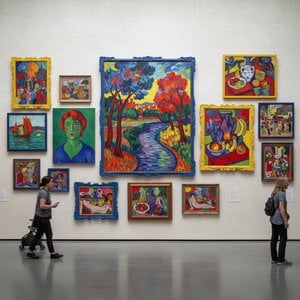
Fauvism's Bold Vision: 10 Masterpieces That Revolutionized Modern Art |
Explore the revolutionary world of Fauvism! Discover 10 masterpieces by Matisse, Derain & Vlaminck that defined this bold art movement. Find museum-quality reproductions and vibrant canvas prints to elevate your home decor at .

Masterpieces of the Hermitage: Top 25 Must-See Artworks in Saint Petersburg
Explore 25 iconic masterpieces from the Hermitage Museum. From Renaissance to Dutch masters, discover the full collection on ArtsDot.com.

Chromatic Masterpieces: 10 Artworks That Define Color & Inspire Your Home Decor
Explore 10 iconic artworks – from Monet to Matisse – that masterfully use color! Discover the stories behind these vibrant paintings, their techniques & emotional impact. Find museum-quality art reproductions and inspiring decor ideas on ArtsDot.com.