

 Preview
 Send
Send Share
Share
 Details
 Guide
Guide

 Download
 Similars
 X-Ray
X-Ray Diaporama
 Q&A
Q&A Stats
StatsMinerva

- 214.0 x 120.0 cm


 Read More
Giclée / Art Print
Museum-quality giclée or canvas print with fast production and flexible finish options. ( Buy Hand Made Painting Switch to Digital Image)




P118B $10

P118H $10

P118W $10

P438Z $10

P508JH $12

P508YH $12

P805H $10

P805Z $10

P919BZ $10

P919G $10

P919XJ $10

P959ZH $10

P968JZ $12

W106C $8

W218G $10

W218JH $8

W218Y $10

W307PJ $10

W316G $10

W316PJ $8

W316Y $10

W398PJ $8

W4111J $10

W500HY $15

W500JH $15

W692G $12

W849H $8

W940BG $15

W953PJ $8




Pick from our preset sizes that match the artwork's original proportions.

Type the width and the height you need, to fit your frame or your wall. A print can only be cut, never made bigger than the picture, so a size with a different shape loses a part of the image. We send you a digital mockup to approve before we print anything. The picture shown on this page does not show the real cut — only the mockup does.
Worldwide Delivery () in 2 weeks instead of standard 4/5 weeks. (3 November)

Free Worldwide Express Shipping

High-Quality Linen Canvas

Full Shipping Insurance

Customs Tax Refund Guarantee

True Color Matching Guarantee

100-Day Return Policy (Defects Only)

100% Money-Back Guarantee

Bulk Discount Offer
 Glass option is only available in size under 110 CM

Minerva
Giclée / Art Print
Reproduction Size
-


Total Price
$ 63
Minerva - A Trio of Renaissance Idealism
For centuries these three paintings – Minerva, Mercury and Hercules – have represented an inseparable triad within the artistic landscape of Northern Mannerism. Yet their creation unfolded across several years, reflecting the evolving tastes and ambitions of a particular era. Hendrick Goltzius’s masterful depiction of Minerva and Mercury in 1611 established a foundational aesthetic, followed by Hercules and Cacus completed in 1613, likely commissioned by Johan Colterman Junior – a young man embodying youthful vigor and intellectual prowess. This artwork distinguishes itself subtly from its predecessors; its dimensions differ slightly, and its original frame bore a distinct character, hinting at meticulous attention to detail and preservation of artistic heritage. The earliest documented sighting of the trio hanging together dates back to 1671, where they resided within the home of Colterman Junior’s descendants – a testament to their enduring appeal and significance as emblems of humanist education.- Subject Matter: The painting portrays a woman seated gracefully, her hand resting confidently on her hip—a posture conveying poise and authority. Alongside her stands a man wielding a spear and shield, symbolizing strength and protection. Complementing this dynamic duo are two additional figures positioned strategically within the composition, adding depth and narrative complexity to the scene.
- Style & Technique: Goltzius’s approach exemplifies Northern Mannerism, characterized by dramatic lighting, stylized forms, and an emphasis on emotional expression. He skillfully employs “swelling line,” a technique that enhances visual impact and contributes to the painting's overall sense of grandeur. The artist meticulously renders textures—particularly in Minerva’s drapery—demonstrating exceptional draughtsmanship.
- Historical Context: Created during the early Baroque period, this artwork reflects the humanist ideals prevalent at the time – a belief that contemplation (Mercury) and action (Minerva) cultivate wisdom and virtue. Hercules's triumph over Cacus serves as a powerful allegory for overcoming obstacles and achieving excellence.
Symbolism & Attributes: Minerva’s Embrace of Knowledge
Minerva, the goddess of wisdom and patron saint of the arts, is depicted leaning upon her shield—a device emblazoned with the head of Medusa, symbolizing vigilance against evil and fearlessness in confronting challenges. At her feet lie symbolic objects – books representing erudition, a portfolio signifying artistic creativity, a pen and penholder embodying intellectual discourse, a weaver’s shuttle symbolizing craftsmanship, and a lute representing musical artistry. These attributes collectively underscore the painting's central theme: the harmonious balance between intellect and practice—a cornerstone of Renaissance humanism.The Portrait of Youthful Power
The depiction of Hercules is particularly noteworthy. Goltzius skillfully captures the youthful dynamism of Johan Colterman Junior, portraying him as a figure radiating confidence and vitality. This portrayal aligns perfectly with the humanist aspiration to cultivate virtue through active engagement—a concept powerfully conveyed by Hercules’s victory over Cacus, representing triumph over adversity and unwavering determination.A Legacy Enduring Through Time
The painting's enduring fascination stems from its masterful execution and profound symbolic resonance. Its meticulous detail, combined with Goltzius’s innovative technique and the artwork’s connection to a pivotal moment in humanist thought, ensures that Minerva—and her companions—continue to inspire admiration and contemplation centuries after their creation. It stands as an exceptional example of Renaissance artistic achievement, inviting viewers to engage with its beauty and contemplate its enduring message.Questions & Answers
Can I see "Minerva" by Hendrik Goltzius under different lights?
"Minerva" can be examined layer by layer on the artwork's X-Ray page, a viewer inspired by a conservator's light bench with eleven optical readings of the image.
How big is the original "Minerva"?
The original "Minerva" by Hendrik Goltzius measures 214 x 120 cm.
Is "Minerva" by Hendrik Goltzius in the public domain, and why?
"Minerva" by Hendrik Goltzius is in the public domain - its copyright has expired. Copyright duration runs from the artist's death, which occurred in 1617.
Related Artworks


Artist Biography
early life and training
hendrick goltzius, a german-born dutch printmaker, draftsman, and painter, was born in january or february 1558. he was the leading dutch engraver of the early baroque period, or northern mannerism, lauded for his sophisticated technique and "exuberance" of his compositions. according to a. hyatt mayor, goltzius "was the last professional engraver who drew with the authority of a good painter and the last who invented many pictures for others to copy". goltzius's family moved to duisburg when he was 3 years old, and after studying painting on glass under his father, he learned engraving from the dutch polymath dirck volckertszoon coornhert.artistic career
in 1577, goltzius moved with coornhert to haarlem in the dutch republic, where he remained based for the rest of his life. he was also employed by philip galle to engrave a set of prints of the history of lucretia. goltzius had a malformed right hand from a fire when he was a baby, which turned out to be especially well-suited to holding the burin. this unique physical characteristic allowed him to master a commanding swing of line, making his engravings highly distinctive. hendrick goltzius brought to an unprecedented level the use of the "swelling line", where the burin is manipulated to make lines thicker or thinner to create a tonal effect from a distance.technique and style
goltzius was a pioneer of the "dot and lozenge" technique, where dots are placed in the middle of lozenge-shaped spaces created by cross-hatching to further refine tonal shading. his command of the burin is said to rival dürer, and he made engravings of bartholomeus spranger's paintings, thus increasing the fame of the latter – and his own. goltzius began painting at the age of forty-two; some of his paintings can be found in vienna. he also executed a few chiaroscuro woodcuts.public collections and legacy
most major print rooms will have a group of goltzius's many engravings, including the museum boijmans van beuningen, rijksmuseum amsterdam, and the metropolitan museum of art. his legacy can be seen in the works of other artists, such as jacques bellange, who was also a master of northern mannerist printmaking. goltzius's engravings and paintings continue to inspire art lovers and scholars alike, and his work can be found on ArtsDot.com and in the wikipedia article dedicated to his life and work.- some of goltzius's notable works include: jupiter, minerva, and the prophet baruch
- museums with his work: los angeles county museum of art, philadelphia museum of art, and british museum
- techniques used by goltzius: "swelling line" and "dot and lozenge" technique

Hendrik Goltzius
1558 - 1617 , Italy
Quick Facts
- Full Name: Hendrick Goltzius
- Nationality: Dutch
- Date Of Birth: 1558
- Date Of Death: 1617
- Place Of Birth: Braunschweig, Italy
- Notable Artworks:
- The Adoration of the Shepherds
- Arcadian Landscape
- Head of a Siren
- Hercules Killing Cacus
- Demogorgon and the Deities
- Apollo Belvedere
- The Last Supper
- Vries, Frederik de (died 1613)
- Artistic Movement Or Style: Northern Mannerism & Baroque engraving
- Artists Who Influenced This Artist:
- Dirck Volckertszoon Coornhert
- Bartholomeus Spranger
- Artists Or Movements Influenced By This Artist: ['Jacques Bellange']
Related Articles

Hendrick Goltzius: Master Engraver & the Flourishing of Dutch Mannerism
Explore the life & art of Hendrick Goltzius, a master engraver of Dutch Mannerism. Discover his innovative techniques, iconic engravings like 'Jahel', and lasting influence on Baroque art. Learn about collecting Goltzius today.

The Enduring Legacy of Fine Art Prints: Technique, History & Aesthetic Impact
Explore the rich history & techniques of fine art prints. Discover investment potential, assess authenticity, and learn how to preserve your collection with expert guidance. Trusted insights for discerning collectors.

Giclée Prints: Archival Quality & Aesthetic Nuances for the Discerning Collector
Explore the world of giclée prints with ArtsDot. Learn about archival quality, aesthetic nuances & investment potential. Expert guidance for discerning art collectors seeking museum-quality reproductions and lasting value.
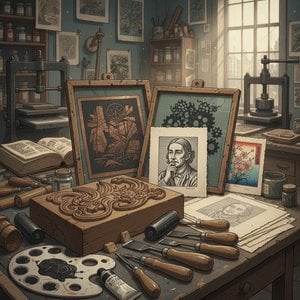
The Enduring Legacy of Printmaking: Techniques, Themes & Artistic Innovation Across Centuries
Explore the rich history of printmaking with ArtsDot. Discover techniques from intaglio to lithography, learn about collecting valuable prints & find museum-quality reproductions. Expert insights for art enthusiasts and collectors.

Echoes of Time: Exploring the Enduring Appeal & Historical Context of Vintage Art Prints
Explore the captivating world of vintage art prints! Discover their history, collecting tips & enduring appeal. Expert insights on chromolithography and building a legacy collection with ArtsDot.


