

- 44.0 x 31.0 cm


The picture follows your choices: , .
Collectible Description
 Read More
Artist Biography
Gustav Klimt was an Art Nouveau master known for The Kiss. Explore his shimmering golden phase and iconic portraits today.
Hand Made Oil Reproduction
Hand-painted oil on canvas in your size and frame, made to order by our artists. ( Switch to Print Switch to Digital Image)
More about this painting
 Preview
 Send
Send Share
Share
 Details
 Guide
Guide

 Download
 Similars
 X-Ray
X-Ray Diaporama
 Q&A
Q&A Stats
StatsOrder your painting in four simple steps
Take your time. You can change any answer; the price in your order card follows each choice.
1 Step one of four
Which size would you like?
These sizes keep the proportions of the original painting. The drawing shows your choice on a wall, above a two-metre sofa.
Or give your own measurements
Pick from our preset sizes that match the artwork's original proportions.

Type the width and the height you need, to fit your frame or your wall. This is hand-painted, so for a size with a different shape the artist can paint a bit more around the picture, or cut a bit — you choose. We send you a digital mockup to approve before the painting starts. The picture shown on this page does not show the real result — only the mockup does.
2 Step two of four
How should it be prepared: rolled, stretched or framed?
The prices below are for the size you chose in step one.
Choose the edges of the stretched canvas
Choose your frame

White $1

Blurside $1

Extended $1

P118B $10

P118H $10

P118W $10

P438Z $10

P508JH $12

P508YH $12

P805H $10

P805Z $10

P919BZ $10

P919G $10

P919XJ $10

P959ZH $10

P968JZ $12

W106C $8

W218G $10

W218JH $8

W218Y $10

W307PJ $10

W316G $10

W316PJ $8

W316Y $10

W398PJ $8

W4111J $10

W500HY $15

W500JH $15

W692G $12

W849H $8

W940BG $15

W953PJ $8

H24-GOLD $30

H24-SILVER $30

H36-GOLD $45

H36-SILVER $45
Framed
Moulding: . Overall size with the frame: .
3 Step three of four
Would you like anything changed in the painting?
Most people answer no. Because each painting is made by hand, our artist can also adapt it for you.
After order, ArtsDot.com team will email client for instructions and provide a mockup preview
4 Step four of four
A few finishing options
All of them are optional. The answers already selected cost nothing extra.
Who paints it?
Worldwide Delivery () in 3/4 weeks instead of standard 5 weeks. (8 November). No compromise on quality.
A nameplate, as in a museum?
Engraved Bronze Plaque Details
This elegant plaque features the artist's name and the title of the artwork, finely engraved for a timeless presentation.
It is made from bronze with a refined, elegant finish. The text is precisely laser-engraved for a sharp and permanent result. Measuring 9x2 cm, the plaque is compact yet easy to read. It's built to be durable and scratch-resistant, offering a professional, museum-quality look. Mounting is simple thanks to the included adhesive backing.
Transparent Acrylic Plaque Details
The plaque includes essential engraved details such as the artist's name, the title of the artwork, the date it was created, the type of media used-like oil on canvas or watercolor-a brief description of the piece, and a QR code that links to the complete artwork information.
It is crafted from clear acrylic, offering a sleek, modern appearance. The text is UV-engraved in black to ensure strong visual contrast. With a size of 10x15 cm, it ensures optimal readability. It comes equipped with two metal hooks for secure wall mounting. The plaque is designed to be weather-resistant, making it suitable for various environments, and it includes interactive features that work seamlessly with smartphone scanning.
Black Acrylic Plaque Details
This elegant plaque includes engraved information such as the artist's name, the title of the artwork, the date it was created, the type of media used (like oil on canvas or watercolor), a short description of the artwork, and a QR code for quick access to more information.
The plaque itself is made from refined black acrylic with a premium finish. The text is laser-engraved in white for high contrast and readability. Its size is 10x15 cm, designed to be easy to read. It comes with two metal hooks for professional mounting. The design is sleek and fits any interior style. It is also weather-resistant and durable, with built-in digital integration for mobile compatibility.
A protective varnish?
When do you need it?
✓ Check and order
Your painting, as you ordered it

Study for
Reproduction Medium
Reproduction Size
-

Elite Senior Artist
More detail, finesse, and extra production time
-

Reproduction Frame
-
-
For artworks or reproductions larger than 105 cm (approximately 41 inches) on any side, the frame will be shipped as a kit, disassembled. This method ensures safe delivery and prevents damage during transport.
Professional assembly required - this is not a DIY product.
The kit must be assembled and the canvas stretched by an experienced professional framer, using wood glue (not supplied), a canvas stretching plier and clamps to hold the bars square while the glue dries. Incorrect assembly or uneven canvas tension can permanently damage the artwork and is not covered by our warranty.
 For artworks or reproductions larger than 105 cm (approximately 41 inches) on any side, the frame will be shipped as a kit, disassembled. This method ensures safe delivery and prevents damage during transport.
All solid wood bars are included, precisely cut to size.
Assembled with the screws provided, plus wood glue for the corner joints, which is not supplied and must be sourced by your framer.
Professional tools are required and not included: a canvas stretching plier (tensioner) and clamps to hold the bars square while the glue dries.
Important:
The corner joints require wood glue, the bars must be held with clamps until the glue is fully dry, and tightening the canvas on the assembled frame requires a canvas stretching plier. None of these are included in the kit. Please arrange an experienced professional framer before ordering this size.

Nameplate
-
-

Protective Varnish
Glossy Varnish (enhances colors, protects against light/moisture)
-

Customize My Artwork
Examples of what can be changed: Replace face with customer photo; Add pet (e.g., replace cat with dog); Include hidden message in background; Change background landscape or elements.
-

Urgent
Worldwide Delivery () in 3/4 weeks instead of standard 5 weeks. (8 November). No compromise on quality.
-
Express Shipping
Worldwide Delivery () in 5 weeks. (15 November).
Included
Total Price
$ 263
Glass option is only available in size under 110 CM
Included with every order
- Free Worldwide Express Shipping
- High-Quality Linen Canvas
- Full Shipping Insurance
- Customs Tax Refund Guarantee
- True Color Matching Guarantee
- 100-Day Return Policy (Defects Only)
- 100% Money-Back Guarantee
- Bulk Discount Offer


A Moment of Quiet Contemplation: Klimt’s Intimate Study
This exquisite study, executed in 1906 by the Austrian Symbolist painter Gustav Klimt, offers a rare glimpse into the artist's process and a poignant meditation on domesticity and introspection. The drawing captures a woman seated comfortably in bed, her posture relaxed yet alert, a book resting gently upon her lap. The scene is deceptively simple, yet brimming with subtle details that speak volumes about Klimt’s evolving artistic vision and his fascination with the human psyche. It's not merely a portrait; it’s a carefully constructed tableau designed to evoke a specific mood – one of quiet contemplation, perhaps even melancholy.
- Subject Matter: The central figure embodies a sense of private intimacy, removed from the bustling world outside. Her attire, though understated, hints at a certain elegance and suggests a life lived within comfortable means.
- Composition: Klimt’s masterful use of space draws our eye to the woman as the focal point, while the surrounding furniture – a chair, couches, and a clock – subtly frame her and establish a domestic setting. The placement of these elements creates a sense of depth and anchors the scene within a recognizable, yet idealized, interior.
- Preliminary Sketch: As a study, this piece reveals Klimt’s initial explorations before committing to the larger, more elaborate works that would define his mature style. Notice the loose lines and expressive shading – evidence of the artist wrestling with form and capturing the essence of his subject.
The Language of Gold: Style and Technique
Klimt’s artistic journey was marked by a constant experimentation, culminating in his signature style that blended Symbolism, Art Nouveau, and elements of Byzantine art. This study demonstrates a crucial transitional phase. While still rooted in the realism of his earlier works, we begin to see the seeds of the opulent ornamentation and decorative patterns that would characterize his later masterpieces, particularly “The Kiss.” The use of charcoal is deliberate; it provides a foundation for layering and building up tonal values, allowing Klimt to capture both the softness of the woman’s skin and the texture of the fabrics. Crucially, this piece foreshadows the incorporation of gold leaf – a technique he would fully embrace in his final paintings—though its presence here is subtle, hinting at the richness that was to come.
Technique Notes:- Charcoal Rendering: Klimt’s skillful use of charcoal creates a remarkable sense of depth and volume.
- Loose Lines: The loose, expressive lines reflect the artist's intuitive approach to capturing the subject's mood and personality.
- Preliminary Study: This piece serves as a vital document in understanding Klimt’s creative development.
Symbolism and Context – A Window into Klimt’s World
To understand this study fully, we must consider the broader context of Klimt's life and artistic concerns during this period. Vienna at the turn of the century was a city undergoing rapid social and cultural change—a vibrant hub of art, music, and intellectual discourse. Klimt, like many artists of his generation, was deeply engaged with these developments, exploring themes of sexuality, mortality, and the search for meaning in a rapidly modernizing world. The woman in this drawing could be interpreted as representing the ideal of feminine beauty – a figure both vulnerable and strong, caught in a moment of quiet reflection. The clock, a recurring motif in Klimt’s work, often symbolizes the passage of time and the inevitability of death. It serves as a subtle reminder of life's fleeting nature.
Historical Context:- Fin de Siècle Vienna: The artwork reflects the artistic and intellectual ferment of Vienna at the turn of the century.
- Symbolism & Modernity: Klimt’s work engages with themes of beauty, mortality, and the complexities of modern life.
Emotional Resonance – A Portrait of Inner Life
Despite its seemingly simple subject matter, this study possesses a remarkable emotional depth. The woman's gaze is averted, suggesting a private world of thoughts and feelings. The arrangement of the room—the comfortable furniture, the book in her lap—creates an atmosphere of intimacy and tranquility. Klimt masterfully captures not just a physical likeness but also a sense of inner life – a quiet moment of contemplation that invites the viewer to share in the woman’s solitude. This reproduction offers a unique opportunity to connect with one of Klimt's most intimate and revealing works, bringing a touch of timeless beauty and profound introspection into your home or studio.
Questions & Answers
Where does "Study for" stand among Gustav Klimt's recurring subjects?
Gustav Klimt's recurring themes include vienna secession influence, symbolic, decorative elements, domestic intimacy, leisure, gold leaf, opulent style, recurring female figures; "Study for" focuses on woman, interior, bed, reading, chair, couch, clock, gold.
Why is the copyright status of "Study for" what it is?
"Study for" by Gustav Klimt is in the public domain - its copyright has expired. Copyright terms are measured from the artist's death, and Gustav Klimt died in 1918.
Who made "Study for", and when?
Gustav Klimt made "Study for" in 1906.
Related Artworks


Gustav Klimt
1862 - 1918, Austria
Artist Biography
A Life Forged in Gold and Shadow
Born on July 14, 1862, in Baumgarten, near Vienna, Gustav Klimt entered a world where the boundaries of art and craft were intimately linked. His father, Ernst Klimt, worked as a gold engraver, a profession that left an indelible mark on his son’s visual language. The young Gustav learned to appreciate the weight of precious metals and the precision of fine detail long before he ever held a brush. This early exposure to the luster of gold leaf would later define his most famous period. Despite the financial hardships that forced his family through frequent moves within Vienna, his talent was undeniable. By 1876, he had entered the Vienna Kunstgewerbeschule, focusing on architectural painting under Ferdinand Laufberger.
His early professional years were marked by a steady, academic success. Alongside his brother Ernst and Franz von Matsch, Klimt formed a partnership that secured essential commissions for decorative murals and ceilings. These works required a disciplined hand and an eye for large-scale ornamentation. He found himself working on significant projects, such as the staircases of the Burgtheater in Vienna, earning the Gold Cross of Merit from Emperor Franz Joseph I. During this time, he looked toward the historical styles of Hans Makart, yet a restless energy was already beginning to stir beneath his formal training.
The Rebellion of the Secession
By the late 1890s, the constraints of the Viennese academic establishment had become stifling. Klimt sought a space where innovation could exist outside the rigid dictates of tradition. In 1897, he became the first president of the Vienna Secession, a movement designed to embrace new currents like Art Nouveau, Symbolism, and Japonism. This was an era of profound change, and Klimt stood at its center. He rejected the heavy, historical academicism in favor of organic lines and symbolic depth. His work began to explore the complexities of human intimacy, sexuality, and mortality with a frankness that often unsettled the conservative public.
This period of defiance brought both significant friction and profound creative growth. A notable instance occurred around 1900, when his commissions for the University of Vienna ceiling paintings—specifically Philosophy—were criticized as being too provocative. The backlash was severe enough that Klimt eventually withdrew from further public commissions, choosing instead to focus on private patronage. This shift allowed him to refine a more personal, decorative style. He drew heavily from the flattened perspectives and patterned aesthetics of Japanese art, integrating these elements into compositions that blurred the distinction between fine painting and ornamental design.
The Golden Era and Final Transitions
Around 1900, Klimt entered his most recognizable phase, often called his golden period. Inspired by the mosaics of Ravenna and medieval manuscripts, he began using gold leaf to create surfaces that seemed to radiate their own light. Works such as The Kiss (1907-1908) demonstrate this mastery, featuring figures enveloped in a shimmering, patterned aura. His portraits from this time, including the Portrait of Adele Bloch-Bauer I, captured more than mere physical likeness; they conveyed a psychological weight through the use of intricate, mosaic-like textures.
As his life drew toward its end, Klimt’s style underwent another subtle transformation. The heavy ornamentation of the golden phase began to give way to a more restrained and angular aesthetic. In works completed in 1918, such as The Jurisprudence, there is a move toward expressive simplification and sharper lines, perhaps reflecting the influence of the burgeoning Expressionist movement. His final years were marked by this continued evolution, even as he faced the physical toll of the Spanish Flu pandemic. He passed away on February 6, 1918, leaving behind a body of work that fundamentally altered the trajectory of Austrian modernism.


Related Articles

Art Nouveau's Golden Age: 10 Masterpieces for Your Home |
Journey into Art Nouveau's golden age! Explore 10 masterpieces by Klimt, Mucha & more. Discover captivating stories behind iconic paintings, floral motifs & flowing lines. Find museum-quality art reproductions for your home at .
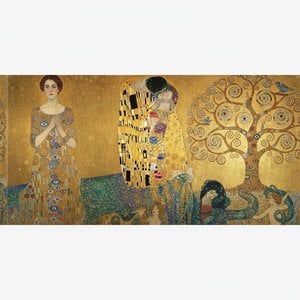
Golden Masterpieces: The Top 25 Greatest Artworks by Gustav Klimt
Explore 25 iconic Gustav Klimt masterpieces from the Golden Phase. Discover museum-quality art on ArtsDot.com.

Masterpieces of Genius: The Top 25 Leonardo da Vinci Artworks
Explore 25 legendary Renaissance masterpieces by Leonardo da Vinci. Discover the stories behind each icon on ArtsDot.com.