Preview
 Send
Send Share
Share
 Details

 Download
 Similars
 X-Ray
X-Ray Diaporama
Adele Bloch-Bauer


 Read More
Hand Made Oil Reproduction
Hand-painted oil on canvas in your size and frame, made to order by our artists. ( Buy Print Buy Image)




P118B $10

P118H $10

P118W $10

P438Z $10

P508JH $12

P508YH $12

P805H $10

P805Z $10

P919BZ $10

P919G $10

P919XJ $10

P959ZH $10

P968JZ $12

W106C $8

W218G $10

W218JH $8

W218Y $10

W307PJ $10

W316G $10

W316PJ $8

W316Y $10

W398PJ $8

W4111J $10

W500HY $15

W500JH $15

W692G $12

W849H $8

W940BG $15

W953PJ $8




Pick from our preset sizes that match the artwork's original proportions.

You may enter your own dimensions to fit a specific frame or space. If your selected size does not match the original image's proportions, we will either crop the artwork or extend the painting with additional hand-painted elements. A digital mockup will be sent for your approval before production begins.
Please note that the on-screen preview does not reflect the actual cropping or extension. Only the mockup will accurately show the final composition.
While custom sizes are available, we recommend selecting a dimension from the predefined list to preserve the original proportions.
After order, ArtsDot.com team will email client for instructions and provide a mockup preview
Worldwide Delivery () in 3/4 weeks instead of standard 5 weeks. (16 August). No compromise on quality.

Free Worldwide Express Shipping

High-Quality Linen Canvas

Full Shipping Insurance

Customs Tax Refund Guarantee

True Color Matching Guarantee

60-Day Return Policy (Defects Only)

100% Money-Back Guarantee

Bulk Discount Offer
 Glass option is only available in size under 110 CM

Adele Bloch-Bauer
Reproduction Medium
Reproduction Size
-


Total Price
$ 263
Artwork Description
The Enigmatic Gaze of Adele Bloch-Bauer
Gustav Klimt’s “Portrait of Adele Bloch-Bauer I,” a seminal work from the early 20th century, transcends mere portraiture to become an embodiment of Viennese Secession and a profound exploration of female identity. Completed between 1903 and 1907, this arresting image captures not just a likeness but a carefully constructed persona—a woman poised on the cusp of modernity, radiating both quiet strength and subtle vulnerability. The painting’s monochrome palette, dominated by shades of gray, immediately establishes an atmosphere of contemplative seriousness, inviting viewers to linger in its stark beauty. It's a deliberate departure from the vibrant hues that would later characterize Klimt’s “Golden Phase,” offering instead a glimpse into the artist’s early experimentation with form and texture.
The genesis of this portrait lies within the opulent world of Vienna’s burgeoning Jewish bourgeoisie, a class rapidly accumulating wealth through industrial enterprises. Adele Bloch-Bauer, the subject, was the wife of Ferdinand Bloch-Bauer, a prominent sugar magnate who became a significant patron of the arts. Klimt, deeply influenced by the artistic currents swirling around him—including Japanese prints and the emerging Art Nouveau movement—was commissioned to immortalize her within this context. The painting isn’t simply a depiction of a wealthy woman; it's an astute observation of her social standing, her role as hostess, and perhaps even a subtle commentary on the constraints placed upon women in that era.
A Dance of Lines and Light
Klimt’s technique is immediately striking. He eschews meticulous detail in favor of expressive lines—loose, dynamic strokes that define the figure's form with remarkable sensitivity. Hatching and cross-hatching are employed not to create a realistic illusion of light and shadow but rather to suggest volume and texture through variations in tone. The artist’s hand is visible in every mark, lending the work an intimate quality, as if we are witnessing the very act of creation. The composition itself is remarkably simple: Adele stands centrally within the frame, her arms gracefully crossed—a pose that conveys both composure and a hint of reserve. This deliberate restraint mirrors the overall mood of the painting, fostering a sense of quiet introspection.
Notably, Klimt utilizes a technique reminiscent of a preparatory sketch, a characteristic that adds to the work’s immediacy and emotional resonance. The lack of polished finish suggests an ongoing process, as if Adele were merely paused in a moment of contemplation. This deliberate choice invites viewers to connect with the subject on a deeper level, recognizing her as a living, breathing individual rather than a static representation.
Symbolism Woven into Form
Beyond its formal qualities, “Portrait of Adele Bloch-Bauer I” is rich in symbolic meaning. The most prominent element—the gold leaf adorning Adele’s dress and the background—references Klimt's later "Golden Phase," but here it serves a more nuanced purpose. Gold, historically associated with divinity and wealth, subtly elevates Adele’s status while simultaneously hinting at the ephemeral nature of beauty and material possessions. The geometric patterns that frame her figure are reminiscent of Byzantine mosaics, further emphasizing her position as a woman of refined taste and cultural awareness.
The crossed arms, a recurring motif in Klimt's work, can be interpreted as a symbol of strength, self-possession, or perhaps even a subtle resistance to societal expectations. Adele’s gaze is direct yet enigmatic—it invites the viewer into her world while simultaneously maintaining an air of mystery. The overall effect is one of captivating complexity, inviting repeated contemplation and interpretation.
A Legacy of Beauty and Loss
“Portrait of Adele Bloch-Bauer I” holds a particularly poignant significance in art history due to its subsequent fate. Following the Nazi annexation of Austria, the painting—along with other works by Klimt and her husband—was stolen and ultimately ended up in the Belvedere Museum in Vienna. The story of this artwork is inextricably linked to the broader narrative of cultural restitution and the enduring impact of the Holocaust. The eventual return of the portrait to the Bloch-Bauer family, culminating in its acquisition by Maria Altmann, Adele’s niece, represents a powerful symbol of justice and remembrance. Today, it stands as a testament to Klimt's artistic genius and a poignant reminder of the complexities of art, history, and human experience.
ArtsDot offers meticulously crafted hand-painted reproductions of this iconic masterpiece, allowing you to bring its timeless beauty into your own space. Each reproduction is created with the same attention to detail and reverence for the original, capturing the essence of Klimt’s vision while providing a stunning addition to any collection.
Related Artworks




Artist Biography
Early Life and Artistic Beginnings
Gustav Klimt, born July 14, 1862, in Baumgarten near Vienna, emerged from a family touched by both artistic inclination and financial hardship. His father, Ernst Klimt, was a gold engraver, a profession that would subtly yet profoundly influence the young Gustav’s aesthetic sensibilities—the allure of gold leaf, the meticulous detail, the sheer opulence. The family's struggles meant frequent moves within Vienna, a transient upbringing that perhaps fostered in Klimt a keen observation of his surroundings and a sensitivity to human experience. Even as a child, his drawing skills were remarkable, nurtured by his father’s profession and an innate talent that quickly became apparent. In 1876, he entered the Vienna Kunstgewerbeschule (School of Applied Arts), embarking on formal training in architectural painting under Ferdinand Laufberger. This provided him with a solid technical foundation, but also exposed him to the prevailing academic styles—styles Klimt would eventually challenge and transcend. It was here, too, that he formed an important artistic partnership with his brother Ernst and Franz von Matsch, a collaboration that secured early commissions for decorative murals and ceilings, laying the groundwork for his future success.The Rise of the Vienna Secession
By the 1890s, Klimt had become increasingly disillusioned with the conservative artistic establishment in Vienna. He yearned for greater creative freedom, a space where innovation could flourish without the constraints of tradition. This desire culminated in the formation of the Vienna Secession in 1897, a pivotal moment in Austrian art history. Klimt was elected its first president, becoming the figurehead of a movement that sought to break away from the rigid academic norms and embrace new artistic currents sweeping across Europe—Art Nouveau, Symbolism, and Japonism. The Secession’s own exhibition building, designed by Joseph Maria Olbrich, became a symbol of this rebellion, a temple dedicated to modern art. Klimt's work was central to the Secession’s ethos, embodying its rejection of conventional aesthetics and its embrace of decorative elements, bold colors, and symbolic imagery. His paintings began to explore themes of love, death, and sexuality with an unprecedented frankness, challenging societal norms and provoking both admiration and outrage.The Golden Phase and Artistic Maturity
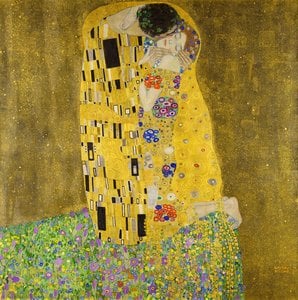
Around 1900, Klimt entered what is now known as his “golden phase,” a period characterized by the lavish use of gold leaf inspired by Byzantine mosaics and medieval illuminated manuscripts. This technique transformed his paintings into shimmering, otherworldly visions, imbued with a sense of spiritual depth and sensual allure. The Kiss (1907-1908), perhaps his most iconic work, exemplifies this style—a couple locked in an embrace, enveloped in a golden aura, their bodies adorned with intricate patterns. This period also saw Klimt produce a series of stunning portraits, including *Portrait of Adele Bloch-Bauer I* (1907), which showcased his ability to capture not only physical likeness but also the psychological complexity of his subjects. He increasingly blurred the lines between painting and ornamentation, integrating decorative elements into his compositions to create a harmonious fusion of form and content. The influence of Japanese art—Japonism—was particularly evident in his flattened perspective, emphasis on line, and use of decorative patterns.Controversy, Influences, and Lasting Legacy
Klimt’s career was not without its controversies. In 1900, he received a prestigious commission to paint ceiling murals for the Great Hall of the University of Vienna, representing Philosophy, Jurisprudence, and Theology. However, these works—particularly *Philosophy*—were deemed provocative and even pornographic by conservative critics, leading to public outcry and ultimately prompting Klimt to refuse further public commissions. This incident marked a turning point in his career, pushing him towards more private patronage and allowing him greater artistic freedom. Throughout his life, Klimt was influenced by a diverse range of artists and styles—from Hans Makart’s historical paintings to the decorative arts of Byzantium and Japan. He also drew inspiration from the Symbolist movement, exploring themes of mythology, allegory, and the subconscious. Gustav Klimt continued painting prolifically until his death on February 6, 1918, from a stroke during the Spanish Flu pandemic. His later works explored more abstract forms and landscapes, demonstrating ongoing artistic evolution. He is now recognized as one of the most important figures in Austrian art history, a leading exponent of the Vienna Secession, and an enduring symbol of Art Nouveau elegance. His paintings command high prices at auction, and his influence continues to resonate in contemporary art and design.Key Characteristics & Artistic Style
- Symbolism: Klimt’s work is deeply symbolic, often exploring themes of love, death, sexuality, and the human condition.
- Art Nouveau: He was a leading figure in the Art Nouveau movement, characterized by its organic lines, decorative patterns, and emphasis on beauty.
- Golden Phase: His use of gold leaf created shimmering, opulent surfaces that became his signature style.
- Decorative Elements: Klimt integrated decorative elements into his compositions, blurring the lines between painting and ornamentation.
- Female Form: The female body was a central subject in his work, often depicted with sensuality and psychological depth.

Gustav Klimt
1862 - 1918 , Austria
Quick Facts
- Artistic Movement Or Style: Symbolism, Art Nouveau
- Artists Or Movements Influenced By This Artist:
- Egon Schiele
- Expressionism
- Surrealism
- Artists Who Influenced This Artist:
- Hans Makart
- Japanese art
- Byzantine art
- Date Of Birth: July 14, 1862
- Date Of Death: February 6, 1918
- Full Name: Gustav Klimt
- Nationality: Austrian
- Notable Artworks:
- The Kiss
- Adele Bloch-Bauer I
- Water Snakes
- Philosophy
- Place Of Birth: Vienna, Austria
Related Articles

The Vienna Secession: A Rebellion of Form & Spirit in Fin-de-Siècle Art
Discover the revolutionary Vienna Secession art movement! Explore Klimt, Olbrich & more. Learn about its history, characteristics & lasting influence on modern art. High-quality reproductions available.

25 Klimt Masterpieces: A Journey Through Iconic Art & Decor
Delve into the world of Gustav Klimt with our top 25 masterpieces! Explore his iconic paintings – 'The Kiss,' 'Portrait of Adele,' and more. Discover museum-quality reproductions & curated decor ideas. Explore the full collection online at ArtsDot.com.

Raphael Kirchner: A Poetic Vision of Belle Époque Society Through Art Nouveau Lithography
Explore the captivating world of Raphael Kirchner, a master of Art Nouveau illustration during the Belle Époque. Discover his iconic 'Kirchner Girls,' pioneering pin-up art & lasting influence.

Art Nouveau's Golden Age: 10 Masterpieces for Your Home |
Journey into Art Nouveau's golden age! Explore 10 masterpieces by Klimt, Mucha & more. Discover captivating stories behind iconic paintings, floral motifs & flowing lines. Find museum-quality art reproductions for your home at .

The Allure of Gold in Art History: Symbolism, Technique & Cultural Significance
Explore the rich history of gold in art! Discover symbolism, techniques & cultural significance from ancient civilizations to Klimt's masterpieces. Expert insights for collectors at ArtsDot.