
- Home

- Print on canvas
- Giuseppe De Nittis
- Twelve Studies of Vesuvius
 Buy Painting
 Send
Send Share
Share
 Details

 Download
 Similars
 X-Ray
X-Ray Diaporama
Twelve Studies of Vesuvius
 Oil On Canvas
- WallArt
- Impressionistic Landscape
 5.0 x 13.0 cm
 Galleria d'Arte Moderna
Giclée / Art Print
Museum-quality giclée or canvas print with fast production and flexible finish options.
 Read more



P118B $10

P118H $10

P118W $10

P438Z $10

P508JH $12

P508YH $12

P805H $10

P805Z $10

P919BZ $10

P919G $10

P919XJ $10

P959ZH $10

P968JZ $12

W106C $8

W218G $10

W218JH $8

W218Y $10

W307PJ $10

W316G $10

W316PJ $8

W316Y $10

W398PJ $8

W4111J $10

W500HY $15

W500JH $15

W692G $12

W849H $8

W940BG $15

W953PJ $8




Pick from our preset sizes that match the artwork's original proportions.

You may enter your own dimensions to fit a specific frame or space. If your selected size does not match the original image's proportions, we will either crop the artwork or extend the image with a mirrored or solid-fill edge. A digital mockup will be sent for your approval before production begins.
Please note that the on-screen preview does not reflect the actual cropping or extension. Only the mockup will accurately show the final composition.
While custom sizes are available, we recommend selecting a dimension from the predefined list to preserve the original proportions.
Worldwide Delivery () in 2 weeks instead of standard 4/5 weeks. (1 July)

Free Worldwide Express Shipping

High-Quality Linen Canvas

Full Shipping Insurance

Customs Tax Refund Guarantee

True Color Matching Guarantee

60-Day Return Policy (Defects Only)

100% Money-Back Guarantee

Bulk Discount Offer
 Glass option is only available in size under 110 CM

Twelve Studies of Vesuvius
Giclée / Art Print
Reproduction Size
-


Total Price
-
Collectible Description
Giuseppe De Nittis: A Synthesis of Salon Tradition and Impressionist Spirit
Giuseppe De Nittis (1846-1884) stands as a pivotal figure in Italian art history, recognized for his ability to synthesize the formal conventions of academic salon painting with the vibrant spontaneity of Impressionist aesthetics. Born in Barletta, Italy on February 25, 1846, De Nittis’ artistic journey began under the tutelage of Giovanni Battista Calò before a controversial expulsion from Naples’ Instituto di Belle Arti for insubordination irrevocably altered his trajectory. This early setback fueled an unwavering determination to hone his craft and explore innovative approaches to capturing the essence of the natural world. He would become one of the most celebrated exponents of the Macchiaioli movement, a group that fundamentally challenged artistic dogma and championed a radically new visual language.The Macchiaioli Revolution: Embracing Bold Brushstrokes
The Macchiaioli – “splattered” artists – emerged in Tuscany during the late 1870s as a reaction against the prevailing academic style dominated by meticulous detail and idealized forms. Led by Giovanni Fattori, Telemaco Signorini, and Giuseppe Martelli, these painters rejected the conventions of realism championed by their predecessors, opting instead for expressive brushstrokes—often thick, impastoed layers of pigment—to convey emotion and immediacy. De Nittis wholeheartedly embraced this revolutionary technique, prioritizing tonal variations and capturing fleeting moments of light and atmosphere above precise representation. This stylistic choice wasn’t merely aesthetic; it represented a profound philosophical shift toward valuing subjective experience as paramount to objective observation.“Twelve Studies of Vesuvius”: Landscape Impressionism at Its Finest
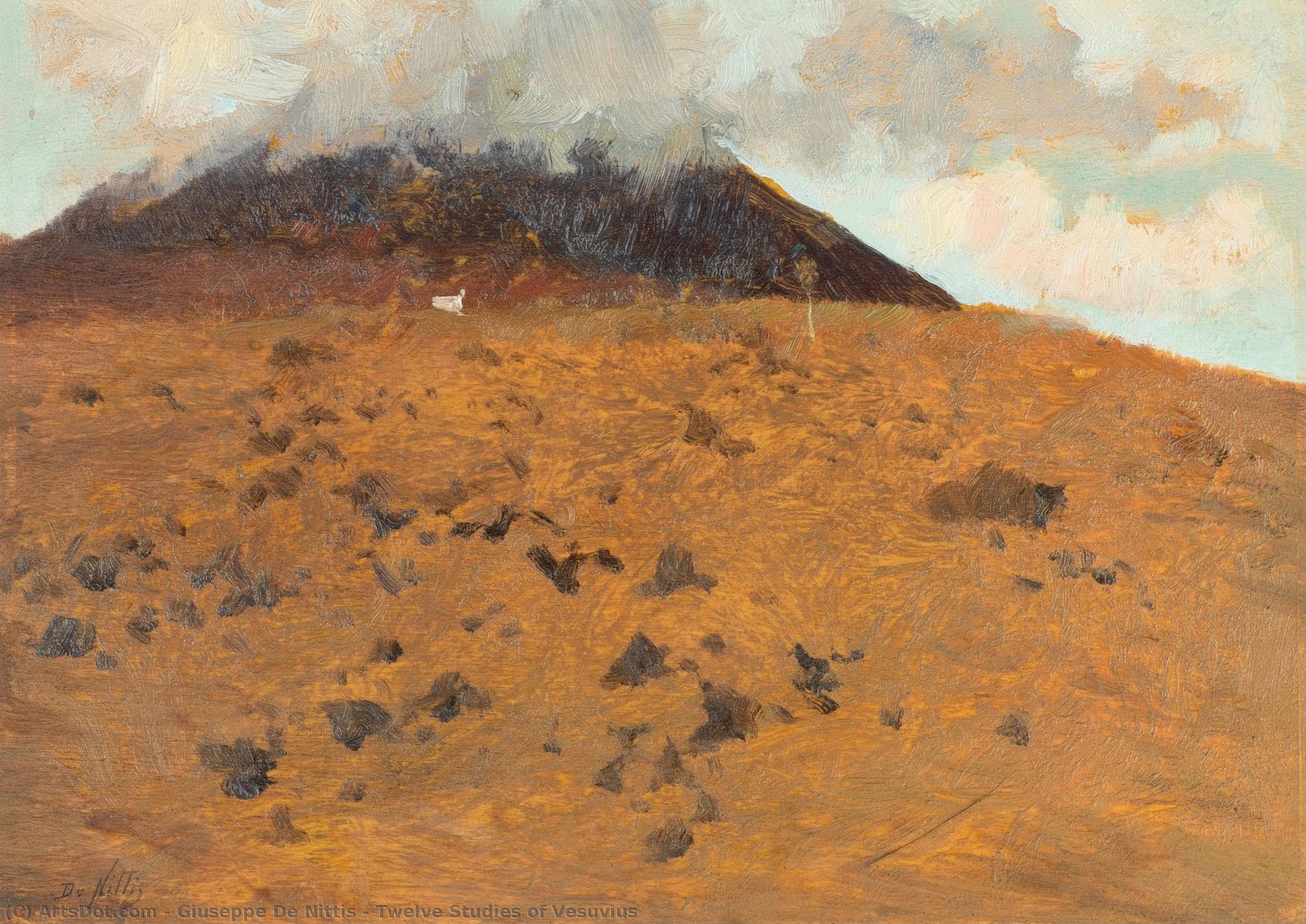
De Nittis' masterpiece, “Twelve Studies of Vesuvius,” exemplifies this fusion of tradition and innovation perfectly. Executed in 1879-80, the painting depicts a dramatic sunset over Mount Vesuvius, capturing the fiery hues of orange, crimson, and violet against a backdrop of hazy clouds. Unlike academic landscapes that strive for idealized beauty, De Nittis’ work confronts the viewer with an unfiltered glimpse into the natural world—a landscape imbued with palpable energy and emotion. The meticulous observation of tonal gradations—characteristic of Impressionist painting—combined with bold brushstrokes creates a textured surface that vibrates with color and light.Symbolism Within Vivid Color: Reflecting Inner States
Beyond its technical brilliance, “Twelve Studies of Vesuvius” resonates with symbolic significance. Mount Vesuvius itself served as a potent emblem of both destruction and renewal – mirroring the anxieties surrounding Italy’s turbulent political landscape during De Nittis' lifetime. The scattered clouds represent uncertainty and change, while the sheep grazing on the hillside symbolize tranquility and pastoral innocence. However, crucially, the painting isn’t merely depicting an external scene; it reflects De Nittis’ own inner state—his fascination with capturing fleeting beauty and conveying profound emotion through color and texture.A Legacy of Impressionistic Vision: Inspiring Generations
Giuseppe De Nittis' contribution to Italian art is undeniable. He solidified the Macchiaioli movement's influence, establishing a new paradigm for landscape painting that continues to inspire artists today. “Twelve Studies of Vesuvius,” with its masterful blend of technique and symbolism, stands as a testament to his artistic genius—a timeless piece of wall decor capable of transporting viewers back to the vibrant atmosphere of late 19th-century Tuscany and prompting contemplation on the enduring power of Impressionistic vision.Related Artworks


Artist Biography
Giuseppe De Nittis: Bridging Salon Art and Impressionism
Giuseppe De Nittis (1846-1884) stands as a pivotal figure in Italian art history, recognized for his ability to synthesize the formal conventions of academic salon painting with the vibrant spontaneity of Impressionist aesthetics. Born in Barletta, Italy on February 25, 1846, De Nittis’ artistic journey began under the tutelage of Giovanni Battista Calò before a controversial expulsion from Naples’ Instituto di Belle Arti for insubordination irrevocably altered his trajectory. This early setback fueled an unwavering determination to hone his craft and explore innovative approaches to capturing the essence of the natural world.Early Career & Influences: The Macchiaioli Movement
De Nittis' formative years coincided with the emergence of the Macchiaioli movement – a group of artists who championed a revolutionary technique characterized by bold, expressive brushstrokes and a rejection of meticulous detail. Embracing this stylistic paradigm, he quickly established connections with luminaries like Telemaco Signorini and Seraphino de Tivoli, actively participating in exhibitions held in Florence and cementing his position within the burgeoning Italian avant-garde. The influence of Impressionism is palpable throughout De Nittis’ oeuvre, particularly evident in his masterful use of light and color—a hallmark of both movements.Parisian Years & Salon Recognition
Seeking greater artistic freedom and exposure, De Nittis relocated to Paris in 1867, securing a lucrative contract with the influential art dealer Adolphe Goupil, which mandated the production of commercially viable genre paintings. This strategic move propelled him into the spotlight of Parisian society and brought him into contact with fellow Impressionists such as Edgar Degas. His debut at the Salon garnered considerable acclaim, propelling him to prominence and establishing his reputation as a skilled artist capable of captivating audiences. The Salon’s endorsement fueled further artistic exploration and solidified De Nittis' commitment to capturing fleeting moments of beauty—a core principle of Impressionist philosophy.Notable Works & Artistic Legacy
De Nittis achieved considerable success at the inaugural Impressionist exhibition in 1874, where he encountered artists who would become lifelong collaborators. His painting “Che Freddo!” (It’s So Cold!), completed that year, exemplifies his stylistic fusion and garnered critical acclaim. Continuing to exhibit prominently throughout the decade, De Nittis secured a gold medal at the Exposition Universelle of 1878 and was honored with the Légion d'honneur—a testament to his artistic merit and national recognition. His landscapes, notably depictions of Mount Vesuvius, remain iconic representations of Italian scenery and demonstrate his profound understanding of atmospheric perspective. Furthermore, De Nittis’ pioneering use of pastel – a medium he embraced wholeheartedly in his later years – profoundly influenced subsequent generations of artists, establishing him as a cornerstone of Impressionist technique and artistic innovation.Contemporary Recognition & Enduring Influence
De Nittis' artwork continues to resonate with audiences today, housed prominently in institutions such as the Pinacoteca Giuseppe de Nittis in Barletta, Italy. His paintings—including “Races at Auteuil,” “Portrait of Madame Florian by Giovanni Boldini,” and “Landscape with Cows”—serve as enduring symbols of Italian Impressionism and exemplify De Nittis’ unwavering dedication to capturing the sublime beauty of the natural world. He remains a celebrated figure in art history, whose stylistic innovations—particularly his masterful blending of salon tradition and Impressionist spontaneity—continue to inspire artists worldwide.
Giuseppe De Nittis
1846 - 1884 , Italy
Quick Facts
- Artistic Movement Or Style: Salon art & Impressionism
- Artists Or Movements Influenced By This Artist:
- Impressionism
- Macchiaioli
- Artists Who Influenced This Artist:
- Telemaco Signorini
- Giovanni Boldini
- Date Of Birth: February 25, 1846
- Date Of Death: August 21, 1884
- Full Name: Giuseppe De Nittis
- Nationality: Italian
- Notable Artworks:
- Races at Auteuil
- Breakfast in the Garden
- Nude with Red Stockings
- Place Of Birth: Barletta, Italy
Related Articles

Willem de Kooning: Abstraction, Gesture & the Evolution of Post-War American Painting
Explore the evolution of Willem de Kooning's iconic Abstract Expressionist paintings. Discover his signature style, key themes & investment potential with expert insights for discerning art collectors.


Sir John Watson Gordon: A Study in Scottish Landscape Painting & Tonal Impressionism
Explore the captivating portraits of Sir John Watson Gordon, a leading Scottish master. Discover his evolution from neoclassical style to atmospheric Tonalism and influence on 19th-century British art. Learn about his iconic sitters & legacy.

Concrete Visions: Exploring the Urban Landscape in Painting – From Realism to Contemporary Art
Explore the evolution of cityscape painting from Realism to contemporary art with ArtsDot. Discover key artists & invest in timeless urban visions. Expert guidance, museum-quality reproductions.

Golden Hours: Sunset Motifs in Western Art History
Explore the captivating history of sunset motifs in Western art! Discover iconic paintings by Monet, Van Gogh & Kuindzhi. Learn about Romanticism, Impressionism & collecting these timeless masterpieces. Expert insights at ArtsDot.

Peter De Wint: A Master of British Landscape & Quiet Pastoral Beauty
Discover the serene landscapes of Peter De Wint (1784-1849), a master of British Romanticism. Explore his life, technique & investment potential with expert insights from ArtsDot.



