

 Send
Send Share
Share
 Details
 Guide
Guide

 Download
 Similars
 Diaporama
 Q&A
Q&A Stats
StatsEnvy

- 120.0 x 55.0 cm


 Read More
Giclée / Art Print
Museum-quality giclée or canvas print with fast production and flexible finish options. ( Buy Hand Made Painting Switch to Digital Image)




































Pick from our preset sizes that match the artwork's original proportions.

Type the width and the height you need, to fit your frame or your wall. A print can only be cut, never made bigger than the picture, so a size with a different shape loses a part of the image. We send you a digital mockup to approve before we print anything. The picture shown on this page does not show the real cut — only the mockup does.
Worldwide Delivery () in 2 weeks instead of standard 4/5 weeks. (10 November)

Free Worldwide Express Shipping

High-Quality Linen Canvas

Full Shipping Insurance

Customs Tax Refund Guarantee

True Color Matching Guarantee

100-Day Return Policy (Defects Only)

100% Money-Back Guarantee

Bulk Discount Offer
 Glass option is only available in size under 110 CM

Envy
Giclée / Art Print
Reproduction Size
-


Total Price
$ 63
A Vision of Wrath: Giotto’s Envy – A Fresco Embodied in Flame
Giotto di Bondone's "Envy," painted circa 1306 for the Scrovegni Chapel in Padua, Italy, stands as a cornerstone of Proto Renaissance art—a dramatic departure from Byzantine formalism and an astonishing leap toward humanist observation. This monumental fresco depicts envy as a grotesque figure adorned with horns, positioned before a doorway radiating warmth against the chilling backdrop of flickering flames. More than just a depiction of sin, it’s a profound meditation on human psychology and spiritual struggle, meticulously crafted by Giotto's masterful hand.The Artist’s Breakthrough: From Byzantine Tradition to Naturalism
Before Giotto, art adhered rigidly to Byzantine conventions—flattened perspectives, stylized figures draped in shimmering gold, and an emphasis on conveying divine grace rather than earthly realism. Cimabue, Giotto’s teacher, championed this style, prioritizing symbolic representation over accurate depiction. However, Giotto possessed a singular talent: he instinctively understood how to capture the nuances of human emotion and the subtleties of natural light—skills that would revolutionize painting for centuries to come. His apprenticeship with Cimabue instilled him with technical prowess, yet Giotto swiftly surpassed his mentor, developing an independent vision rooted in direct observation.Symbolism Woven into Flame: Decoding Envy’s Imagery
The fresco's symbolism is layered and deliberate. The horned figure embodies envy itself—a consuming passion fueled by desire for what others possess. Its stance before the doorway symbolizes the barrier between virtue and vice, representing the temptation to transgress moral boundaries. Crucially, the fireplace represents purgatory – a purifying fire that consumes earthly attachments and prepares the soul for divine salvation. Giotto’s use of chiaroscuro—the dramatic interplay of light and shadow—intensifies this symbolic narrative, highlighting the figure's torment and conveying an overwhelming sense of urgency. The inclusion of two additional figures adds to the complexity, suggesting a broader moral commentary on human relationships and societal anxieties.Technique and Innovation: Giotto’s Pioneering Approach
Giotto revolutionized painting technique by abandoning Byzantine flatness in favor of spatial depth achieved through innovative perspective—a breakthrough that would foreshadow the Renaissance's artistic flowering. He meticulously studied anatomy, striving for accuracy in portraying human musculature and posture. Furthermore, he employed a fresco technique—applying pigment directly onto wet plaster—allowing for unparalleled luminosity and textural richness. Unlike his predecessors who relied on tempera paint, Giotto’s method ensured that “Envy” retains its vibrant colors and captivating atmosphere even after centuries of exposure. The result is an artwork that transcends mere representation; it communicates profound emotion and invites contemplation about the human condition.A Legacy of Emotional Resonance
“Envy” continues to inspire artists and captivate audiences today because it succeeds in conveying a visceral understanding of human psychology—a feat rarely accomplished in medieval art. Giotto’s masterful composition, combined with his groundbreaking technique and symbolic depth, cemented his place as one of the most influential painters of all time. Its enduring power resides not only in its artistic brilliance but also in its timeless exploration of fundamental moral dilemmas, ensuring that Giotto's vision of wrath—expressed so powerfully on this extraordinary fresco—remains relevant for generations to come.Questions & Answers
How do I discover artworks close to "Envy" by Giotto di Bondone?
The Similars page of "Envy" by Giotto di Bondone presents related artworks.
What is the dominant hue of "Envy" by Giotto di Bondone?
The dominant hue of "Envy" by Giotto di Bondone is golden yellow range. The hue is the underlying tone of the palette.
How well known is "Envy" by Giotto di Bondone?
"Envy" by Giotto di Bondone has a recognized popularity level. This classification reflects how widely the work is recognized.
Related Artworks


![Scrovegni - Last Judgment (detail) [03] — Giotto Di Bondone, Proto-renaissance](/media/artworks/images-thumb/7d/a9/7da93e3737abc9f37453cee26f9f9796.jpg)
![Legend Of St Francis - [08] - Vision Of The Flaming Chariot — Giotto Di Bondone, Gothic And Proto-renaissance](/media/artworks/images-thumb/65/6e/656e345ff55e49ce2e4377a050b85aa1.jpg)
![Legend Of St Francis - [21] - Apparition To Fra Agostino And To Bishop Guido Of Arezzo — Giotto Di Bondone, Proto-renaissance](/media/artworks/images-thumb/8a/06/8a0632ef03ba49f12919faa78718a88b.jpg)
![Scrovegni - [41] - Fortitude — Giotto Di Bondone, Medieval Art Movement](/media/artworks/images-thumb/82/95/8295e17210ed19a8cb1d1f463a40b09a.jpg)
![Legend Of St Francis - [18] - Apparition At Arles — Giotto Di Bondone, Proto-renaissance](/media/artworks/images-thumb/79/1c/791c45725458c47701a241d551e6298f.jpg)


Artist Biography
The Life and Origins of Giotto di Bondone
Giotto di Bondone emerged from the rolling hills near Florence, Italy, around 1267. He was a painter and architect who spent his life working through the transition from the medieval period toward the Renaissance. While his full name carries the weight of his lineage, he was often known simply as Giotto. His presence in the Florentine landscape was marked by a shift in how figures occupied space, moving away from the flat, gold-backed icons of the Byzantine tradition toward a more tangible sense of weight and human presence.
His life was rooted in the Tuscan landscape, and he remained a central figure in the artistic life of Florence until his death on January 8, 1337. He moved through the cities of Italy, leaving behind traces of his hand in various chapels and public works. His work was not a sudden break from what came before, but a steady, observant evolution of how light and shadow might define a form. He looked at the world and sought to capture its physical reality, giving his subjects a sense of gravity and a place within a believable, three-dimensional environment.
Early Life, Family and Training
Born in Florence, Italy, he was the son of a blacksmith named Bondone. His early years are often described through a story of a shepherd boy. In this account, he spent his time sketching the likeness of sheep onto flat rocks. This habit caught the attention of the master Cimabue, who took the boy on as an apprentice. Whether this story is a literal truth or a way to explain his natural talent, it points to a childhood spent observing the movement and weight of living things.
His training under Cimabue provided the technical foundation for his later work. He moved away from the rigid, flattened styles that defined the era, focusing instead on how figures occupy space. He learned to look at the world directly, seeking to capture the way a body carries its own weight. This focus on the physical reality of his subjects became a hallmark of his approach. He did not merely copy the icons of his time; he sought to understand the anatomy and the presence of the people he painted.
Work in Rome and Assisi
By the end of the thirteenth century, Giotto’s presence moved beyond the Florentine sphere. Between 1297 and 1300, he worked in Rome, a period that saw him engaging with the monumental scale of the city's religious centers. One of the most significant tasks from this time was the production of a massive mosaic for the Navicella, which decorated the façade of Old St. Peter's basilica. This work required a different kind of precision than the frescoes of his youth, dealing with the permanence of stone and glass to shape a sacred space.
His influence also reached the hills of Assisi. While the exact nature of his involvement remains a subject of scholarly discussion, many recognize his hand in the frescoes of the Upper Basilica of Saint Francis. In these spaces, he worked alongside the religious fervor of the era, a time when he was a contemporary of figures like Dante Alighieri and Duccio di Buoninsegna. His work in Assisi helped move religious imagery away from the flat, stylized patterns of the past, focusing instead on a sense of weight and human presence within the chapel walls.
The Masterpiece of the Scrovegni Chapel
In Padua, the Scrovegni Chapel—often called the Arena Chapel—holds the work Giotto completed around 1305. Enrico Scrovegni commissioned the space, and the resulting frescoes cover the walls in a continuous narrative. The scenes follow the Life of the Virgin and the Life of Christ. Instead of the flat, gold-heavy backgrounds common to the era, the figures here occupy a space that feels heavy and real. You can see the weight in their bodies and the way they react to one another through simple, direct gestures.
The walls move through the stories of the Bible with a sense of human drama. In the scenes of the Life of Christ, the figures do not simply exist as symbols; they carry the physical presence of people experiencing grief or quiet observation. The use of light and shadow helps to shape the drapery of their clothing and the contours of their faces. This approach makes the sacred events feel like they are happening within a tangible, three-dimensional environment rather than a distant, spiritual void.
The scale of the work is immense, covering the interior of the chapel from floor to ceiling. The *Last Judgment* occupies a large portion of the wall, presenting a stark view of the end of days. The figures are grounded, their feet resting on solid ground, and their expressions reflect a range of human emotions. It is a place where the divine is brought down to a human scale through the careful application of color and form.
Architectural Contributions and Florence
In 1334, the Commune of Florence made a choice regarding the future of the cathedral's silhouette. Following the death of Arnolfo di Cambio, Giotto was nominated as his successor. He focused much of his later energy on the design and construction of a new campanile for the cathedral. This bell tower was intended to rise beside the Basilica of Santa Maria del Fiore, and the first stone was laid on 19 July 1334.
His approach to the tower moved away from a simple, skeletal gothic frame. Instead, he applied a surface of colored marble in geometric patterns, using white marble from Carrara, green marble from Prato, and red marble from Siena. He used chiaroscuro and a form of perspective in his design, treating the structure as if it were a painted object. The tower is a square plan, standing 84.7 metres tall, and is divided into five horizontal stages. While he died before the work reached its full height, his design for the lower floor remains a part of the Florentine skyline.
Technique and Artistic Style
Giotto moved away from the rigid, flattened stylization that defined much of medieval art. Instead of the distant, symbolic figures common in the Byzantine tradition, he focused on a clear and simple structure. He sought to depict the world as it appeared to the eye, introducing the practice of drawing accurately from life. This shift brought a sense of weight and volume to his subjects, making them occupy a tangible, three-dimensional space rather than floating against a gold background.
There is a quiet psychological penetration in the way he handles his figures. He used light and shadow to sculpt form, giving the body a sense of physical presence and gravity. This attention to the human condition allowed him to convey a range of emotions through gesture and expression. In his work, the divine is not a distant abstraction but something that feels grounded and real. His approach pointed toward the innovations of the Renaissance style, moving art toward a more naturalistic representation of the human experience.
- Crucifix (1290)
- Madonna in Maest (c. 1310)
- The Stefaneschi Triptych (1320)
Key Works and Religious Paintings
In the nave of Santa Maria Novella in Florence, a large wooden crucifix hangs, painted in tempera and gold. Created around 1290-1295, the work shows Christ's body in a vertical, naturalistic pose. The weight of the figure pulls downward, with the head bowed and the ribs visible. At the base, the cross rests upon arid rocks that suggest Mount Golgotha, where Christ's blood trickles into a cavity containing the bones of Adam.
The Badia Polyptych, now held in the Uffizi in Florence, shows a different side of his ability to handle sacred subjects. His work often focused on the human experience within religious narratives. This is seen in the Ognissanti Madonna, also known as the Madonna in Maesta, painted circa 1310. In this piece, the figures possess a sense of weight and volume, moving away from the flat, gold-heavy styles of the past. He also painted the Descent Into Limbo, a scene that continues this focus on psychological depth and physical presence.
- Crucifix (Santa Maria Novella)
- Badia Polyptych
- Ognissanti Madonna
- Descent Into Limbo
Legacy and Influence on Art History
The shift in how painters approached the human form began with his hands. By moving away from the flat, gold-backed figures of the Byzantine tradition, he changed the direction of Italian painting. He introduced a way of seeing that focused on weight and the way light settles on a surface. This change allowed art to move toward the Renaissance, providing a foundation for the naturalism that later artists would build upon. He is often called the father of European painting because he helped move art from symbolic icons toward a more tangible reality.
His influence can be traced through the works of those who followed him. The way he used space and human emotion provided a blueprint for Masaccio and Michelangelo. He showed that a figure could have volume and occupy a real, three-dimensional space. This approach turned religious scenes into lived experiences, where characters possessed a psychological depth that had been missing in earlier, more rigid styles. His work bridged the gap between the medieval era and the early Renaissance, setting a standard for how stories could be told through visual weight and gesture.
- Crucifix (1290)
- The Stefaneschi Triptych (1330)
- Baroncelli Polyptych (1334)
Where to See the Works Today
To see his hand in person, one must travel to Padua, Italy. The Scrovegni Chapel holds the large fresco cycles that changed how stories were told on walls. The colors and the way the figures occupy the space are best understood by standing within that chapel. It is a quiet place where the weight of the painted bodies feels real against the architecture.
In Florence, several of his works remain. The Crucifix at Santa Maria Novella is kept in the center of the nave. It shows a body that sinks under its own weight, a departure from the more rigid shapes of the past. Nearby, the Uffizi holds the Badia Polyptych. Seeing these pieces in their respective Italian settings allows for a sense of the scale he worked with.
Other pieces have moved to different collections. The Stefaneschi Triptych is held in the Vatican Pinacoteca in Vatican City. Looking at these works in their current locations provides a way to trace how his style moved through different religious spaces.

Giotto di Bondone
1267 - 1337 , Italy
Related Articles

Giotto di Bondone: Revolutionizing Late Medieval Painting through Narrative Innovation
Explore the revolutionary art of Giotto di Bondone! Discover his groundbreaking techniques, iconic frescoes like those in the Arena Chapel, and lasting impact on Renaissance painting. A deep dive for art enthusiasts.
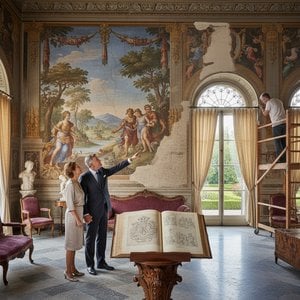
The Fresco as Family Legacy: Preserving Heritage Through Wall Art
Explore the rich history & enduring legacy of fresco painting. Discover how to preserve family heritage through stunning wall art. Expert insights & restoration guidance.

Masterpieces of Giotto di Bondone: The Top 25 Essential Artworks
Explore 25 iconic Giotto di Bondone masterpieces. Journey through Proto-Renaissance art and explore the full collection online at ArtsDot.com.

Late Medieval Masterpieces: 10 Artworks That Defined an Era | ArtsDot
Journey through 10 defining Late Medieval masterpieces – from Giotto's frescoes to Jan van Eyck’s realism. Explore the stories, techniques & vibrant colors of Gothic art. Find museum-quality reproductions and elevate your home decor with ArtsDot.com! Discover all masterpieces on ArtsDot.com

Proto-Renaissance Masters: 10 Artworks That Changed History | ArtsDot
Journey back to the dawn of Renaissance art! Explore 10 iconic Proto-Renaissance masterpieces by Giotto, Cimabue & Duccio. Discover their stories, techniques & lasting impact. Find museum-quality reproductions for your home at ArtsDot.com


![Scrovegni - [05] - Joachim's Dream](/media/artworks/images-thumb/8f/67/8f67bb5da87296bd452b3f0b237b528d.jpg)


