


 Preview
 Send
Send Share
Share
 Details

 Download
 Similars
 X-Ray
X-Ray Diaporama
James Munroe


 Read More
Giclée / Art Print
Museum-quality giclée or canvas print with fast production and flexible finish options. ( Buy Hand Made Painting Buy Image)




P118B $10

P118H $10

P118W $10

P438Z $10

P508JH $12

P508YH $12

P805H $10

P805Z $10

P919BZ $10

P919G $10

P919XJ $10

P959ZH $10

P968JZ $12

W106C $8

W218G $10

W218JH $8

W218Y $10

W307PJ $10

W316G $10

W316PJ $8

W316Y $10

W398PJ $8

W4111J $10

W500HY $15

W500JH $15

W692G $12

W849H $8

W940BG $15

W953PJ $8




Pick from our preset sizes that match the artwork's original proportions.

You may enter your own dimensions to fit a specific frame or space. If your selected size does not match the original image's proportions, we will either crop the artwork or extend the image with a mirrored or solid-fill edge. A digital mockup will be sent for your approval before production begins.
Please note that the on-screen preview does not reflect the actual cropping or extension. Only the mockup will accurately show the final composition.
While custom sizes are available, we recommend selecting a dimension from the predefined list to preserve the original proportions.
Worldwide Delivery () in 2 weeks instead of standard 4/5 weeks. (23 August)

Free Worldwide Express Shipping

High-Quality Linen Canvas

Full Shipping Insurance

Customs Tax Refund Guarantee

True Color Matching Guarantee

60-Day Return Policy (Defects Only)

100% Money-Back Guarantee

Bulk Discount Offer
 Glass option is only available in size under 110 CM

James Munroe
Giclée / Art Print
Reproduction Size
-


Total Price
$ 63
Collectible Description
A Portrait of Dignified Reflection: Gilbert Stuart’s James Monroe
Gilbert Stuart's depiction of James Monroe, completed in 1821, stands as a testament to the artist’s mastery of neoclassical portraiture and his ability to capture not just likeness but also an essence of character. This painting, housed in prominent collections like those of John Doggett and Abel Phillips, offers a glimpse into the intellectual landscape of early American history—a period defined by burgeoning republican ideals and ambitious aspirations for national identity.Subject Matter and Composition
The portrait portrays Monroe seated at a table adorned with a crimson curtain backdrop – a deliberate choice that speaks to Stuart’s understanding of visual symbolism. Monroe himself is presented in formal attire, embodying the aristocratic elegance favored during Stuart's era while simultaneously conveying an air of quiet contemplation. His hands folded calmly on the tabletop suggest deliberation and seriousness, drawing the viewer’s gaze inward toward his inner thoughts. The inclusion of a book reinforces this impression, hinting at Monroe’s scholarly pursuits and intellectual engagement—a crucial aspect of his legacy as a diplomat and statesman. Stuart skillfully utilizes pyramidal composition to stabilize the figure and create a sense of balance, emphasizing Monroe's dignified posture and conveying an aura of composure.Neoclassical Style and Technique
Stuart adhered rigorously to the principles of Neoclassicism, reflecting the artistic sensibilities prevalent in Europe during his time. This style prioritized clarity, restraint, and idealized beauty—characteristics evident in Stuart’s meticulous rendering of Monroe's features. He employed a glazing technique – applying thin layers of translucent paint over subsequent coats – to achieve luminous skin tones and subtle gradations of color. The artist meticulously observed anatomical accuracy, demonstrating an impressive understanding of human form. Furthermore, Stuart skillfully utilized chiaroscuro—the dramatic interplay between light and shadow—to sculpt Monroe’s face and drapery, enhancing the portrait's depth and creating a captivating visual experience for the viewer.Historical Context and Symbolism
Painted during Monroe’s presidency (1813-1825), this portrait captures him at a pivotal moment in American history – as he navigated the complexities of westward expansion and solidified the nation’s position on the international stage. The crimson curtain symbolizes grandeur, nobility, and perhaps even ambition—qualities associated with Monroe's leadership. Stuart’s portrayal transcends mere representation; it aims to convey Monroe’s intellectual integrity and moral fortitude—traits considered essential for upholding republican virtue. By placing Monroe within a carefully constructed visual environment, Stuart subtly reinforces the artist’s belief in portraying subjects as embodiments of noble ideals.Emotional Impact and Legacy
Gilbert Stuart's James Monroe transcends mere likeness, offering viewers an invitation to contemplate the character and intellect of one of America’s founding fathers. The painting’s serene composition and masterful technique evoke a sense of quiet dignity and contemplative reflection—qualities that resonate powerfully with audiences today. It serves as a reminder of Stuart’s enduring contribution to portraiture and his ability to transform visual art into a vehicle for conveying profound human qualities. As a beautifully executed reproduction, this artwork continues to inspire admiration for both artistic excellence and the spirit of intellectual curiosity.Related Artworks


Artist Biography
Gilbert Stuart: A Life in Portraiture
- Born: December 3, 1755, Saunderstown, Rhode Island
- Died: July 9, 1828, Boston, Massachusetts
- Nationality: American
- Movement: Neoclassicism
- Known for: Portraiture, particularly portraits of prominent figures in early American history.
Early Life and Training
- Gilbert Stuart was born into a family with Scottish roots; his father, also named Gilbert, was an inventor who established the first snuff mill in Rhode Island.
- His artistic talent emerged at a young age, demonstrating skill even as a child.
- At 14, he painted "Dr. Hunter's Spaniels," showcasing early promise.
- He traveled to Scotland around 1771 to study under Cosmo Alexander, but returned after Alexander’s death in 1775.
- Further training occurred in London with Benjamin West, a prominent American painter residing in England, from 1775 to 1780. This period was crucial for developing his artistic style and gaining recognition within the Royal Academy.
Artistic Career and Major Works
- Stuart's career faced challenges during the American Revolution, prompting him to relocate to England in 1775.
- He achieved early success with "The Skater" (1782), a portrait that established his reputation.
- His most famous work is the unfinished portrait of George Washington, known as the Athenaeum Portrait (begun in 1796). This image has become iconic, appearing on U.S. currency and postage stamps. Stuart produced numerous copies of this portrait for patrons across America and Europe.
- He painted portraits of several other prominent figures including John Adams, Thomas Jefferson, James Madison, and many members of the Federalist elite.
- Stuart’s style was characterized by a Neoclassical approach, emphasizing realism and capturing the likeness and character of his subjects. He often employed a dramatic use of light and shadow to enhance the portraits' impact.
Influences and Development
- Cosmo Alexander provided early training in technique and composition.
- Benjamin West’s influence was significant, shaping Stuart’s understanding of portraiture and artistic principles.
- The Neoclassical movement, with its emphasis on classical forms and ideals, heavily influenced his style.
- Stuart's own observations and interactions with his subjects contributed to the psychological depth and realism in his portraits. He aimed to capture not just a likeness but also the character and personality of those he painted.
Historical Significance and Legacy
- Gilbert Stuart is considered one of America’s foremost portraitists, playing a vital role in documenting the early years of the United States.
- The Athenaeum Portrait of George Washington has become an enduring symbol of American identity and leadership.
- His portraits provide valuable historical insights into the lives and appearances of prominent figures from the late 18th and early 19th centuries.
- Stuart’s work is represented in major museums across the United States and Europe, ensuring his legacy continues to be appreciated by generations.
- He established a distinct American style of portraiture that blended European techniques with uniquely American sensibilities.

Gilbert Stuart
1755 - 1828 , United Kingdom
Quick Facts
- Artistic Movement Or Style: Neoclassical
- Artists Who Influenced This Artist:
- Cosmo Alexander
- Benjamin West
- Date Of Birth: December 3, 1755
- Date Of Death: July 9, 1828
- Full Name: Gilbert Charles Stuart
- Nationality: American
- Notable Artworks:
- Dr. Hunter's Spaniels
- The Skater
- Athenaeum Portrait of Washington
- Place Of Birth: Saunderstown, United Kingdom
Related Articles

American Realism's Defining Works: 10 Masterpieces for Your Home
Explore 10 defining American Realism masterpieces – Hopper, Homer & more. Discover the stories behind these iconic paintings and bring timeless art to your home with ArtsDot's museum-quality reproductions. Explore the full collection online.

Grant Wood & American Regionalism: Identity, Myth & the Rural Landscape
Explore the world of Grant Wood & American Regionalism with ArtsDot. Discover the symbolism behind 'American Gothic', recurring themes, and the movement's lasting impact on art history. High-quality reproductions available.

19th Century Masterpieces: 10 Paintings That Defined an Era | ArtsDot
Journey through 19th century art with ArtsDot! Explore 10 iconic paintings – from Monet & Renoir to Courbet – and discover the stories behind Romanticism, Realism & Impressionism. Find museum-quality reproductions for your home decor. Explore the full collection online!

Benjamin West: Transatlantic Ambition & Shaping American Art
Explore the life & legacy of Benjamin West, pioneering American artist and Royal Academy president. Discover his Neoclassical masterpieces, transatlantic influence, and lasting impact on art history. Learn more at ArtsDot.
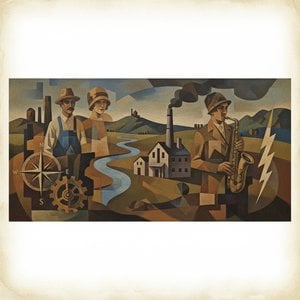
James Otto Lewis: Navigating American Modernism Through Regional Identity & Stylistic Innovation
Explore the captivating portraits of James Otto Lewis, a pivotal figure bridging 19th-century realism & American Modernism. Discover his groundbreaking work documenting Native American culture and regional identity.



