

- 49.0 x 39.0 cm


The picture follows your choices: , .
Collectible Description
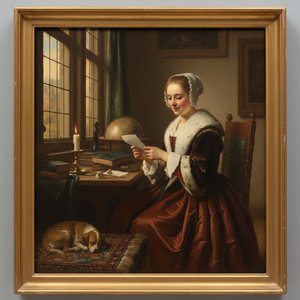
Discover Gerrit Dou’s ‘Self-Portrait,’ a captivating Baroque masterpiece showcasing masterful chiaroscuro and intricate detail. Explore the artist's unique style & technique in this stunning 1665 painting.
 Read More
Artist Biography
A master of the Leiden fijnschilder style, Gerrit Dou excelled in detailed genre scenes. Discover his exquisite Dutch Golden Age masterpieces.
Hand Made Oil Reproduction
Hand-painted oil on canvas in your size and frame, made to order by our artists. ( Switch to Print Switch to Digital Image)
More about this painting
 Preview
 Send
Send Share
Share
 Details
 Guide
Guide

 Download
 Similars
 X-Ray
X-Ray Diaporama
 Q&A
Q&A Stats
StatsOrder your painting in four simple steps
Take your time. You can change any answer; the price in your order card follows each choice.
1 Step one of four
Which size would you like?
These sizes keep the proportions of the original painting. The drawing shows your choice on a wall, above a two-metre sofa.
Or give your own measurements
Pick from our preset sizes that match the artwork's original proportions.

Type the width and the height you need, to fit your frame or your wall. This is hand-painted, so for a size with a different shape the artist can paint a bit more around the picture, or cut a bit — you choose. We send you a digital mockup to approve before the painting starts. The picture shown on this page does not show the real result — only the mockup does.
2 Step two of four
How should it be prepared: rolled, stretched or framed?
The prices below are for the size you chose in step one.
Choose the edges of the stretched canvas
Choose your frame

White $1

Blurside $1

Extended $1

P118B $10

P118H $10

P118W $10

P438Z $10

P508JH $12

P508YH $12

P805H $10

P805Z $10

P919BZ $10

P919G $10

P919XJ $10

P959ZH $10

P968JZ $12

W106C $8

W218G $10

W218JH $8

W218Y $10

W307PJ $10

W316G $10

W316PJ $8

W316Y $10

W398PJ $8

W4111J $10

W500HY $15

W500JH $15

W692G $12

W849H $8

W940BG $15

W953PJ $8

H24-GOLD $30

H24-SILVER $30

H36-GOLD $45

H36-SILVER $45
Framed
Moulding: . Overall size with the frame: .
3 Step three of four
Would you like anything changed in the painting?
Most people answer no. Because each painting is made by hand, our artist can also adapt it for you.
After order, ArtsDot.com team will email client for instructions and provide a mockup preview
4 Step four of four
A few finishing options
All of them are optional. The answers already selected cost nothing extra.
Who paints it?
Worldwide Delivery () in 3/4 weeks instead of standard 5 weeks. (9 November). No compromise on quality.
A nameplate, as in a museum?
Engraved Bronze Plaque Details
This elegant plaque features the artist's name and the title of the artwork, finely engraved for a timeless presentation.
It is made from bronze with a refined, elegant finish. The text is precisely laser-engraved for a sharp and permanent result. Measuring 9x2 cm, the plaque is compact yet easy to read. It's built to be durable and scratch-resistant, offering a professional, museum-quality look. Mounting is simple thanks to the included adhesive backing.
Transparent Acrylic Plaque Details
The plaque includes essential engraved details such as the artist's name, the title of the artwork, the date it was created, the type of media used-like oil on canvas or watercolor-a brief description of the piece, and a QR code that links to the complete artwork information.
It is crafted from clear acrylic, offering a sleek, modern appearance. The text is UV-engraved in black to ensure strong visual contrast. With a size of 10x15 cm, it ensures optimal readability. It comes equipped with two metal hooks for secure wall mounting. The plaque is designed to be weather-resistant, making it suitable for various environments, and it includes interactive features that work seamlessly with smartphone scanning.
Black Acrylic Plaque Details
This elegant plaque includes engraved information such as the artist's name, the title of the artwork, the date it was created, the type of media used (like oil on canvas or watercolor), a short description of the artwork, and a QR code for quick access to more information.
The plaque itself is made from refined black acrylic with a premium finish. The text is laser-engraved in white for high contrast and readability. Its size is 10x15 cm, designed to be easy to read. It comes with two metal hooks for professional mounting. The design is sleek and fits any interior style. It is also weather-resistant and durable, with built-in digital integration for mobile compatibility.
A protective varnish?
When do you need it?
✓ Check and order
Your painting, as you ordered it

Self-Portrait
Reproduction Medium
Reproduction Size
-

Elite Senior Artist
More detail, finesse, and extra production time
-

Reproduction Frame
-
-
For artworks or reproductions larger than 105 cm (approximately 41 inches) on any side, the frame will be shipped as a kit, disassembled. This method ensures safe delivery and prevents damage during transport.
Professional assembly required - this is not a DIY product.
The kit must be assembled and the canvas stretched by an experienced professional framer, using wood glue (not supplied), a canvas stretching plier and clamps to hold the bars square while the glue dries. Incorrect assembly or uneven canvas tension can permanently damage the artwork and is not covered by our warranty.
 For artworks or reproductions larger than 105 cm (approximately 41 inches) on any side, the frame will be shipped as a kit, disassembled. This method ensures safe delivery and prevents damage during transport.
All solid wood bars are included, precisely cut to size.
Assembled with the screws provided, plus wood glue for the corner joints, which is not supplied and must be sourced by your framer.
Professional tools are required and not included: a canvas stretching plier (tensioner) and clamps to hold the bars square while the glue dries.
Important:
The corner joints require wood glue, the bars must be held with clamps until the glue is fully dry, and tightening the canvas on the assembled frame requires a canvas stretching plier. None of these are included in the kit. Please arrange an experienced professional framer before ordering this size.

Nameplate
-
-

Protective Varnish
Glossy Varnish (enhances colors, protects against light/moisture)
-

Customize My Artwork
Examples of what can be changed: Replace face with customer photo; Add pet (e.g., replace cat with dog); Include hidden message in background; Change background landscape or elements.
-

Urgent
Worldwide Delivery () in 3/4 weeks instead of standard 5 weeks. (9 November). No compromise on quality.
-
Express Shipping
Worldwide Delivery () in 5 weeks. (16 November).
Included
Total Price
$ 263
Glass option is only available in size under 110 CM
Included with every order
- Free Worldwide Express Shipping
- High-Quality Linen Canvas
- Full Shipping Insurance
- Customs Tax Refund Guarantee
- True Color Matching Guarantee
- 100-Day Return Policy (Defects Only)
- 100% Money-Back Guarantee
- Bulk Discount Offer


A Moment of Contemplation: Gerrit Dou’s ‘Self-Portrait’
Gerrit Dou's 1665 self-portrait is more than just a likeness; it’s an exquisitely rendered meditation on the artist’s own presence and the quiet beauty he sought to capture. Painted during the height of the Dutch Golden Age, this work exemplifies the meticulous style that earned Dou the moniker “Gérard Dou” – a testament to his dedication to detail and mastery of light. The painting immediately draws the eye to the artist himself, seated on a simple bench, holding an open book, a gesture suggesting both intellectual pursuit and personal reflection. This isn’t a flamboyant self-promotion; rather, it's a deeply intimate portrayal, inviting us into Dou’s world.
The Art of Chiaroscuro and Trompe-l'oeil
Dou’s technique is the cornerstone of this captivating piece. He was a leading figure within the Leiden fijnschilders – a group known for their incredibly detailed and realistic paintings, particularly their innovative use of chiaroscuro, the dramatic interplay of light and shadow. Notice how he skillfully manipulates darkness to sculpt the folds of his clothing, creating a palpable sense of volume and texture. The subtle gradations of tone are achieved through layers upon layers of translucent glazes – a hallmark of Dou’s process – building up color slowly to achieve an almost luminous effect. Furthermore, elements within the composition subtly employ trompe-l'oeil techniques, particularly in the rendering of the potted plants and the bird perched above, creating an illusion of three-dimensionality that further enhances the painting’s realism.
Symbolism and Context
The inclusion of the book suggests a connection to learning and knowledge, aligning with Dou’s own intellectual curiosity. The potted plants – likely herbs or flowers – were not merely decorative; they held symbolic significance in Dutch art, representing prosperity, fertility, and domestic tranquility. The bird, a frequent motif in Dou's work, could symbolize hope, freedom, or even the fleeting nature of time. Painted in 1665, this self-portrait reflects a period of relative stability for the Netherlands following the Thirty Years’ War, yet also hints at the anxieties and uncertainties that permeated society. Dou’s dedication to capturing these nuances speaks volumes about his artistic vision.
A Legacy of Refinement
Measuring 49 x 39 cm, this intimate self-portrait offers a rare glimpse into the studio of one of the Dutch Golden Age's most accomplished artists. Gerrit Dou’s meticulous approach and profound understanding of light and shadow have secured his place as a master of realism and a key figure in the development of Northern European painting. This hand-painted reproduction allows you to experience the full impact of Dou’s artistry, bringing this captivating moment of contemplation into your own space.
Questions & Answers
What luminance does "Self-Portrait" by Gerrit Dou have?
The colors of "Self-Portrait" show a dark luminance.
How strong is the contrast in "Self-Portrait" by Gerrit Dou?
"Self-Portrait" by Gerrit Dou shows a serene contrast between its light and dark areas.
Why is the copyright status of "Self-Portrait" what it is?
"Self-Portrait" by Gerrit Dou is in the public domain - its copyright has expired. Copyright terms are measured from the artist's death, and Gerrit Dou died in 1675.
Related Artworks


Gerrit Dou
1613 - 1675, Netherlands
Artist Biography
Early Life, Family and Training
Gerrit Dou was born on April 7, 1613, in Leiden, Netherlands. He grew up in a household where light and glass were central to daily life, as his father worked as a glazier and glass engraver. This early exposure to the delicate manipulation of light through glass likely shaped his developing eye. His father provided his first lessons, instilling a sense of precision that would define his later years. By 1622, at the age of fourteen, he began an apprenticeship with the copper engraver Bartholomeus Dolendo. It was under Dolendo that he also studied the fundamentals of drawing, learning to translate form onto a surface with careful intent.
His training continued through the specialized world of glasswork, spending two years in the stained-glass workshop of Pieter Couwenhorn. These formative years were spent mastering the technicalities of material and color before he moved toward the broader canvas. Between 1628 and 1631, his path took a significant turn when he entered the studio of Rembrandt. This period of study allowed him to absorb the methods of a master, particularly regarding the way light and shadow interact to create depth and mood. While he would eventually develop a style of his own, the years spent in that studio provided the essential foundation for his technical growth.
Technique and Artistic Style
Dou’s approach to painting was defined by a quiet, almost obsessive devotion to detail. He was a leading figure of the Leiden fijnschilders, a group that prioritized a refined and meticulous technique. Rather than working on large, sweeping canvases, he preferred small-scale works that invited close inspection. To achieve this level of precision, he reportedly used a combination of concave and convex lenses, essentially using magnification to help him render the world with astonishing accuracy. This method allowed him to capture the tiniest textures, from the sheen of pewter to the subtle wrinkles in linen, with a clarity that felt almost photographic.
His method, often called verliefde schildering or "loved painting," involved applying many thin layers of paint to create a surface with an enamel-like smoothness. This painstaking process gave his works a polished, velvety quality. He had a particular talent for trompe l'oeil "niche" paintings, where he used arched stone openings to create a deceptive sense of depth, making the small scenes feel like real, lived-in rooms. His mastery of chiaroscuro was most evident in his candlelit night-scenes, where he used the interplay of light and shadow to pull the viewer into intimate, domestic moments.
His focus remained largely on genre scenes, capturing the quiet rhythms of everyday life. Some of his notable subjects include:
Key Works and Masterpieces
Dou’s early output shows a man quickly finding his own voice. In 1628, he produced The Night School, a work that reflects the beginnings of his lifelong fascination with quiet, indoor settings. By 1630, his ability to render specific, often gritty human experiences was already evident in The Extraction of Tooth. These early years established his ability to turn small, domestic moments into something deeply observed and physically present.
As his career progressed, he became a specialist in the interplay of light and shadow. He found a particular rhythm in candlelit scenes, such as The Astronomer by Candlelight. His 1650 work, The Dutch Housewife, currently held in the Louvre, Paris, demonstrates the polished, enamel-like surfaces that became his signature. He continued to refine this approach through the mid-century, painting The Silver Ewer in 1663 and The Moneylender in 1664, both of which highlight his devotion to texture and the way light hits a surface.
Many of his most significant achievements are found in the way he handled human vulnerability and quietude. The Evening School, located in the Amsterdam Rijksmuseum, remains a primary example of his skill with light. Perhaps his most celebrated achievement is The Dropsical Woman, painted in 1663, which many consider his chef-d'oeuvre due to its intense level of detail and psychological depth.
- The Night School (1628)
- The Extraction of Tooth (1630)
- The Dutch Housewife (1650)
- The Evening School (undated)
- The Silver Ewer (1663)
- The Dropsical Woman (1663)
Patrons and Commissions
Gerrit Dou’s ability to capture the smallest details of domestic life brought him significant financial success and a steady stream of high-profile clients. His work was highly sought after by the merchant class, who valued the quiet, polished scenes of everyday existence. One of his most notable arrangements involved Pieter Spiering, who paid 500 guilders annually simply for the right of first refusal on Dou's latest paintings. This ensured that Spiering could secure the artist's newest creations before anyone else had the chance to bid on them.
Beyond the local merchants of the Dutch Republic, Dou’s reputation reached the highest levels of European nobility. Queen Christina of Sweden was a significant collector of his work, eventually owning eleven of his paintings. His studio also attracted international interest; Cosimo III de' Medici visited his home, and it is believed he may have purchased at least one work during his visit. While his large-scale genre scenes brought in substantial sums, he also maintained a steady practice in portraiture. For these personal commissions, he charged a rate of 6 guilders an hour.
Circle, Rivals and Pupils
Gerrit Dou’s artistic path was deeply shaped by his time in the studio of Rembrandt. He spent about three years studying under the master, absorbing the way light and shadow could define a scene. While he took much from Rembrandt’s use of chiaroscuro, Dou eventually moved away from his teacher's broader, more textured approach. He sought a different kind of precision, focusing on small-scale works that required a steady hand and an almost obsessive attention to detail. This shift helped him become the founder of the Dutch school of Fijnschilderij, a group of painters dedicated to this highly polished, fine style.
His influence extended through the many artists who sought to learn his meticulous methods. He was a teacher to several notable figures who would go on to make their own marks on Dutch art. Among his most prominent pupils were Frans van Mieris the Elder and Gabriël Metsu. His studio also served as a training ground for Godfried Schalcken, Carel de Moor, and Matthijs Naiveu. These students carried forward the tradition of fine painting, ensuring that the technical precision Dou championed remained a significant part of the artistic landscape.
Legacy and Influence
Gerrit Dou left a mark on the Dutch Golden Age that extended far beyond his own studio in Leiden. As the founder of the Dutch school of Fijnschilderij, he established a standard for fine painting that defined an era. His influence flowed directly into the work of his pupils, most notably Frans van Mieris the Elder and Gabriël Metsu. These artists carried forward his devotion to meticulous detail and the quiet observation of domestic life, ensuring his technical approach remained a part of the artistic conversation for years to come.
The reach of his work is felt today in the halls of major institutions. His paintings are held in various collections, including the Museum Huis ten Bosch in the Hague, where his ability to render light and texture remains on display. His paintings continue to hold the attention of art enthusiasts and artists who find inspiration in the way he captured the smallest nuances of a scene. Whether through a candlelit interior or a carefully composed niche, his hand remains visible in the history of Dutch art.
Where to See the Works Today
Finding the traces of Gerrit Dou's hand requires a trip through some of Europe's most significant halls. His presence is felt most strongly in Paris, where The Louvre holds thirteen of his paintings. In these quiet rooms, one can observe the way he handled light in scenes like The Dropsical Woman (1663). Amsterdam also offers a deep look into his life through the collections at the Rijksmuseum, which preserves twelve of his works, including the detailed The Evening School.
Beyond the Netherlands, his influence traveled far. The Leiden Collection in New York City keeps six of his paintings, allowing viewers to see his meticulous technique across the Atlantic. In Europe, the Residenzgalerie in Salzburg houses four works, while the Alte Pinakothek in Munich holds three. These collections allow us to see the evolution of his style, from the early influence of his teacher to the highly polished surfaces he became known for.
- The Night School (about 1628)
- The Dutch Housewife (1650)
- The Moneylender (1664)


Related Articles
Gerrit Dou: Intimacy & Light in the Dutch Golden Age
Explore the exquisite world of Gerrit Dou, a master of Dutch Golden Age painting. Discover his intimate genre scenes, signature use of light, and lasting legacy. Learn about collecting Dou's works & their value.

Illuminating Realism: Exploring the Dutch Golden Age of Painting (1600-1700)
Explore the Dutch Golden Age of painting (1600-1700) with ArtsDot. Discover Rembrandt, Vermeer & other masters. Learn about techniques, history & find museum-quality reproductions.

Golden Age Reflections: Dutch Baroque Painting & Cultural Innovation
Explore the Dutch Golden Age of painting! Discover key artists like Vermeer & ter Borch, their innovative techniques, and the rich cultural context behind these Baroque masterpieces. Learn about collecting & appreciating this iconic art period.