

 Preview
 Send
Send Share
Share
 Details
 Guide
Guide

 Download
 Similars
 X-Ray
X-Ray Diaporama
 Q&A
Q&A Stats
StatsClouds

- 200.0 x 206.0 cm


 Read More
Get a print-ready file that goes far beyond the web preview. Every digital image we sell comes from a high-resolution master in our stock database — usually 5,000 to 15,000 pixels wide — so you can print large, crop tightly, or reproduce fine detail with confidence.
No file leaves our studio untouched. A digital expert checks the colors against the original painting and corrects them if needed, then improves clarity and detail with professional retouching tools — always staying faithful to the artist's brushwork and style. The result is an image that looks like the painting, not like a filtered scan.
You approve before you're done: our expert sends the image by e-mail within 72 hours for your review. Not satisfied? Ask for improvements or corrections, or request a refund if the quality falls short.
This is the quality relied on by publishers, design studios, galleries and print shops.
Digital Image
Download a high-resolution file for personal display, printing, and creative projects. ( Switch to Print Buy Hand Made Painting)
Included in Every Digital Image Order
Expert Digital Delivery, Guaranteed
When you choose ArtsDot.com, you're not just getting an image - you're receiving a professionally enhanced digital artwork, crafted with precision and backed by a satisfaction guarantee. Here's everything that comes with your order, automatically:

Fast Email Delivery
Your high-resolution digital image file will be emailed to you within 72 hours of ordering - ready for immediate use.

AI-Enhanced Digital File
Your artwork is professionally optimized using advanced AI tools and manual editing, ensuring maximum detail, clarity, and color accuracy.

Free Lifetime Re-Delivery
Accidentally deleted or lost your file? No worries - we'll resend it to you anytime, free of charge.

No Import Fees - Ever
Enjoy your artwork instantly with zero customs, duties, or delivery fees - digital downloads are always tax-free.

Color Accuracy Guarantee
We ensure your digital image reflects the original colors as closely as possible using professional tools and color management.

100-Day Satisfaction Guarantee
If you're not satisfied with your digital image, we'll revise it or refund 100% within 100 days - no questions asked.

100% Money-Back Guarantee
Not satisfied? Get a full refund within 100 days of receiving your digital file - no questions asked.

Bulk Order Discounts
Buy 3 images, save 10% - Buy 5, save 15% - Buy 10+, save 20%. Great for creative projects, galleries, and agencies.
A Symphony of Abstraction: Exploring Gerhard Richter’s “Clouds”
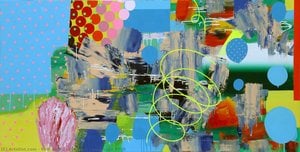
Gerhard Richter's 1982 masterpiece, "Clouds," is a pivotal work in contemporary art, embodying his lifelong exploration of the boundaries between representation and abstraction. This large-scale painting isn't merely an image *of* clouds; it’s an investigation into perception, the act of seeing, and the very nature of painting itself. It invites us to question what we expect from a landscape and revel in the pure visual experience.Deconstructing Reality: Style & Technique
“Clouds” exemplifies Richter's unique approach – a masterful blend of abstract expressionism with subtle realism. Measuring 200 x 206 cm, the canvas is awash in layered oil paint, applied with bold strokes, scrapes, and smudges. This isn’t precise rendering; it’s an *evocation* of atmosphere. The technique – often described as a form of blurred photorealism pushed to its abstract limits – creates a sense of depth and movement.- Impasto & Layering: Richter's generous application of paint, visible through the impasto texture, adds physicality and dynamism.
- Color Palette: A vibrant interplay of blues, greens, yellows, reds, and oranges suggests a dynamic sky, perhaps stormy or illuminated by shifting light.
- Gestural Abstraction: The sweeping brushstrokes and blurred forms are not random; they’re carefully constructed to create an immersive visual experience.
Richter's Artistic Journey & Context
Gerhard Richter (born 1932) is a German artist whose career has been defined by stylistic shifts and conceptual rigor. Emerging in the post-war era, he grappled with questions of history, memory, and representation. His work often oscillates between photorealistic paintings – based on photographs – and abstract compositions like “Clouds.” This duality reflects his skepticism towards fixed meanings and a desire to challenge artistic conventions. "Clouds" sits comfortably within this oscillation, playfully disrupting our expectations of what a landscape painting should be. It’s part of a series of cloud paintings Richter created, exploring the ephemeral nature of these atmospheric formations.Symbolism & Emotional Resonance
While seemingly devoid of explicit symbolism, “Clouds” resonates with deeper meanings. The ambiguity inherent in the abstract forms invites individual interpretation. The swirling shapes can evoke feelings of turbulence, vastness, or even a dreamlike state. Richter’s intention wasn't to *tell* us what to feel but to create an experience that allows for personal connection and emotional response. The painting subtly questions our desire to find concrete meaning in art, suggesting instead that we might simply appreciate the beauty of visual pleasure.Legacy & Accessibility
“Clouds” is a significant work within Richter’s oeuvre and modern art history. It has been exhibited at prestigious institutions like the Tate Modern in London and currently resides in the collection of the Museum of Modern Art (MoMA) in New York City, solidifying its importance.- For Collectors: Owning a piece that embodies Richter’s innovative spirit is an investment in art history.
- For Interior Designers: The dynamic composition and vibrant colors of “Clouds” can serve as a striking focal point in any contemporary space, adding depth and sophistication.
- Reproductions Available: Experience the essence of Richter’s genius with high-quality, handmade oil painting reproductions available at ArtsDot.com.
Further Exploration
Delve deeper into the world of Gerhard Richter and the history of painting with resources like Wikipedia’s History of Painting page. "Clouds" is more than just a painting; it's an invitation to contemplate the power of abstraction, the complexities of perception, and the enduring legacy of one of contemporary art’s most influential figures.Questions & Answers
What technique was used for "Clouds", and when was it created?
"Clouds" was created in 1982 using the oil on canvas technique. Material and date describe how and when the original was made.
How saturated is the palette of "Clouds"?
The colors of "Clouds" by Gerhard Richter have a balanced soft saturation. Saturation describes how vivid or muted the colors are.
What use and space are recommended for "Clouds" by Gerhard Richter?
"Clouds" is suggested for statement, and the recommended space is a living room.
Related Artworks



Artist Biography
The Early Life of Gerhard Richter
Dresden, Germany, 1932. The setting is the Hospital Dresden-Neustadt. Gerhard Richter enters a world defined by the tightening grip of National Socialism. His father, Horst Richter, navigates the academic rigor of the Technische Hochschule in Dresden as a student of mathematics and physics. His mother, Hildegard Schönfelder, works as a bookseller. The household is shaped by these disparate intellectual and commercial pursuits. In 1936, the family expands with the birth of his sister, Gisela.
War and political upheaval fracture the family's stability. The shadow of the regime extends into the most private spheres of existence. Richter’s aunt, Marianne, becomes a victim of the Nazi euthanasia program, a casualty of the state's systematic violence against those deemed undesirable. This period of displacement and loss leaves a mark on the family's history, as the realities of the Third Reich permeate the domestic landscape of his childhood.
Artistic Training and Early Career
The path to formal training is rarely linear. After dropping out of school at age fifteen, Richter enters the industrial landscape of post-war Germany. He finds work as a sign painter in a factory, a pragmatic step in a period of survival. By 1948, having graduated from trade school, he secures his first paid work as a painter. The years that follow are defined by manual labor and technical apprenticeship; he works as an advertising and stage-set painter, learning the mechanics of representation through the lens of commercial and theatrical utility.
Ambition meets resistance in 1950. Richter applies to the Dresden Art Academy, but the institution rejects him. He does not stay away for long. In 1951, he begins formal studies at the Dresden Academy of Fine Arts. This period is marked by the heavy influence of socialist realism, the state-mandated style of East Germany. He navigates the tension between these ideological requirements and his own developing technical mastery. From 1957 to 1961, he remains within the academy's structure, working as a master trainee.
Escape to West Germany and Düsseldorf
The year 1961 marks a sharp fracture in Richter’s life. Two months before the construction of the Berlin Wall, he makes the decision to leave East Germany behind. He moves to West Germany alongside his wife, Marianne Eufinger. This is more than a change of geography; it is a flight from the ideological constraints of the East toward the experimental freedom of the West.
In Düsseldorf, the atmosphere is thick with the energy of a burgeoning art scene. Richter enrolls at the Staatliche Kunstakademie, entering a space where the rigid traditions of socialist realism no longer hold sway. He studies under a group of instructors, including Karl von Appen, Heinz Lohmar, Will Grohmann, and Karl Otto Götz. The academic setting provides the technical foundation for what is to come, but the real shifts happen in the company of his peers. Alongside Sigmar Polke and Konrad Lueg, Richter becomes part of a circle of students navigating a landscape of rapid cultural change.
The Emergence of Capitalist Realism
Düsseldorf becomes a crucible of tension. The post-war landscape is shifting, moving away from austerity toward the bright, pervasive influence of consumer culture and mass media. Richter finds himself at the center of this friction, navigating the intersection of the Fluxus and Pop Art movements. He is not merely observing this change; he is actively dismantling established artistic norms alongside a circle of peers.
The year 1963 marks a sharp departure from traditional practice. Richter, Sigmar Polke, and Konrad Fischer stage a provocative happening titled Living with Pop. The scene unfolds within a Düsseldorf department store. They present themselves as living sculptures amidst furniture displays, a gesture that blurs the boundaries between art, commerce, and everyday existence. This act helps define the term 'Capitalist Realism,' a deliberately ambiguous label used by Richter and Polke to reflect their shared skepticism toward the aesthetics and ideologies of a consumer-driven society.
Techniques of Photorealism and Abstraction
The canvas becomes a site of tension between the sharp clarity of a photograph and the chaotic movement of paint. In his photorealistic works, Richter often employs a signature blurring effect, a technique that distorts the subject and creates a sense of detachment. He builds these images through a layering process, applying thin glazes of paint to create depth and a sense of filtered memory. This method allows him to recreate the appearance of a photographic print while simultaneously questioning the reliability of the image itself.
The approach shifts radically when he moves toward abstraction. Here, the controlled application of paint gives way to a more visceral, unpredictable process. He uses squeegees to drag thick layers of paint across the surface, manipulating the medium in ways that invite chance and spontaneity. This technique breaks the surface into textured, gestural marks that defy the precision of his figurative work. Beyond the traditional canvas, his experimentation extends into other forms, including the creation of monotypes and glass sculpture.
- Betty (1988)
- Fuji (2013)
- Wand (Wall) (1994)
Exploration of Color and Form
The investigation into color moves away from the emotional toward the systematic. Between 1966 and 2008, Richter produced his Color Charts (*Farbtafeln*), a series defined by the rigorous arrangement of colored squares. These works strip away the spontaneity of the brushstroke, replacing it with a controlled, grid-like logic. The focus shifts to the inherent properties of the pigment itself, organized into a repetitive, almost clinical structure that challenges the traditional expectation of what a painting should communicate.
This pursuit of neutrality extends into the monochromatic. From 1966 to 2014, the Gray Paintings (*Graue Bilder*) explored the subtle tonal nuances found within a single hue. Here, the complexity lies in the minute shifts of light and shadow across a gray surface. It is a study of perception, where the absence of varied color forces a confrontation with the texture and depth of the medium. This disciplined approach to the spectrum finds an unexpected application in the sacred. In 2007, Richter applied his understanding of color and geometry to a stained-glass window for the Cologne Cathedral, translating his modern sensibilities into a traditional architectural medium.
Significant Works and Major Paintings
The market and the canvas often collide in Richter's career. In 2015, his 1986 work Abstraktes Bild sold for over $44.5 million. This piece belongs to a body of work that moves between the precision of a photograph and the chaotic layering of paint. While some works focus on the mechanics of color, others turn toward the personal. In 1988, he produced Betty, an oil painting of his daughter looking toward one of his abstract works. It remains one of his most frequently cited pieces, appearing in the top three of his most requested reproductions.
History and memory provide the weight for his more somber investigations. The 1988 series October 18, 1977 addresses the Baader-Meinhof group, a controversial German terrorist organization. This period of work sits alongside his more recent large-scale endeavors. In 2014, he created the Birkenau cycle, consisting of four large-scale abstract paintings. These works confront the trauma of the Holocaust through abstraction rather than literal depiction. Even his landscapes carry a sense of distance; Fuji, painted in 2013, uses a muted palette of red, orange, and blue to suggest a faded memory of the Japanese mountain.
- Motorboat (1965)
- Star Picture (1969)
- Red Blue Yellow (1972)
- 1024 Colours (1973)
- George (1975)
Legacy and Global Influence
The scale of Richter’s presence in the contemporary landscape is measured by sheer frequency. He has presented his work at Documenta more times than any other artist, a record that tracks his persistent engagement with the evolution of modern painting. In 1972, he represented West Germany at the Venice Biennale, a moment that solidified his standing on the international stage. His canvases have moved from the experimental spaces of Düsseldorf to the permanent collections of the Museum of Modern Art in New York.
His influence reaches into the very definition of the medium. He has been called the 'Picasso of the 21st century,' a title reflecting a career that refuses to settle into a single mode. He moves between the precision of the photographic and the chaos of the abstract, never allowing one to fully replace the other. This refusal to be categorized has made him a central figure in the discourse of contemporary art, influencing how subsequent generations approach the tension between reality and representation.
- Abstraktes Bild (1986)
- Betty (1988)
- Fuji (2013)
Where to See His Works Today
The physical presence of Richter’s practice spans major institutional collections across Europe. In Essen, Germany, the Museum Folkwang maintains works from his extensive output. The reach of his imagery extends to Rome, where the MAXXI National Museum of XXI Century Arts holds pieces within its permanent collection. These locations offer a direct encounter with the tension between his photographic and abstract methods.
In London, the Tate features his paintings, placing his visual language within the context of British institutional history. The Kunstmuseum Winterthur also maintains works in its collection, ensuring his influence remains visible in Switzerland. These museums act as repositories for the various stages of his career, from early experiments to large-scale canvases.
- Stadtbild SA (219/1) - undated
- Zwei-Mann-Bob (Two-man bobsled) - about 2026

Gerhard Richter
1932 - , Germany
Quick Facts
- Artists Or Movements Influenced By This Artist: ['Countless artists']
- Full Name: Gerhard Richter
- Nationality: German
- Notable Artworks:
- Motorboat
- Group of People
- Star Picture
- Red Blue Yellow
- 1024 Colours
- George
- Clouds
- July
- Betty
- Abstract Painting 780-1
- I.G.
- Abstract Picture
- Reading
- S. with Child
- Self-portrait
- Moritz
- Firenze
- Forest (7)
- Juist
- Flow
- Zwei-Mann-Bob (Two-man bobsled)
- Place Of Birth: Dresden, Germany
- Date Of Birth: 1932