Preview
 Send
Send Share
Share
 Details

 Download
 Similars
 X-Ray
X-Ray Diaporama
Hope
 Acrylic On Canvas
- WallArt
- Symbolist Movement
 1886
1886 111.0 x 142.0 cm
 Tate Britain
 Read More
Giclée / Art Print
Museum-quality giclée or canvas print with fast production and flexible finish options. ( Buy Hand Made Painting Buy Image)




P118B $10

P118H $10

P118W $10

P438Z $10

P508JH $12

P508YH $12

P805H $10

P805Z $10

P919BZ $10

P919G $10

P919XJ $10

P959ZH $10

P968JZ $12

W106C $8

W218G $10

W218JH $8

W218Y $10

W307PJ $10

W316G $10

W316PJ $8

W316Y $10

W398PJ $8

W4111J $10

W500HY $15

W500JH $15

W692G $12

W849H $8

W940BG $15

W953PJ $8




Pick from our preset sizes that match the artwork's original proportions.

You may enter your own dimensions to fit a specific frame or space. If your selected size does not match the original image's proportions, we will either crop the artwork or extend the image with a mirrored or solid-fill edge. A digital mockup will be sent for your approval before production begins.
Please note that the on-screen preview does not reflect the actual cropping or extension. Only the mockup will accurately show the final composition.
While custom sizes are available, we recommend selecting a dimension from the predefined list to preserve the original proportions.
Worldwide Delivery () in 2 weeks instead of standard 4/5 weeks. (16 August)

Free Worldwide Express Shipping

High-Quality Linen Canvas

Full Shipping Insurance

Customs Tax Refund Guarantee

True Color Matching Guarantee

60-Day Return Policy (Defects Only)

100% Money-Back Guarantee

Bulk Discount Offer
 Glass option is only available in size under 110 CM

Hope
Giclée / Art Print
Reproduction Size
-


Total Price
$ 63
Collectible Description
A Silent Plea: Unpacking the Profound Beauty of George Frederic Watts’ “Hope”
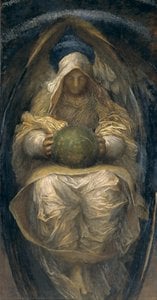
George Frederic Watts' "Hope," painted in 1886, isn’t merely a portrait; it’s an embodiment of resilience, a visual meditation on the enduring spirit within the face of adversity. Completed in two distinct versions – one residing in a private collection and the other gracing the walls of Tate Britain – this oil painting transcends its subject matter to become a universal symbol of quiet determination and the tenacious pursuit of beauty amidst darkness. Watts, a pivotal figure in the Symbolist movement, masterfully eschews overt displays of optimism, instead offering a profoundly moving depiction of vulnerability and unwavering hope. The piece immediately draws the viewer in with its muted palette – predominantly deep blues, browns, and greys—creating an atmosphere of contemplative melancholy. Yet, within this somber backdrop, a single, luminous thread of light emerges, hinting at the enduring power of the human spirit.The Figure and Her Burden
At the heart of “Hope” sits a woman, shrouded in a veil that obscures her face, yet radiating an undeniable sense of inner strength. She is seated upon a globe – a potent symbol of worldly concerns and the weight of existence – leaning forward with a delicate grace towards a frayed lyre. The posture itself speaks volumes: not one of frantic action or desperate yearning, but rather of patient listening, a quiet absorption of what remains. Her hands are clasped before her face, suggesting both introspection and a protective gesture, as if shielding herself from the overwhelming silence surrounding her. This isn’t a triumphant declaration of hope; it's a hesitant, almost fragile acceptance of its possibility. The artist deliberately avoids romanticizing suffering, presenting instead a raw and honest portrayal of vulnerability—a recognition that hope is not always loud or exuberant, but often whispers in the quiet corners of the soul.Symbolism Woven into the Canvas: Music, Silence, and the Unseen
Watts’ genius lies in his masterful deployment of symbolism. The lyre itself is a key element, representing music—not just auditory pleasure, but also inspiration, memory, and connection to something beyond the tangible world. Crucially, it's only *one* string remaining intact; this deliberate sparseness underscores the precariousness of hope, suggesting that even in the darkest times, there remains a flicker of potential beauty. The globe beneath her symbolizes the vastness of experience, the challenges and responsibilities of life. The veil concealing her face is particularly significant – it represents the unknown, the uncertainties we all confront, and the willingness to embrace them with courage. Notably, Watts abandoned the star that initially graced the upper left corner of the first version, opting for a more austere presentation, suggesting that hope doesn’t require external validation or divine intervention; it resides within us.Historical Context and Watts' Vision
Painted in 1886, “Hope” reflects the broader Symbolist movement’s fascination with spirituality, psychology, and the inner life. Watts was deeply influenced by his travels to Italy, particularly his exposure to Renaissance art and philosophy, which informed his belief that art should explore abstract ideas and emotions rather than simply depict reality. The painting emerged during a period of personal grief for Watts – his granddaughter had recently died – adding layers of emotional depth to the work. He sought to capture not just the *feeling* of hope, but its essence—its quiet persistence in the face of loss and uncertainty. The piece aligns with Watts’ broader project of creating a “House of Life,” a series of allegorical paintings intended to represent the totality of human experience.An Enduring Legacy: Hope as Inspiration
“Hope” continues to resonate powerfully today, not just for its artistic merit but also for its timeless message. It’s a reminder that even in moments of profound sadness and despair, the capacity for hope remains—a fragile yet resilient thread connecting us to something larger than ourselves. Its influence extends beyond the art world; it has been cited as an inspiration by figures such as Barack Obama, who used the image's powerful symbolism in his 2008 campaign. Reproductions of “Hope” serve as potent reminders that even when faced with overwhelming challenges, a quiet determination to find beauty and meaning can sustain us through the darkest times. It’s a piece that invites contemplation, prompting viewers to consider their own sources of hope and resilience—a truly remarkable testament to the enduring power of the human spirit.Related Artworks


Artist Biography
early life and education
george frederic watts, a prominent figure in the symbolist movement, was born on february 23, 1817, in marylebone, london. his early life was marked by delicate health and the loss of his mother at a young age. watts' father, a piano-maker, provided him with a conservative christian education and introduced him to the classics, including the iliad. this classical influence would later become a cornerstone of his artistic style.career
watts began his artistic journey at the age of 10, learning sculpture under william behnes. he later enrolled as a student at the royal academy schools at 18. his first exhibition at the academy in 1837 marked the beginning of his prolific career.- caractacus, a drawing submitted for a competition to design murals for the new houses of parliament, earned watts a first prize in 1843.
- his subsequent travels to italy (1843-1847) and his association with the british ambassador henry fox influenced his style, as seen in his portrait of lady holland, exhibited in 1848.
- watts' return to britain led to a commission for a fresco in the houses of parliament, which he completed between 1848 and 1853.
symbolist masterpieces
watts' most famous works include:- hope and love and life, intended as part of an epic symbolic cycle called the "house of life."
- the triumph of the red cross knight (from the faerie queene), completed in 1852-53, showcases his mastery of allegorical subjects.
- his portrait of actress ellen terry, painted in 1864, exemplifies his ability to capture the essence of his subjects.
legacy
watts' influence on the art world is undeniable. his association with the symbolist movement and his innovative use of color and form have made him a beloved figure in the history of british art. view george frederic watts' artworks on ArtsDot.commuseums featuring watts' work
- lincoln's inn, featuring his fresco justice, a hemicircle of lawgivers.
- the watts gallery – artists' village in guildford, united kingdom, dedicated to preserving watts' works and other artists.

George Frederic Watts
1817 - 1904 , United Kingdom
Quick Facts
- Artistic Movement Or Style: Symbolist
- Artists Or Movements Influenced By This Artist:
- Romanticism
- Pre-Raphaelites
- Artists Who Influenced This Artist:
- William Behnes
- Henry Fox
- Date Of Birth: February 23, 1817
- Date Of Death: July 1, 1904
- Full Name: George Frederic Watts
- Nationality: British
- Notable Artworks:
- Hope
- Love and Life
- The Triumph of the Red Cross Knight
- Place Of Birth: Marylebone, United Kingdom
Related Articles

Georges Braque's Masterpieces: 25 Paintings That Defined Cubism & Modern Art | ArtsDot
Explore 25 iconic Georges Braque paintings that revolutionized Cubism & modern art. Discover the stories behind his masterpieces, from Fauvism to Analytical Cubism. Find museum-quality reproductions & elevate your home decor with ArtsDot.com.

Georges Seurat's Masterpieces: 25 Paintings That Defined Pointillism | ArtsDot
Explore 25 iconic Georges Seurat paintings & discover the brilliance of Pointillism. From 'La Grande Jatte' to his harbor scenes, delve into art history with ArtsDot.com. Find museum-quality reproductions for your home decor. Explore the full collection online!

George Frederic Watts: Symbolism, Spirituality & Victorian Ideal Beauty
Explore the captivating Symbolist art of George Frederic Watts. Discover his allegorical masterpieces, classical influences & spiritual themes. Learn about his legacy and find high-quality reproductions at ArtsDot.

Frederick Waters Watts: A Victorian Vision of Aestheticism & Spiritual Symbolism
Explore the captivating world of Frederick Watts, a key Victorian painter blending aestheticism & spiritual symbolism. Discover his allegorical masterpieces like 'Hope' and delve into his artistic journey with ArtsDot.

The Enduring Legacy of Oil on Canvas: Technique, History & Aesthetic Impact
Explore the rich history & techniques of oil painting – from Renaissance masters to Impressionism. Discover pigments, layering methods, and why this timeless medium endures. Expert insights for artists & art enthusiasts.