

- 61.0 x 74.0 cm


The picture follows your choices: , .
Collectible Description
A vibrant gathering of Native American people around a large teepee captures the spirit of 1837 in this George Catlin masterpiece, inviting you to bring this historic frontier scene into your private collection.
 Read More
Artist Biography
Explore the captivating art of George Catlin (1796-1872), renowned for his vivid portraits & landscapes documenting Native American life on the frontier. Discover a vanishing world through his stunning paintings!
Hand Made Oil Reproduction
Hand-painted oil on canvas in your size and frame, made to order by our artists. ( Switch to Print Switch to Digital Image)
More about this painting
 Preview
 Send
Send Share
Share
 Details
 Guide
Guide

 Download
 Similars
 X-Ray
X-Ray Diaporama
 Q&A
Q&A Stats
StatsOrder your painting in four simple steps
Take your time. You can change any answer; the price in your order card follows each choice.
1 Step one of four
Which size would you like?
These sizes keep the proportions of the original painting. The drawing shows your choice on a wall, above a two-metre sofa.
Or give your own measurements
Pick from our preset sizes that match the artwork's original proportions.

Type the width and the height you need, to fit your frame or your wall. This is hand-painted, so for a size with a different shape the artist can paint a bit more around the picture, or cut a bit — you choose. We send you a digital mockup to approve before the painting starts. The picture shown on this page does not show the real result — only the mockup does.
2 Step two of four
How should it be prepared: rolled, stretched or framed?
The prices below are for the size you chose in step one.
Choose the edges of the stretched canvas
Choose your frame

White $1

Blurside $1

Extended $1

P118B $10

P118H $10

P118W $10

P438Z $10

P508JH $12

P508YH $12

P805H $10

P805Z $10

P919BZ $10

P919G $10

P919XJ $10

P959ZH $10

P968JZ $12

W106C $8

W218G $10

W218JH $8

W218Y $10

W307PJ $10

W316G $10

W316PJ $8

W316Y $10

W398PJ $8

W4111J $10

W500HY $15

W500JH $15

W692G $12

W849H $8

W940BG $15

W953PJ $8

H24-GOLD $30

H24-SILVER $30

H36-GOLD $45

H36-SILVER $45
Framed
Moulding: . Overall size with the frame: .
3 Step three of four
Would you like anything changed in the painting?
Most people answer no. Because each painting is made by hand, our artist can also adapt it for you.
After order, ArtsDot.com team will email client for instructions and provide a mockup preview
4 Step four of four
A few finishing options
All of them are optional. The answers already selected cost nothing extra.
Who paints it?
Worldwide Delivery () in 3/4 weeks instead of standard 5 weeks. (3 November). No compromise on quality.
A nameplate, as in a museum?
Engraved Bronze Plaque Details
This elegant plaque features the artist's name and the title of the artwork, finely engraved for a timeless presentation.
It is made from bronze with a refined, elegant finish. The text is precisely laser-engraved for a sharp and permanent result. Measuring 9x2 cm, the plaque is compact yet easy to read. It's built to be durable and scratch-resistant, offering a professional, museum-quality look. Mounting is simple thanks to the included adhesive backing.
Transparent Acrylic Plaque Details
The plaque includes essential engraved details such as the artist's name, the title of the artwork, the date it was created, the type of media used-like oil on canvas or watercolor-a brief description of the piece, and a QR code that links to the complete artwork information.
It is crafted from clear acrylic, offering a sleek, modern appearance. The text is UV-engraved in black to ensure strong visual contrast. With a size of 10x15 cm, it ensures optimal readability. It comes equipped with two metal hooks for secure wall mounting. The plaque is designed to be weather-resistant, making it suitable for various environments, and it includes interactive features that work seamlessly with smartphone scanning.
Black Acrylic Plaque Details
This elegant plaque includes engraved information such as the artist's name, the title of the artwork, the date it was created, the type of media used (like oil on canvas or watercolor), a short description of the artwork, and a QR code for quick access to more information.
The plaque itself is made from refined black acrylic with a premium finish. The text is laser-engraved in white for high contrast and readability. Its size is 10x15 cm, designed to be easy to read. It comes with two metal hooks for professional mounting. The design is sleek and fits any interior style. It is also weather-resistant and durable, with built-in digital integration for mobile compatibility.
A protective varnish?
When do you need it?
✓ Check and order
Your painting, as you ordered it

Sioux Dog Feast
Reproduction Medium
Reproduction Size
-

Elite Senior Artist
More detail, finesse, and extra production time
-

Reproduction Frame
-
-
For artworks or reproductions larger than 105 cm (approximately 41 inches) on any side, the frame will be shipped as a kit, disassembled. This method ensures safe delivery and prevents damage during transport.
Professional assembly required - this is not a DIY product.
The kit must be assembled and the canvas stretched by an experienced professional framer, using wood glue (not supplied), a canvas stretching plier and clamps to hold the bars square while the glue dries. Incorrect assembly or uneven canvas tension can permanently damage the artwork and is not covered by our warranty.
 For artworks or reproductions larger than 105 cm (approximately 41 inches) on any side, the frame will be shipped as a kit, disassembled. This method ensures safe delivery and prevents damage during transport.
All solid wood bars are included, precisely cut to size.
Assembled with the screws provided, plus wood glue for the corner joints, which is not supplied and must be sourced by your framer.
Professional tools are required and not included: a canvas stretching plier (tensioner) and clamps to hold the bars square while the glue dries.
Important:
The corner joints require wood glue, the bars must be held with clamps until the glue is fully dry, and tightening the canvas on the assembled frame requires a canvas stretching plier. None of these are included in the kit. Please arrange an experienced professional framer before ordering this size.

Nameplate
-
-

Protective Varnish
Glossy Varnish (enhances colors, protects against light/moisture)
-

Customize My Artwork
Examples of what can be changed: Replace face with customer photo; Add pet (e.g., replace cat with dog); Include hidden message in background; Change background landscape or elements.
-

Urgent
Worldwide Delivery () in 3/4 weeks instead of standard 5 weeks. (3 November). No compromise on quality.
-
Express Shipping
Worldwide Delivery () in 5 weeks. (10 November).
Included
Total Price
$ 263
Glass option is only available in size under 110 CM
Included with every order
- Free Worldwide Express Shipping
- High-Quality Linen Canvas
- Full Shipping Insurance
- Customs Tax Refund Guarantee
- True Color Matching Guarantee
- 100-Day Return Policy (Defects Only)
- 100% Money-Back Guarantee
- Bulk Discount Offer


A Window into a Vanishing World
In the evocative masterpiece Sioux Dog Feast, painted in 1837, the legendary American artist George Catlin invites us to step through a portal of time. This captivating work serves as more than just a landscape; it is a profound ethnographic window into the heart of the Great Plains during a pivotal era of North American history. The scene unfolds around a majestic, towering teepee that dominates the composition, its sturdy poles reaching toward the sky like sentinels of tradition. Within this wilderness setting, Catlin masterfully captures a moment of communal life, where the Native American people are gathered in what feels like a sacred celebration or a vital social ritual. The presence of birds fluttering through the air and a faithful dog resting in the foreground breathes an organic, pulsing vitality into the canvas, suggesting a world where humanity and nature exist in a delicate, rhythmic harmony.
The artistry of George Catlin is defined by his unique ability to blend meticulous documentation with a romantic, almost cinematic sensibility. As a painter who abandoned the law to document the "vanishing" cultures of the West, Catlin employs a technique that emphasizes both the structural grandeur of the encampment and the intimate details of the figures within it. The brushwork, while grounded in the realism required for historical record, possesses an atmospheric quality that captures the shifting light and the rugged textures of the frontier. For the discerning collector or interior designer, this piece offers a rich tapestry of earth tones and naturalistic hues that can anchor a room with a sense of history and groundedness. The composition’s balance—the heavy, central presence of the teepee contrasted by the scattered, lively movement of the people—creates a visual rhythm that is both soothing and intellectually stimulating.
Beyond its aesthetic allure, Sioux Dog Feast carries a deep emotional resonance and historical weight. To gaze upon this painting is to confront the bittersweet beauty of a way of life that Catlin himself feared was slipping into the shadows of history. Every element, from the positioning of the individuals to the quiet companionship of the animals, symbolizes the strength of community and the resilience of culture amidst a changing landscape. For those seeking to adorn their spaces with art that tells a story, this reproduction offers an unparalleled opportunity to possess a fragment of American heritage. It is a piece that does not merely decorate a wall; it provokes conversation, inspires reflection on the passage of time, and brings the untamed spirit of the 19th-century frontier into the modern home.
Questions & Answers
Is there a slideshow for "Sioux Dog Feast" by George Catlin?
"Sioux Dog Feast" by George Catlin can be viewed as a slideshow on the artwork's Diaporama page.
At what age did George Catlin make "Sioux Dog Feast"?
George Catlin was 41 years old when creating "Sioux Dog Feast" in 1837. The age is computed from the artist's birth year, 1796.
How is "Sioux Dog Feast" recommended to be printed - what size, what orientation?
For "Sioux Dog Feast", the recommended print setup is a medium size and a landscape orientation.
Related Artworks


George Catlin
1796 - 1872, United States of America
Artist Biography
Early Life and the Call of the Frontier
George Catlin, born in Wilkes-Barre, Pennsylvania, in 1796, was a man destined to become a bridge between worlds—the established American society of his time and the rapidly vanishing cultures of Native American tribes. His childhood was deeply imprinted with tales of the frontier, stories recounted by his mother, Polly Sutton, who had herself endured the harrowing experience of capture during an Indian raid. These narratives ignited within young Catlin a fascination with the West, a land perceived as both dangerous and profoundly romantic. Though initially trained in law, he discovered his true calling not within the courtroom but in capturing the essence of a way of life he feared was slipping away. He abandoned legal practice after only two years, driven by an artistic impulse and a growing conviction that the traditions and appearances of Native Americans deserved meticulous documentation for posterity. This wasn’t merely aesthetic curiosity; it was a sense of urgency, a premonition that westward expansion would irrevocably alter these cultures. His early work involved engravings depicting scenes along the Erie Canal, demonstrating his technical skill and attention to detail—qualities that would become hallmarks of his later, more ambitious projects. These initial endeavors served as a crucial foundation, honing his observational abilities and establishing his commitment to visual storytelling.Documenting a Vanishing World: The Indian Gallery
Catlin’s defining achievement was undoubtedly the creation of “The Indian Gallery,” an extraordinary collection of over 500 paintings dedicated to portraying Native American life and culture. Beginning in the 1830s, he embarked on five extensive expeditions into the American West, traveling up the Missouri River and venturing into territories inhabited by tribes such as the Mandan, Sioux, Blackfeet, and Choctaw. He wasn’t simply an observer; Catlin immersed himself within these communities, participating in ceremonies, witnessing daily life, and forging relationships with tribal leaders. His paintings are remarkable for their realism and vibrant colors, capturing not only physical likenesses but also a sense of the dignity and complexity of Native American customs. Ball-Play of the Choctaw, for example, is a dynamic depiction of a traditional game, showcasing the athleticism and communal spirit of the tribe. Similarly, his portrait of Mó-sho-la-túb-bee, He Who Puts Out and Kills, Chief of the Tribe, reveals a powerful leader with an unwavering gaze, conveying both authority and wisdom. Catlin’s style is characterized by meticulous detail, often including elaborate backgrounds that provide context for his subjects—landscapes, tipis, ceremonial objects—all rendered with a keen eye for accuracy. He sought to present Native Americans not as savage stereotypes but as individuals with rich cultural traditions and complex social structures, challenging the prevailing prejudices of his time.Challenges and Recognition: A Life Dedicated to Preservation
Despite the artistic merit and historical significance of The Indian Gallery, Catlin faced considerable challenges in gaining recognition and financial support for his work. He envisioned donating the collection to the U.S. government, hoping it would be preserved as a national treasure, but his initial proposals were repeatedly rejected. Undeterred, he took his gallery on tour, exhibiting it first in London, then Paris, and Berlin during the 1840s and 50s. These European exhibitions garnered considerable acclaim, introducing audiences to a world they had previously only known through secondhand accounts. Catlin also published several books detailing his travels and observations, including Manners, Customs, and Condition of the North American Indians (1841) and Last Rambles Amongst the Indians of the Rocky Mountains and the Andes (1868), further solidifying his reputation as a leading authority on Native American culture. However, financial difficulties continued to plague him throughout his life. In a desperate attempt to recoup some of his investment, he recreated over 400 paintings in a smaller “cartoon collection,” but even this effort failed to yield substantial returns. This period was marked by constant struggle and a poignant irony—a man dedicated to preserving a culture facing extinction found himself battling for his own survival.Legacy and Historical Significance
George Catlin died in 1872, leaving behind a legacy that continues to resonate today. While his work wasn’t fully appreciated during his lifetime, it has since been recognized as an invaluable historical record of Native American life before the sweeping changes brought about by westward expansion. His paintings offer a glimpse into cultures that were often misrepresented or ignored in mainstream narratives. Prairie Meadows Burning, with its dramatic depiction of a controlled burn and accompanying riders, captures not only the landscape but also the intimate relationship between Native Americans and their environment. Pipestone Quarry, Coteau Des Prairies illustrates the spiritual significance of this sacred site for many tribes. Catlin’s meticulous documentation provides insights into tribal customs, social structures, religious beliefs, and artistic traditions—information that would have been lost to history without his dedicated efforts. His work serves as a powerful reminder of the importance of cultural preservation and the need to challenge preconceived notions about indigenous peoples. He wasn't simply an artist; he was a chronicler, a witness, and a passionate advocate for a vanishing way of life—a legacy that continues to inspire and inform our understanding of American history and culture.Key Works
- Sham Fight, Mandan Boys (1832-1833): A lively depiction of a playful mock battle among young Mandan warriors.
- Mrs. George Catlin (Clara Bartlett Gregory) (1850): A portrait showcasing the artist’s wife, offering insight into his personal life.
- Pipestone Quarry, Coteau Des Prairies (1848): Illustrates a sacred site for many tribes and their spiritual connection to the land.
- Medicine Buffalo of the Sioux (1839): A striking portrait capturing the dignity and power of a prominent Sioux leader.
- Prairie Meadows Burning (1832): Depicts a dramatic scene of controlled burning, highlighting the relationship between Native Americans and their environment.
- Dubuque's Grave, Upper Mississippi (1836): A landscape painting capturing the serene beauty of the Upper Mississippi region with Impressionistic brushwork.
- Eagle Dance, Choctaw (1837): A vibrant portrayal of a traditional Choctaw ceremony, showcasing their rich cultural heritage.
- Little Wolf, A Famos Warrior (1844): A powerful portrait of a Native American warrior, symbolizing strength and resilience.


Related Articles
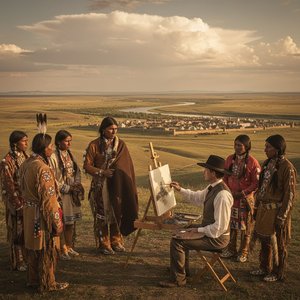
George Catlin: Witnessing & Representing Indigenous Life on the American Frontier
Explore the captivating art of George Catlin, renowned for his vivid portraits & landscapes documenting Native American life on the frontier. Discover a vanishing world through stunning paintings and historical context.

Mastering Cubism: The Top 25 Georges Braque Artworks
Explore 25 iconic Georges Braque masterpieces and the birth of Cubism. Discover museum-quality art on ArtsDot.com.

Georges Seurat's Masterpieces: 25 Paintings That Defined Pointillism | ArtsDot
Explore 25 iconic Georges Seurat paintings & discover the brilliance of Pointillism. From 'La Grande Jatte' to his harbor scenes, delve into art history with ArtsDot.com. Find museum-quality reproductions for your home decor. Explore the full collection online!