


 Preview
 Send
Send Share
Share
 Details
 Guide
Guide

 Download
 Similars
 X-Ray
X-Ray Diaporama
 Stats
StatsLA RIXE


 Read More
Giclée / Art Print
Museum-quality giclée or canvas print with fast production and flexible finish options. ( Buy Hand Made Painting Switch to Digital Image)




P118B $10

P118H $10

P118W $10

P438Z $10

P508JH $12

P508YH $12

P805H $10

P805Z $10

P919BZ $10

P919G $10

P919XJ $10

P959ZH $10

P968JZ $12

W106C $8

W218G $10

W218JH $8

W218Y $10

W307PJ $10

W316G $10

W316PJ $8

W316Y $10

W398PJ $8

W4111J $10

W500HY $15

W500JH $15

W692G $12

W849H $8

W940BG $15

W953PJ $8




Pick from our preset sizes that match the artwork's original proportions.

Type the width and the height you need, to fit your frame or your wall. A print can only be cut, never made bigger than the picture, so a size with a different shape loses a part of the image. We send you a digital mockup to approve before we print anything. The picture shown on this page does not show the real cut — only the mockup does.
Worldwide Delivery () in 2 weeks instead of standard 4/5 weeks. (22 October)

Free Worldwide Express Shipping

High-Quality Linen Canvas

Full Shipping Insurance

Customs Tax Refund Guarantee

True Color Matching Guarantee

100-Day Return Policy (Defects Only)

100% Money-Back Guarantee

Bulk Discount Offer
 Glass option is only available in size under 110 CM

LA RIXE
Giclée / Art Print
Reproduction Size
-


Total Price
$ 63
The Drama of Human Encounter in Rococo Splendor
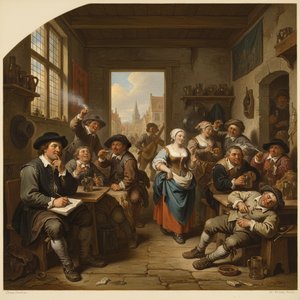
To stand before La Rixe is to be immediately drawn into the vibrant heart of human interaction—a moment suspended between jest and genuine discord. The title itself, translating simply as 'The Quarrel,' suggests a volatile energy barely contained within the canvas. Yet, what captivates the modern viewer is not merely the conflict, but the exquisite refinement with which it is rendered. This scene pulses with the characteristic spirit of the Rococo period; an era that celebrated life’s pleasures and social intricacies, even when those interactions devolved into spirited debate or outright dispute. The composition masterfully clusters three central figures in a dynamic tableau, their proximity suggesting both intimacy and palpable tension.
A Study in Rococo Elegance and Tension
Technically, the painting is a rich testament to oil on canvas mastery. One observes the signature softness of the Rococo style—the flowing lines defining the voluminous drapery and the delicate gestures of the figures’ hands. The artist has employed a palette dominated by warm, earthy tones—deep reds, sunlit yellows, and rich browns—which imbue the scene with an almost feverish vibrancy. These warmth are beautifully counterpointed by cooler accents of blue and grey in the garments, providing necessary visual rest points for the eye. The light itself is diffused, bathing the group in a soft glow that sculpts the faces and highlights the luxurious textures of their elaborate attire, allowing the viewer to appreciate every fold of silk and every subtle expression.
Historical Echoes and Artistic Lineage
The hand that painted this work belongs to Gaspare Traversi, an artist whose career blossomed in Naples during a period of profound artistic transition. While the Rococo aesthetic speaks of aristocratic leisure, Traversi’s training under masters influenced by Caravaggism lends an unexpected dramatic weight to the scene. This fusion is key: the lightness and grace expected of Rococo portraiture are grounded by a sense of narrative immediacy, a touch of Baroque drama that prevents the quarrel from feeling merely frivolous. It speaks to a society both deeply concerned with outward appearance—the finery of their clothes—and intensely invested in the power dynamics played out among its members.
Symbolism and Emotional Resonance for the Collector
For those who collect art not just for beauty, but for narrative depth, La Rixe offers a compelling meditation on social status and conflict. The elaborate clothing is more than mere decoration; it functions as a visual marker of rank within an imagined aristocratic sphere. The overlapping figures and the use of linear perspective draw the viewer into the very vortex of their disagreement, making one feel like an unseen observer privy to a private moment of high drama. Reproducing this piece allows one to bring not just a painting, but a carefully curated atmosphere—an echo of sophisticated, passionate human exchange—into a modern interior space.
Questions & Answers
What level of contrast does "LA RIXE" by Gaspare Traversi show?
The light-dark contrast of "LA RIXE" is recorded as statement. Contrast describes how strongly light and dark areas differ.
Which museum holds the original "LA RIXE"?
The original "LA RIXE" by Gaspare Traversi is held at The Louvre, Paris, France. A reproduction allows the work to be displayed at home.
What underlying hue runs through "LA RIXE" by Gaspare Traversi?
The dominant hue of "LA RIXE" by Gaspare Traversi is golden yellow range. The hue is the underlying tone of the palette.
Related Artworks


Artist Biography
Gaspare Traversi: A Venetian Baroque Painter's Dramatic Vision
Gaspare Traversi (1722-1770) stands as a singular figure in the vibrant artistic landscape of Naples during the Rococo era, yet his stylistic affinities extend far beyond the confines of Campania. Born to Genoese merchant parents in Naples, he embarked on an artistic journey marked by meticulous training under Francesco Solimena—a pivotal encounter that cemented his allegiance to Caravaggist principles—and fostered collaborations with fellow Solimena pupils like Giuseppe Bonito and Francesco de Mura. Active primarily between 1732 and 1769, Traversi’s oeuvre transcends regional boundaries, encompassing commissions in Parma and establishing him as a contemporary of luminaries such as Giovanni Lorenzo Berti.- Early Training & Solimena Influence: Traversi's formative years were spent honing his craft under Francesco Solimena, arguably Naples’ most celebrated Baroque painter. This mentorship instilled within him the dramatic chiaroscuro technique characteristic of Caravaggio—a stylistic cornerstone that would permeate his subsequent works.
- Genre Painting & Venetian Style: Traversi distinguished himself as a genre painter, capturing scenes of everyday life with remarkable psychological depth and theatrical flair. His canvases frequently depict animated bourgeois gatherings, imbued with an unsettling sense of claustrophobia and punctuated by expressive facial expressions—a stylistic hallmark reminiscent of Hogarth’s satirical portraits.
- Religious Iconography & Caravaggist Drama: Despite his adherence to Venetian Baroque influences, Traversi's religious paintings retain a visceral immediacy akin to Caravaggio’s masterpieces. He skillfully employs tenebrism—the dramatic interplay of light and shadow—to heighten emotional impact and convey profound spiritual contemplation.
- Notable Commissions & Collaborations: Traversi secured prestigious commissions throughout Italy, notably in Parma where he collaborated with Giovanni Lorenzo Berti on a monumental portrait depicting Saint Margaret of Cortona. This collaborative effort exemplifies Traversi’s commitment to exploring complex narratives and conveying moral lessons through visual storytelling.
A Venetian Baroque Painter's Dramatic Vision
Traversi’s artistic sensibility aligns closely with the Venetian Baroque tradition, particularly evident in his meticulous attention to detail and his masterful manipulation of light and shadow—techniques perfected by artists like Pietro Pellegrino Paladino and Giovanni Battista Tiepolo. His canvases pulsate with dynamism, mirroring the theatrical grandeur favored by Venetian painters during their golden age. The influence of Caravaggio is undeniable, manifesting itself in Traversi’s penchant for dramatic compositions and his unflinching portrayal of human emotion.- Caravaggist Technique: Traversi's use of tenebrism—the stark contrast between light and dark—is a deliberate homage to Caravaggio’s revolutionary approach to painting, prioritizing emotional intensity over idealized beauty.
- Psychological Depth & Dramatic Composition: Like Caravaggio, Traversi delves into the psychological complexities of his subjects, capturing fleeting expressions of emotion with uncanny accuracy. His canvases are characterized by dynamic compositions that propel the narrative forward and engage the viewer’s gaze.
Satirical Observations & Moralistic Tales
Traversi's genre paintings transcend mere depiction; they serve as astute social commentaries, exposing the follies and pretensions of the aristocratic elite with biting wit and unflinching honesty. His canvases frequently portray animated groups of bourgeois protagonists crammed into confined spaces—a stylistic device that underscores the psychological pressures inherent in societal hierarchies. Traversi’s works resonate with moralistic tales—much like Caravaggio's “The Fortune Teller”—offering viewers a glimpse into the anxieties and contradictions of his time.- Social Critique: Traversi’s satirical portraits expose hypocrisy and vanity within the upper echelons of society, reflecting the broader intellectual currents of the Enlightenment.
- Moralistic Narrative: His canvases convey moral lessons through dramatic narratives—a stylistic characteristic shared with Caravaggio—challenging viewers to confront uncomfortable truths about human behavior.
Legacy & Influence
Despite lacking pupils, Gaspare Traversi exerted a considerable influence on subsequent generations of Neapolitan artists, notably Lorenzo de Caro and Giuseppe Bonito. His distinctive style—characterized by dramatic chiaroscuro, psychological depth, and moralistic narratives—continues to inspire admiration and scholarly debate. Robert Longhi’s monograph solidified Traversi's reputation as a pivotal figure in Venetian Baroque art, ensuring his enduring legacy within the annals of Italian painting history.
Gaspare Traversi
1722 - 1770 , Italy
Quick Facts
- Full Name: Gaspare Traversi
- Nationality: Italian
- Date Of Birth: 1722
- Date Of Death: 1770
- Place Of Birth: Naples, Italy
- Notable Artworks:
- Saint Margaret of Cortona
- Job mocked by his wife.
- Reading a Letter
- Artistic Movement Or Style: Rococo
- Artists Who Influenced This Artist: ['Francesco Solimena']
- Artists Or Movements Influenced By This Artist:
- Hogarth
- Longhi
Related Articles

The Rococo Aesthetic: Opulence, Rebellion & the Pursuit of Pleasure in 18th-Century Art
Explore the opulent world of Rococo art! Discover its origins, key artists like Watteau & Boucher, and lasting influence on design. Expert insights for collectors & enthusiasts.
David Teniers the Younger: Genre Painting & Social Commentary in Baroque Flanders
Explore the captivating world of David Teniers the Younger, a leading Flemish Baroque painter. Discover his genre scenes, social commentary, and lasting influence on 17th-century art. Learn about his life, techniques & legacy.

Rococo's Radiant Legacy: 10 Masterpieces for Your Home |
Indulge in the elegance of Rococo! Explore 10 masterpieces by Fragonard, Boucher & Watteau. Discover the stories behind these iconic paintings and bring timeless art to your home with museum-quality reproductions from .

From Grandeur to Grace: Exploring the Evolution of Baroque & Rococo Art
Explore the captivating evolution from Baroque's drama to Rococo's grace! Discover key artists, characteristics & lasting influence of these art movements with expert insights at ArtsDot.

Simon Vouet: A Baroque Master's Journey from Italian Influence to French Classicism
Explore the life & art of Simon Vouet, a pivotal French Baroque painter who introduced Italian styles to France. Discover his masterpieces and lasting influence on 17th-century art.


