Preview
 Send
Send Share
Share
 Details
 Guide
Guide

 Download
 Similars
 X-Ray
X-Ray Diaporama
 Stats
StatsThe Cook
 Oil On Canvas
- WallArt
- Dutch Golden Age
 1657
1657- Early Modern
 40.0 x 34.0 cm
 Thyssen-Bornemisza Museum
 Read More
Hand Made Oil Reproduction
Hand-painted oil on canvas in your size and frame, made to order by our artists. ( Switch to Print Switch to Digital Image)




P118B $10

P118H $10

P118W $10

P438Z $10

P508JH $12

P508YH $12

P805H $10

P805Z $10

P919BZ $10

P919G $10

P919XJ $10

P959ZH $10

P968JZ $12

W106C $8

W218G $10

W218JH $8

W218Y $10

W307PJ $10

W316G $10

W316PJ $8

W316Y $10

W398PJ $8

W4111J $10

W500HY $15

W500JH $15

W692G $12

W849H $8

W940BG $15

W953PJ $8




Pick from our preset sizes that match the artwork's original proportions.

Type the width and the height you need, to fit your frame or your wall. This is hand-painted, so for a size with a different shape the artist can paint a bit more around the picture, or cut a bit — you choose. We send you a digital mockup to approve before the painting starts. The picture shown on this page does not show the real result — only the mockup does.
After order, ArtsDot.com team will email client for instructions and provide a mockup preview
Worldwide Delivery () in 3/4 weeks instead of standard 5 weeks. (24 October). No compromise on quality.

Free Worldwide Express Shipping

High-Quality Linen Canvas

Full Shipping Insurance

Customs Tax Refund Guarantee

True Color Matching Guarantee

100-Day Return Policy (Defects Only)

100% Money-Back Guarantee

Bulk Discount Offer
 Glass option is only available in size under 110 CM

The Cook
Reproduction Medium
Reproduction Size
-


Total Price
$ 263
A Moment Frozen in Time: The Quiet Majesty of Gabriel Metsu
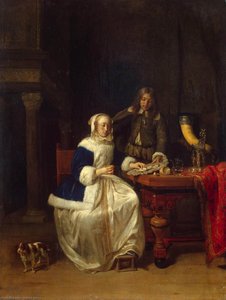
In the heart of the Dutch Golden Age, amidst a period defined by unparalleled prosperity and a burgeoning middle class, Gabriel Metsu captured something far more profound than mere domesticity. His 1657 masterpiece, "The Cook," currently held in the prestigious Museo Thtle Thyssen-Bornemisza in Madrid, serves as a breathtaking window into the seventeenth century. At first glance, the painting presents a deceptively simple tableau of everyday life, yet beneath its surface lies a masterful distillation of realism and psychological depth. The scene centers on a woman, draped in a striking blue gown that commands the viewer's attention, standing before a monumental oven. Her posture, marked by a calm and steady confidence, suggests a moment of quiet purpose as she holds aloft a tray laden with food, inviting us to witness the sacred rituals of nourishment and service.
Metsu’s technical prowess is nothing short of extraordinary, making this piece an essential inspiration for those who appreciate the fine nuances of classical oil painting. He employs chiaroscuro with surgical precision, skillfully manipulating light and shadow to sculpt the physical forms within the room. The way the light catches the subtle sheen on the food tray or illuminates the rugged texture of the oven’s brickwork creates a sense of three-dimensional reality that is almost tactile. Through the delicate use of glazing—layering thin, translucent washes of pigment over thicker underlayers—Metsu achieves a luminous, ethereal quality. This technique imbues the painting with a soft glow, as if the scene itself is breathing, making it an ideal centerpiece for any collection seeking to evoke warmth and timeless elegance.
Symbolism and the Soul of the Dutch Interior
Beyond its visual splendor, "The Cook" is a tapestry of symbolic meaning, reflecting the core values of seventeenth-century Dutch society. The oven, a dominant and rustic presence in the composition, is far more than a kitchen appliance; it stands as a powerful emblem of warmth, stability, and the hearth—the very foundation of domestic life. Even the small details, such as the bird hanging from the rafters, are heavy with intent. This poultry, likely a chicken, serves as a subtle nod to fertility and the prosperity of the household, grounding the painting in the era's preoccupation with abundance and the rewards of diligent labor.
For the discerning collector or interior designer, this work offers a unique emotional resonance. It does not shout; rather, it whispers stories of peace, sustenance, and the beauty found in the mundane. The dark, atmospheric background provides a dramatic contrast that pushes the central figures forward, creating a focal point that can anchor a room with its quiet intensity. Whether viewed as a historical document or a triumph of Baroque technique, "The Cook" remains a captivating testament to Metsu's ability to elevate the ordinary into the extraordinary, offering a sense of enduring grace to any space it inhabits.
Questions & Answers
How does the style of "The Cook" relate to its creator's era?
"The Cook" by Gabriel Metsu is placed in the Dutch Golden Age movement, within the Early-Modern era of its creator.
Where in the home does a reproduction of "The Cook" fit well?
The recommended space for "The Cook" by Gabriel Metsu is a living room. The suggestion can of course be adapted to your interior.
Who made "The Cook", and when?
Gabriel Metsu made "The Cook" in 1657.
Related Artworks


Artist Biography
**a life of artistic exploration**
gabriël metsu, a dutch painter from the netherlands, lived a life marked by artistic exploration and innovation. born in 1629, metsu's work embodied the spirit of the dutch golden age, a period renowned for its prolific artistic output. this biography delves into the life and works of this enigmatic figure, whose contributions to the art world continue to fascinate.**early life and influences**
metsu was born in 1629, the son of jacques metsu, a tapestry worker and painter originally from hainault. this eclectic background likely influenced gabriel's early interest in diverse artistic techniques. the family's move to leiden, where metsu grew up, exposed him to various cultural influences.**artistic career**
metsu's career was marked by an adherence to no single style or technique, earning him the title of "a highly eclectic artist." his work spanned history paintings, still lifes, portraits, and genre works. notably, only 14 of his 133 works are dated, leaving much to be discovered about his creative process.- rembrandt van rijn's influence on metsu's early work is evident, particularly in his use of light and color.
- metsu's move to amsterdam in 1655 marked a significant shift in his style, with more emphasis on domestic interiors and genre scenes.
- his training of michiel van musscher and joost van geel reflects his commitment to the artistic community.
**notable works and legacy**
metsu's paintings often featured young women, market scenes, and old people, drawing from popular emblems. a notable example is the poultry seller, which showcases his use of symbolism. key works:- the sick child (c. 1664), reflecting metsu's admiration for vermeer's work.
- portrait of the family hinlopen, a masterpiece that blends genre and portrait painting.
**museums and collections**
metsu's works can be found in various museums, including the rijksmuseum in amsterdam. for more information on his art and to explore other dutch golden age painters, visit /en/art/show/art-d3c627-en/ for a comprehensive overview. **conclusion:** gabriel metsu's life and art are a testament to the innovative spirit of the dutch golden age. his eclectic style, though sometimes enigmatic, has left an indelible mark on the world of art. as we continue to uncover more about his life and works, we are reminded of the profound impact he had on the development of western art.- for a deeper understanding of the dutch golden age, refer to [https://en.wikipedia.org/wiki/dutch_golden_age_painting](https://en.wikipedia.org/wiki/dutch_golden_age_painting).
- explore more of metsu's works and those of his contemporaries at [https://ArtsDot.com/@/gabriel-metsu](https://ArtsDot.com/@/gabriel-metsu).
**references:**
- the house of orange-nassau historic collection trust (the hague, netherlands), [https://ArtsDot.com/@@/a@d3ccx5](https://ArtsDot.com/@@/a@d3ccx5).
- van gogh museum (netherlands) - a haven for art lovers, [https://ArtsDot.com/@@/a@d3c8x3](https://ArtsDot.com/@@/a@d3c8x3).
- dutch golden age painting, [https://en.wikipedia.org/wiki/dutch_golden_age_painting](https://en.wikipedia.org/wiki/dutch_golden_age_painting).

Gabriel Metsu
1629 - 1667 , Netherlands
Quick Facts
- Artistic Movement Or Style: Dutch Golden Age painting
- Artists Or Movements Influenced By This Artist:
- Michiel van Musscher
- Joost van Geel
- Artists Who Influenced This Artist:
- Rembrandt van Rijn
- Johannes Vermeer
- Date Of Birth: 1629
- Date Of Death: 1667
- Full Name: Gabriel Metsu
- Nationality: Dutch
- Notable Artworks:
- The Sick Child
- Poultry Seller
- Portrait of the Hinlopen Family
- Place Of Birth: Leiden, Netherlands
Related Articles

Dutch Masters: 10 Golden Age Paintings That Still Inspire |
Journey into the Dutch Golden Age! Explore 10 iconic paintings by Rembrandt, Vermeer & Hals. Discover the stories behind these Baroque masterpieces and find museum-quality art reproductions to elevate your home decor on .

Dante Gabriel Rossetti's 25 Masterpieces: A Journey Through Victorian Art & Symbolism | ArtsDot
Explore 25 iconic artworks by Dante Gabriel Rossetti, a leading Pre-Raphaelite artist. Discover the stories behind masterpieces like 'Proserpine' & 'Beata Beatrix'. Find museum-quality art reproductions and elevate your home decor with ArtsDot.com.

Dutch Baroque Masters: 10 Paintings That Shaped an Era | ArtsDot
Journey through the Golden Age with our guide to the Top 10 Dutch Baroque masterpieces! Explore iconic paintings by Rembrandt, Vermeer & Frans Hals. Find museum-quality art reproductions and elevate your home decor at ArtsDot.com.

Golden Age Reflections: Dutch Baroque Painting & Cultural Innovation
Explore the Dutch Golden Age of painting! Discover key artists like Vermeer & ter Borch, their innovative techniques, and the rich cultural context behind these Baroque masterpieces. Learn about collecting & appreciating this iconic art period.

Illuminating Innovation: Exploring the Dutch Golden Age of Painting
Explore the Dutch Golden Age of painting with ArtsDot. Discover Rembrandt, Vermeer & other Masters. Learn about key characteristics, iconic artworks, and lasting influence. Expert insights for collectors & enthusiasts.