


 Preview
 Send
Send Share
Share
 Details
 Guide
Guide

 Download
 Similars
 X-Ray
X-Ray Diaporama
 Stats
StatsA Study


 Read More
Purchase a high-resolution, enhanced digital image, far superior to the online preview.
Each file is meticulously prepared by our in-house specialists using advanced tools and expert manual retouching. We ensure every image has exceptional clarity, precise color accuracy, and fine detail.
The final file is delivered via email within 72 hours, optimized for immediate use in professional, editorial, and print environments. This is the same quality trusted by top-tier design studios, publishers, and galleries.
Digital Image
Download a high-resolution file for personal display, printing, and creative projects. ( Switch to Print Buy Hand Made Painting)
Included in Every Digital Image Order
Expert Digital Delivery, Guaranteed
When you choose ArtsDot.com, you're not just getting an image - you're receiving a professionally enhanced digital artwork, crafted with precision and backed by a satisfaction guarantee. Here's everything that comes with your order, automatically:

Fast Email Delivery
Your high-resolution digital image file will be emailed to you within 72 hours of ordering - ready for immediate use.

AI-Enhanced Digital File
Your artwork is professionally optimized using advanced AI tools and manual editing, ensuring maximum detail, clarity, and color accuracy.

Free Lifetime Re-Delivery
Accidentally deleted or lost your file? No worries - we'll resend it to you anytime, free of charge.

No Import Fees - Ever
Enjoy your artwork instantly with zero customs, duties, or delivery fees - digital downloads are always tax-free.

Color Accuracy Guarantee
We ensure your digital image reflects the original colors as closely as possible using professional tools and color management.

100-Day Satisfaction Guarantee
If you're not satisfied with your digital image, we'll revise it or refund 100% within 100 days - no questions asked.

100% Money-Back Guarantee
Not satisfied? Get a full refund within 100 days of receiving your digital file - no questions asked.

Bulk Order Discounts
Buy 3 images, save 10% - Buy 5, save 15% - Buy 10+, save 20%. Great for creative projects, galleries, and agencies.
A Study in Light and Motion: Frederic Remington’s Equestrian Portrait
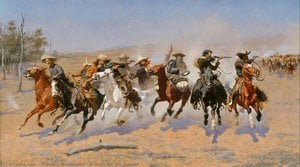
Frederic Remington's "A Study," painted in 1908, isn’t merely a depiction of a horse; it’s a profound meditation on the relationship between man and beast, a snapshot of the American West rendered with an almost palpable sense of movement and observation. The painting captures a sorrel stallion – its coat a rich, burnished copper – in a moment of quiet contemplation as it grazes within a sun-drenched field. Remington, a master of capturing the rugged spirit of the frontier, eschews romanticized grandeur for a more intimate, almost scientific approach to his subject. He wasn’t interested in heroic battles or sweeping landscapes; instead, he sought to understand and portray the subtle nuances of animal behavior, particularly the horse – an integral part of Western life.
Remington's technique is characterized by a remarkable sensitivity to light and shadow. The painting is dominated by a warm, golden glow that washes over the horse’s coat, highlighting its musculature and creating a sense of warmth and vitality. Notice how he uses short, broken brushstrokes – a hallmark of his style – to suggest movement and texture. These quick, decisive marks capture not just the physical form of the animal but also the feeling of it shifting slightly with each breath, each subtle shift in weight. The background is rendered with a looser, more atmospheric approach, suggesting distance and depth without sacrificing the overall clarity of the composition.
The Horse as Symbol: A Reflection of the West
For Remington, the horse represented far more than just transportation or labor; it embodied the very essence of the American West. It was a symbol of independence, resilience, and the enduring connection between humans and nature. The sorrel stallion in “A Study” embodies these qualities perfectly – strong, proud, and deeply rooted in its environment. Remington’s fascination with horses stemmed from his own childhood experiences on the ranch, where he spent countless hours observing their behavior and learning to ride them. This intimate knowledge is evident in the painting's remarkable accuracy and emotional resonance.
Furthermore, the horse held a complex significance within Native American culture, often viewed as a sacred animal. Remington’s work, while sometimes criticized for its romanticized portrayal of the West, also acknowledged this deeper connection to the land and its inhabitants. The painting subtly hints at this duality – the powerful, independent spirit of the horse mirrored in the vastness of the Western landscape.
A Glimpse into the Artist’s Process
“A Study” offers a rare glimpse into Remington's working method. He began with numerous preliminary sketches and studies, meticulously observing the horse’s anatomy, posture, and expression. These preparatory drawings reveal his deep understanding of equine movement and his commitment to capturing the animal’s true character. The painting itself is believed to be based on a live model – likely one of Remington's own horses – which allowed him to accurately render its form and capture its unique personality.
Remington was known for his dedication to realism, but he also possessed a remarkable ability to infuse his paintings with emotion. “A Study” is not simply a portrait; it’s an evocation of the spirit of the West – a testament to the enduring beauty and power of nature, and the profound connection between humans and animals.
Collecting a Legacy: Reproductions and Beyond
Reproductions of "A Study" offer a wonderful opportunity to bring this iconic image into your home or office. The quality of these reproductions varies greatly; seek out prints created using giclée technology, which ensures exceptional color accuracy and detail. The original’s subtle tonal variations are faithfully reproduced, capturing the painting's atmospheric depth and luminous quality. Consider framing the print in a natural wood frame to complement the painting’s rustic charm.
Beyond its aesthetic appeal, “A Study” serves as a powerful reminder of Frederic Remington’s enduring legacy as one of America’s greatest Western artists. It is a timeless masterpiece that continues to captivate viewers with its evocative imagery and profound insights into the human spirit.
Questions & Answers
What does "A Study" by Frederic Remington depict, and in what mood?
"A Study" by Frederic Remington combines horse, western, remington, landscape, cowboy, plains, study, painting with a calm atmosphere.
How can I get a print of "A Study" by Frederic Remington?
To get a print of "A Study" by Frederic Remington, simply order it on its Fine Art Print page: a fine art print on cotton canvas or archival canvas paper.
What national origin stands behind the Tonalism of "A Study"?
"A Study" connects the Tonalism movement with United States of America through its creator's birthplace.
Related Artworks


Artist Biography
A Chronicler of the Vanishing West: The Life and Art of Frederic Remington
Frederic Sackrider Remington, born in Canton, New York, on October 4, 1861, wasn’t a product of the Wild West he so vividly depicted; rather, he was an Easterner who forged his artistic identity through fascination and dedicated study. His lineage hinted at a life far removed from dusty trails and cavalry charges – French Basque ancestry mingled with staunchly Republican New England roots, a father who was a Civil War colonel and newspaper editor, and connections to the famed Remington Arms dynasty through distant cousins. Yet, it was an early exposure to military themes, coupled with a restless spirit and a keen eye for storytelling, that set him on a path toward becoming arguably the most recognizable artist of the American West. His childhood moved to Bloomington, Illinois, then back to Canton and finally Ogdensburg, New York, but his imagination remained captivated by tales of frontier life. Though initially steered towards a military education at Vermont Episcopal Institute, Remington’s true calling lay not in following orders, but in observing and interpreting the world around him through art. A brief stint at Yale University confirmed this; football and sketching held far more appeal than formal academic pursuits.From Illustrator to Painter: Forging an Artistic Vision
Remington’s artistic journey began not with grand canvases, but with ink and paper. His first published work, a cartoon for the *Yale Courant*, signaled an early aptitude for capturing action and narrative. A pivotal trip to Montana in 1881 ignited his lifelong obsession with the West. This wasn't merely a tourist’s gaze; Remington sought to immerse himself in the culture, observing cowboys, Native Americans, and the landscape itself. He initially attempted ranching and mining ventures, but these proved unsuccessful, freeing him to fully dedicate himself to art. Returning East, he quickly established himself as an illustrator for magazines like *Harper's Weekly* and *Collier’s*, his dynamic depictions of Western scenes captivating a national audience hungry for stories of the frontier. These illustrations weren’t simply reportage; they were infused with drama, energy, and a romanticized vision of the West that resonated deeply with the public imagination. It was through this work that Remington honed his skills in composition, capturing movement, and conveying emotion – qualities that would later define his paintings. He received minimal formal training beyond some drawing classes at Yale and a short period at the Art Students League, developing instead a distinctive style characterized by energetic brushwork, bold colors, and a focus on realism blended with dramatic flair.Capturing a Vanishing World: Themes and Style
Remington’s art is inextricably linked to a specific moment in American history – the twilight of the Old West. His canvases are populated by iconic figures: rugged cowboys driving cattle, stoic Native Americans facing displacement, and U.S. Cavalry soldiers engaged in both heroic battles and tragic conflicts. He didn't shy away from depicting the harsh realities of frontier life, but his work often leans towards a romanticized portrayal, emphasizing courage, adventure, and the clash of cultures. His paintings aren’t simply historical documents; they are evocative narratives that explore themes of heroism, loss, and the inevitable march of progress. Remington's style evolved over time, moving from tighter, more academic renderings to looser, more expressive brushwork. He was a master of capturing movement – horses galloping across the plains, cowboys wrestling steers, soldiers charging into battle. He often employed quick sketches and photographs as reference material, but his art always transcended mere imitation, imbued with his own unique vision and emotional intensity. Notable works like *My Ranch*, *Waiting in the Moonlight*, *Ridden Down* (1905), and *The Long-Horn Cattle Sign* (1908) exemplify his ability to capture both the grandeur and the vulnerability of the American West.Legacy and Enduring Influence
Frederic Remington died unexpectedly in 1909 at the age of 48, leaving behind a vast body of work that continues to captivate audiences today. His impact on Western art is undeniable; he didn’t just depict the West, he helped *define* it for generations of Americans. He established a visual language for the frontier – an iconography of cowboys, Indians, and cavalrymen that became deeply ingrained in popular culture.- His work inspired countless other artists, including N.C. Wyeth and Zane Grey.
- The Frederic Remington Art Museum in Ogdensburg, New York, stands as a testament to his enduring legacy, preserving an extensive collection of his paintings, sculptures, and archival materials.
- His art continues to be exhibited in major museums across the country, including the Metropolitan Museum of Art and the Amon Carter Museum of American Art.

Frederic Remington
1861 - 1909 , United States of America
Quick Facts
- Full Name: Frederic Sackrider Remington
- Nationality: American
- Date Of Birth: 1861
- Date Of Death: 1909
- Place Of Birth: Canton, United States of America
- Notable Artworks:
- My Ranch
- Waiting in the Moonlight
- Ridden Down (1905)
- The Long-Horn Cattle Sign
- Artistic Movement Or Style: Western American Art
- Artists Or Movements Influenced By This Artist:
- N.C. Wyeth
- Zane Grey