


 Preview
 Send
Send Share
Share
 Details

 Download
 Similars
 X-Ray
X-Ray Diaporama
 Stats
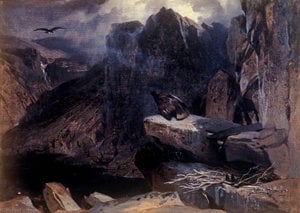
StatsDead Reindeer Attacked by Eagle
 Watercolor
- WallArt
- Romanticism
 1849
1849- 19th Century
 29.0 x 40.0 cm
 Nordnorsk Kunstmuseum
 Read More
Hand Made Oil Reproduction
Hand-painted oil on canvas in your size and frame, made to order by our artists. ( Switch to Print Switch to Digital Image)




P118B $10

P118H $10

P118W $10

P438Z $10

P508JH $12

P508YH $12

P805H $10

P805Z $10

P919BZ $10

P919G $10

P919XJ $10

P959ZH $10

P968JZ $12

W106C $8

W218G $10

W218JH $8

W218Y $10

W307PJ $10

W316G $10

W316PJ $8

W316Y $10

W398PJ $8

W4111J $10

W500HY $15

W500JH $15

W692G $12

W849H $8

W940BG $15

W953PJ $8




Pick from our preset sizes that match the artwork's original proportions.

You may enter your own dimensions to fit a specific frame or space. If your selected size does not match the original image's proportions, we will either crop the artwork or extend the painting with additional hand-painted elements. A digital mockup will be sent for your approval before production begins.
Please note that the on-screen preview does not reflect the actual cropping or extension. Only the mockup will accurately show the final composition.
While custom sizes are available, we recommend selecting a dimension from the predefined list to preserve the original proportions.
After order, ArtsDot.com team will email client for instructions and provide a mockup preview
Worldwide Delivery () in 3/4 weeks instead of standard 5 weeks. (17 September). No compromise on quality.

Free Worldwide Express Shipping

High-Quality Linen Canvas

Full Shipping Insurance

Customs Tax Refund Guarantee

True Color Matching Guarantee

100-Day Return Policy (Defects Only)

100% Money-Back Guarantee

Bulk Discount Offer
 Glass option is only available in size under 110 CM

Dead Reindeer Attacked by Eagle
Reproduction Medium
Reproduction Size
-


Total Price
$ 263
A Savage Symphony in Watercolor
In the quiet, frozen reaches of the nineteenth-century imagination, few scenes capture the raw, unyielding pulse of nature as poignantly as Franz Williwm Schiertz’s "Dead Reindeer Attacked by Eagle." Painted in 1849, this evocative watercolor serves as a window into a world where survival is the only law. The composition immediately arrests the viewer with its dramatic tension; amidst a vast, snow-dusted landscape of imposing mountains, a struggle for life and death unfolds in the foreground. Two predatory eagles descend upon a fallen reindeer, their movements captured with an expressive fluidity that suggests both the grace of flight and the ferocity of the hunt. It is a scene that transcends mere observation, inviting us into a moment of profound biological drama set against the eternal stillness of the North.
The technique employed by Schiertz is a masterclass in the delicate yet powerful capabilities of the watercolor medium. Eschewing rigid outlines for loose, atmospheric washes, the artist creates a sense of depth that feels almost infinite. The distant, snow-capped peaks are rendered with soft, blurred edges, suggesting the presence of mist and the biting chill of an overcast winter day. Through the clever use of dry brush techniques, Schiertz introduces essential textures—the coarse fur of the reindeer, the ruggedness of the rocky terrain, and the sharp, predatory detail of the eagles' wings. This interplay between translucent washes and textured strokes allows the light to appear diffused and natural, as if caught during the fleeting twilight of a subarctic afternoon.
The Romanticism of Survival
Stylistically, this work is deeply rooted in the Romantic movement, which sought to evoke intense emotion through the depiction of the sublime and the untamed. Schiertz does not shy away from the darker, more visceral aspects of the natural world; instead, he uses them to highlight the grandeur of existence. The color palette is intentionally restrained, dominated by muted browns, slate grays, icy blues, and stark whites. This somber tonality reinforces the themes of bleakness and endurance, ensuring that the viewer’s focus remains on the emotional weight of the subject matter. There is a haunting beauty in this desolation, a reminder of the cyclical nature of life where death provides the sustenance for new strength.
For the discerning collector or interior designer, "Dead Reindeer Attacked by Eagle" offers more than just a visual centerpiece; it offers a narrative depth that can anchor a room with character and gravity. The painting’s ability to evoke both melancholy and awe makes it an ideal choice for spaces designed for contemplation or for those seeking to introduce a touch of wild, historical elegance into a modern setting. As a high-quality reproduction, this piece brings the rugged spirit of the 19th-century Norwegian landscape into the contemporary home, serving as a timeless testament to the enduring power of the natural world.
Related Artworks




Artist Biography
A Life Dedicated to the Northern School: William Marlow’s Journey as Painter and Etcher
William Marlow, born in London in 1740 and passing away in Twickenham in 1813, wasn't a household name during his lifetime, yet his contributions to English landscape and marine painting quietly shaped the artistic landscape of the late 18th and early 19th centuries. Initially apprenticed to Samuel Scott, Marlow’s career evolved from producing topographical views – essentially ‘portraits’ of country estates – into a more nuanced exploration of memory and experience gleaned from his travels, particularly in France and Italy. This shift wasn't abrupt; rather, it represented a gradual refinement of his style, influenced by the burgeoning Romantic movement that was beginning to sweep across Europe. Marlow’s early works demonstrate a meticulous attention to detail, reflecting the influence of traditional English landscape painting, while later pieces reveal a growing sensitivity to light and atmosphere, hallmarks of the Continental tradition he admired. He eschewed membership in the Royal Academy when it was founded, a decision perhaps indicative of his independent spirit and preference for pursuing artistic expression outside established institutions. His career wasn’t defined by grand exhibitions or widespread acclaim, but rather by a consistent dedication to capturing the beauty of the natural world through both painting and etching – a medium he skillfully employed to translate his observations into durable images.- Early Training & Influences: Marlow's initial training under Samuel Scott provided him with a solid grounding in traditional English landscape techniques. However, his sojourn on the Continent proved pivotal, exposing him to the vibrant colors and dramatic lighting favored by French and Italian artists.
- Topographical Views vs. Romantic Landscapes: Initially focused on depicting country houses and estates with remarkable accuracy, Marlow’s work gradually transitioned towards capturing broader landscapes imbued with emotion and atmosphere – a hallmark of the Romantic era.
- The Etching Medium: Marlow's proficiency in etching allowed him to create detailed studies and preparatory sketches that informed his paintings. The process also offered a unique way to explore textures, light, and shadow, adding another layer of complexity to his artistic vision.
A Belgian Connection: Le Brun’s Influence and the Rise of Northern School Painting
The story of William Marlow is inextricably linked to that of Jean-Baptiste Pierre Le Brun, a French art dealer and connoisseur who profoundly impacted the development of the Northern School of painting. Born in 1748, Le Brun dedicated his life to collecting and promoting the works of Dutch and Flemish artists – a movement largely overlooked by the established English art world at the time. His meticulously researched catalogues, particularly *Galerie des peintres flamands, hollandais et allemands* (1792-1796), were groundbreaking in their systematic approach to identifying and evaluating Northern painters, elevating them from obscurity to prominence. Le Brun’s influence extended beyond mere cataloging; he actively fostered relationships with artists and collectors, shaping the market for Northern School paintings and establishing a network of dealers that spanned Europe.- Le Brun's Innovations in Art Trading: Le Brun revolutionized art trading by prioritizing profit maximization through strategic auctions, recognizing the value of art as an investment, and expanding his reach internationally.
- Shifting Focus from Names to Quality: Unlike previous dealers who emphasized artist reputation, Le Brun focused on the aesthetic qualities and artistic merit of the paintings themselves, broadening their appeal to a wider audience.
- The Northern School’s Rise: Through his tireless efforts, Le Brun played a crucial role in popularizing the Northern School of painting in France, transforming it from a relatively unknown regional style into a recognized and highly sought-after movement.
Marlow's Artistic Style and Techniques
Marlow’s artistic style is characterized by a meticulous attention to detail combined with a growing sense of atmospheric perspective. His early works often feature sharply defined forms and bright colors, reflecting the influence of English topographical painting. However, as he matured, his palette softened, and he began to employ looser brushstrokes and subtle gradations of tone to create a more evocative sense of space and light. He was particularly adept at capturing the effects of weather – rain, mist, and sunlight filtering through clouds – adding depth and drama to his landscapes. His etching technique allowed him to explore textures and tonal variations with remarkable precision, complementing his painting style and providing a valuable tool for compositional planning.- Color Palette: Marlow’s color palette shifted from the bright, saturated hues of his early works to more muted tones reflecting the atmospheric effects he sought to capture.
- Brushwork and Texture: His later paintings demonstrate a move towards looser brushstrokes and a greater emphasis on capturing the texture of surfaces – rocks, trees, water – contributing to a sense of realism and immediacy.
- Light and Atmosphere: Marlow’s greatest strength lay in his ability to render light and atmosphere with sensitivity and skill. He skillfully used shading and color to create a sense of depth and perspective, evoking the mood and character of the landscapes he depicted.
Historical Significance and Legacy
While William Marlow may not be as widely celebrated as some of his contemporaries, his work holds significant historical value. He represents a crucial link between the traditional English landscape tradition and the emerging Romantic movement in England. His embrace of Northern School painting – championed by Le Brun – helped to broaden the horizons of English art and introduce new artistic influences to the British market. Marlow’s meticulous observation of nature and his skillful rendering of light and atmosphere continue to resonate with viewers today, reminding us of the enduring beauty of the natural world and the power of art to capture its essence. His legacy lies not in grand monuments or public acclaim, but in the quiet contribution he made to the evolution of English landscape painting – a testament to the importance of dedication, observation, and artistic vision.
franz williwm schiertz
1813 - 1887 , Germany
Quick Facts
- Artistic Movement Or Style: Landscape & Marine Painting
- Artists Or Movements Influenced By This Artist: ['Richard Wilson']
- Artists Who Influenced This Artist: ['Samuel Scott']
- Date Of Birth: 1740
- Date Of Death: 1813
- Full Name: William Marlow
- Nationality: English
- Notable Artworks: ['Pont Royal, Paris']
- Place Of Birth: London, England
Related Articles

Ephemeral Visions: Exploring the History & Emotional Resonance of Watercolor Painting
Explore the captivating history of watercolor painting, from ancient techniques to modern masters like Kandinsky & Blake. Discover essential artists, collecting tips & the emotional power of this luminous medium. Expert insights for art enthusiasts.

Watercolor Wonders: 10 Masterpieces That Redefined Art History | ArtsDot
Journey through 10 legendary watercolor masterpieces by Sargent, Turner & Homer! Explore iconic landscapes, portraits & floral art that redefined history. Find museum-quality reproductions and curated decor ideas at ArtsDot.com.

Ephemeral Echoes: Exploring the Aesthetic & Historical Significance of Vintage Watercolor Painting
Explore the captivating world of vintage watercolor painting! Discover its rich history, techniques, influential artists & collecting tips. Expert insights for enthusiasts and collectors at ArtsDot.

Ephemeral Visions: Exploring the Artistic Legacy & Nuances of Watercolor Painting
Explore the captivating world of watercolor painting! Discover its rich history, essential techniques, influential artists & collecting tips from art experts. A comprehensive guide for enthusiasts.

Ephemeral Visions: Exploring the Artistic Legacy & Contemporary Practice of Watercolor Painting
Explore the captivating world of watercolor painting! Discover its rich history, essential techniques, influential artists & collecting tips. A comprehensive guide for art enthusiasts from ArtsDot.
