Preview
 Send
Send Share
Share
 Details
 Guide
Guide

 Download
 Similars
 X-Ray
X-Ray Diaporama
 Q&A
Q&A Stats
StatsHarran II


 Read More
The artwork displayed on this page is protected by copyright law, which means we cannot legally create or sell an identical reproduction. This protection is enforced under international agreements such as the Berne Convention and by national laws, including those outlined by the U.S. Copyright Law - Title 17.
This method fully complies with copyright regulations because it does not involve copying or duplicating the protected artwork. Instead, it is a creative reinterpretation - a new painting that is influenced by the original but not identical to it.
Giclée / Art Print
Museum-quality giclée or canvas print with fast production and flexible finish options. ( Buy Hand Made Painting Switch to Digital Image)




P118B $10

P118H $10

P118W $10

P438Z $10

P508JH $12

P508YH $12

P805H $10

P805Z $10

P919BZ $10

P919G $10

P919XJ $10

P959ZH $10

P968JZ $12

W106C $8

W218G $10

W218JH $8

W218Y $10

W307PJ $10

W316G $10

W316PJ $8

W316Y $10

W398PJ $8

W4111J $10

W500HY $15

W500JH $15

W692G $12

W849H $8

W940BG $15

W953PJ $8




Pick from our preset sizes that match the artwork's original proportions.

Type the width and the height you need, to fit your frame or your wall. A print can only be cut, never made bigger than the picture, so a size with a different shape loses a part of the image. We send you a digital mockup to approve before we print anything. The picture shown on this page does not show the real cut — only the mockup does.
Worldwide Delivery () in 2 weeks instead of standard 4/5 weeks. (18 November)

Free Worldwide Express Shipping

High-Quality Linen Canvas

Full Shipping Insurance

Customs Tax Refund Guarantee

True Color Matching Guarantee

100-Day Return Policy (Defects Only)

100% Money-Back Guarantee

Bulk Discount Offer
 Glass option is only available in size under 110 CM

Harran II
Giclée / Art Print
Reproduction Size
-


Total Price
$ 63
The Geometry of Vision: Exploring Frank Stella's Abstract Brilliance
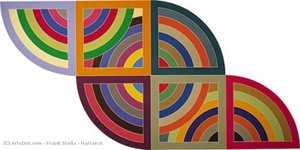
To stand before a work like Harran II is not merely to observe paint on canvas; it is to engage in an optical dialogue with the artist’s intellect. This piece, dating from 1967, captures a pivotal moment in modern art—a decisive pivot away from gestural excess toward rigorous, almost architectural clarity. Frank Stella, whose career was defined by his refusal to accept established boundaries, presents here a vision built entirely upon the foundational elements of color and form. The overall impression is one of controlled energy; a vibrant, pulsating grid where every concentric band seems to hum with contained visual vibration.
A Masterclass in Op Art and Color Theory
The composition itself is breathtakingly systematic. It unfolds as a perfect quadrant division, a symmetrical arrangement that lends the piece an inherent sense of order, almost like a scientific diagram rendered in jewel tones. The palette—a sophisticated interplay of greens, oranges, browns, blues, and purples—is deployed with remarkable precision. Stella eschews narrative entirely; there is no subject to decipher save for the pure relationship between adjacent hues. This dedication to non-representational form places Harran II firmly within the lineage of Op Art, yet it carries a distinctly American punch, one that refuses to be purely academic. The technique speaks of meticulous application—flat planes of color meeting with razor-sharp definition, suggesting either the disciplined hand of an expert painter or the clean lines of modern printing processes.
Historical Resonance and Artistic Intent
Contextually, this work emerges from a period when Abstract Expressionism’s emotional outpouring began to feel exhausted. Stella, influenced by masters who valued structure over spontaneous outburst, steered painting toward a more intellectual engagement. Harran II embodies that shift. It is an assertion of pictorial autonomy—the canvas becomes a self-contained universe governed only by its own internal logic. The repetition inherent in the concentric circles suggests themes of cyclical nature, pattern recognition, and perhaps even the very mechanics of perception itself. For the contemporary collector or designer, this translates into a piece that anchors a space with sophisticated, thoughtful dynamism.
Emotional Impact and Decorative Potential
What makes this artwork so compelling for interior design is its ability to act as a visual catalyst. It does not whisper; it resonates. The crisp edges and vibrant color shifts provide an immediate focal point, injecting a controlled burst of energy into any room. While the subject matter remains purely abstract, the emotional impact is anything but coolly academic. Instead, one feels a sense of harmonious complexity—the feeling of solving a beautiful, intricate puzzle. Owning a reproduction of Harran II is acquiring not just decoration, but a conversation piece that speaks volumes about an appreciation for modernist rigor and the sublime power of pure visual structure.
Questions & Answers
Can I watch "Harran II" as a full-screen slideshow?
A slideshow is available: the Diaporama page of "Harran II" by Frank Stella.
What colors dominate "Harran II" by Frank Stella?
The color identity of "Harran II" by Frank Stella: a neutrals palette, dominated by espresso (#3b4348).
Where can I find artworks similar to "Harran II" by Frank Stella?
Artworks similar to "Harran II" by Frank Stella are gathered on the artwork's Similars page.
Related Artworks


Artist Biography
A Life Dedicated to the Essence of Painting
Frank Stella, who passed away on May 4, 2024, at the age of 87, was a towering figure in American art, a relentless innovator whose career spanned seven decades and challenged conventional notions of painting, sculpture, and architectural design. Born in Malden, Massachusetts, in 1936 to first-generation Italian-American parents, Stella’s artistic journey began with an early exposure to the visual world through his mother's landscape paintings and a formative education at Phillips Academy Andover, where he encountered the rigorous color theories of Josef Albers and the expressive power of Hans Hofmann. These influences, coupled with studies in history at Princeton University and frequent trips to New York City galleries, laid the groundwork for a radical departure from the prevailing Abstract Expressionism of the time. Stella wasn’t interested in the emotional turmoil or subjective gesture that defined artists like Pollock and Kline; he sought something purer, more objective—a distillation of painting down to its most fundamental elements.Rejecting Illusion: The Rise of Minimalism
Stella's emergence onto the art scene in the late 1950s was nothing short of revolutionary. He famously declared that “a painting should be a flat surface with paint on it—nothing more,” a statement that became a manifesto for the burgeoning Minimalist movement. This philosophy materialized most strikingly in his *Black Paintings* (1958-1960), a series of canvases defined by precisely spaced, symmetrical black stripes separated by bands of exposed canvas. Works like Die Fahne Hoch! (1959) – a title deliberately provocative, referencing the Nazi anthem – weren’t intended as expressions of political sentiment but rather as explorations of form and surface, challenging viewers to confront the painting as an object in itself. The deliberate coolness and rejection of emotional content were jarring at the time, signaling a decisive break from Abstract Expressionism's emphasis on subjective experience. He wasn’t aiming to depict something *about* the world; he was presenting the world—or rather, the painting—as it *is*. This focus on materiality and geometric precision extended into his shaped canvases of the 1960s, where Stella abandoned the traditional rectangular format in favor of complex polygons, often crafted from aluminum and copper paint. These weren’t merely paintings; they were sculptural objects that blurred the boundaries between two and three dimensions, further emphasizing the artwork's physical presence.Expanding Boundaries: From Protractor Series to Maximalism
The 1970s marked a period of significant experimentation for Stella. The *Protractor Series* (1971) saw him introduce sweeping arcs and vibrant colors arranged within square borders, creating dynamic compositions inspired by the circular cities he visited in the Middle East. Simultaneously, Stella embraced printmaking with enthusiasm, mastering techniques like lithography, screenprinting, and etching to create abstract prints that echoed his painting’s geometric vocabulary. His engagement extended beyond the visual arts; he designed sets and costumes for Merce Cunningham's dance piece *Scramble* in 1967, demonstrating a willingness to collaborate across disciplines. A retrospective at the Museum of Modern Art in 1970—a remarkable achievement for an artist still so young—cemented his status as a leading figure in contemporary art. However, Stella wasn’t content to rest on his laurels. He began incorporating relief into his work, gradually evolving towards what could be described as “maximalist” painting with sculptural qualities, utilizing collage elements and aluminum supports.A Legacy of Innovation
Stella's later career witnessed a dramatic shift in style. The austere geometry of his earlier works gave way to exuberant compositions characterized by curving forms, bold colors, and seemingly spontaneous brushstrokes—a move towards a more baroque aesthetic that surprised many but demonstrated his unwavering commitment to artistic exploration. His commission for the BMW Art Car Project in 1976 showcased his ability to adapt his distinctive drawing style to an unconventional canvas: a 3.0 CSL racing car. Throughout his life, Stella received numerous accolades, including the National Medal of Arts in 2009 and the Lifetime Achievement Award in Contemporary Sculpture from the International Sculpture Center in 2011. Frank Stella’s impact on art history is undeniable. He didn't just create paintings; he redefined what a painting *could be*. His relentless pursuit of formal clarity, his rejection of illusionism, and his willingness to push boundaries paved the way for generations of artists who followed, solidifying his place as one of the most important and influential figures of the 20th and 21st centuries. He leaves behind not only a vast body of work but also a legacy of intellectual rigor and artistic courage that will continue to inspire for years to come.
Frank Stella
1936 - 2024 , United States
Quick Facts
- Full Name: Frank Philip Stella
- Nationality: American
- Date Of Birth: 1936
- Date Of Death: May 4, 2024
- Place Of Birth: Malden, United States of America
- Notable Artworks:
- Die Fahne Hoch!
- Louisiana Lottery Co.
- Wolfeboro IV
- Artistic Movement Or Style:
- Minimalism
- Post-Painterly Abstraction
- Artists Who Influenced This Artist:
- Josef Albers
- Hans Hofmann
- Jackson Pollock
- Franz Kline
- Artists Or Movements Influenced By This Artist:
- Minimalism
- Geometric abstraction
Related Articles

Beyond Aesthetic Harmony: Custom Art & the Psychology of Interior Narrative
Explore the profound impact of art on interior psychology & wellbeing. Discover how curated collections & bespoke artwork transform spaces into emotionally resonant narratives. Expert guidance for personalized design.

Geometric Abstraction's 10 Defining Masterpieces | Art for Your Home - ArtsDot
Explore 10 defining masterpieces of Geometric Abstraction! Discover Kandinsky, Mondrian & Malevich’s iconic works. Find museum-quality art reproductions and curated decor ideas to elevate your home at ArtsDot.com.
Harmonies in Abstraction: Cultivating a Narrative Through Palette, Mood, and Technique in the Contemporary Collection
Explore the world of contemporary abstract art with expert guidance from ArtsDot. Discover key artists, investment insights & build a collection that resonates. Museum-quality paintings available.
De Stijl Explained: The Bold Art Movement That Redefined Modern Design and Universal Harmony
Discover the profound beauty of De Stijl. Explore how masters like Piet Mondrian used geometric abstraction and primary colors to seek universal harmony. Perfect for art enthusiasts looking to bring bold, modern sophistication into their home decor through timeless abstract mastery.

Clyfford Still's Abstract Expressionism: A Study of Color, Form & the Existential Landscape
Explore the profound world of Clyfford Still's Abstract Expressionism with ArtsDot. Discover his unique style, existential themes & investment potential. Expert analysis for discerning collectors.