Preview
 Send
Send Share
Share
 Details
 Guide
Guide

 Download
 Similars
 X-Ray
X-Ray Diaporama
 Stats
StatsTime Saving Truth from Falsehood and Envy
 Oil On Canvas
- WallArt
- Rococo
 1737
1737- Early Modern
 149.0 x 114.0 cm
 Wallace Collection
 Read More
Giclée / Art Print
Museum-quality giclée or canvas print with fast production and flexible finish options. ( Buy Hand Made Painting Switch to Digital Image)




P118B $10

P118H $10

P118W $10

P438Z $10

P508JH $12

P508YH $12

P805H $10

P805Z $10

P919BZ $10

P919G $10

P919XJ $10

P959ZH $10

P968JZ $12

W106C $8

W218G $10

W218JH $8

W218Y $10

W307PJ $10

W316G $10

W316PJ $8

W316Y $10

W398PJ $8

W4111J $10

W500HY $15

W500JH $15

W692G $12

W849H $8

W940BG $15

W953PJ $8




Pick from our preset sizes that match the artwork's original proportions.

You may enter your own dimensions to fit a specific frame or space. If your selected size does not match the original image's proportions, we will either crop the artwork or extend the image with a mirrored or solid-fill edge. A digital mockup will be sent for your approval before production begins.
Please note that the on-screen preview does not reflect the actual cropping or extension. Only the mockup will accurately show the final composition.
While custom sizes are available, we recommend selecting a dimension from the predefined list to preserve the original proportions.
Worldwide Delivery () in 2 weeks instead of standard 4/5 weeks. (25 September)

Free Worldwide Express Shipping

High-Quality Linen Canvas

Full Shipping Insurance

Customs Tax Refund Guarantee

True Color Matching Guarantee

100-Day Return Policy (Defects Only)

100% Money-Back Guarantee

Bulk Discount Offer
 Glass option is only available in size under 110 CM

Time Saving Truth from Falsehood and Envy
Giclée / Art Print
Reproduction Size
-


Total Price
$ 63
The Drama of Choice: Adam and Eve in Rococo Allegory
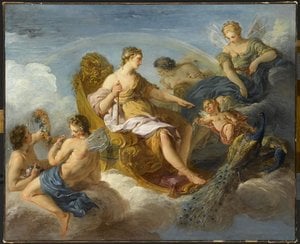
To gaze upon this magnificent canvas, Time Saving Truth from Falsehood and Envy, is to be drawn into the very crucible of human decision. François Lemoyne masterfully captures not merely a biblical narrative, but a profound psychological struggle played out in the hallowed grounds of Eden. The composition centers on Adam and Eve, depicted in an embrace that speaks volumes—a moment suspended between divine grace and tempting transgression. Yet, this intimacy is immediately complicated by the surrounding chaos. They are not alone; they are besieged. Angels, representing celestial guidance and pure truth, clash visually with darker, more turbulent figures embodying falsehood and envy. The air itself seems thick with unspoken conflict, making the viewer an immediate participant in this eternal drama of free will.
A Masterpiece of Rococo Grandeur
Painted in 1737, this work stands as a quintessential example of late Baroque transitioning into the efflorescence of the Rococo period. Lemoyne, celebrated for his ability to imbue large-scale allegories with both intellectual weight and emotional immediacy, utilizes the grandeur associated with classical painting while retaining the delicate, dramatic flair characteristic of the era. His technique allows the narrative intensity—the struggle between light and shadow, virtue and temptation—to leap off the canvas. The brushwork, though highly skilled, never sacrifices storytelling for mere display; every gesture, every outstretched hand, contributes to the overarching tension that defines the piece.
Symbolism Woven into the Scene
The symbolism here is rich and multi-layered, inviting deep contemplation from any admirer of art history. The Garden of Eden itself functions as a microcosm of the human soul—a place of perfect potential marred by external pressures. The central couple embodies humanity at its most vulnerable and potent. The surrounding figures are not mere background decoration; they are active forces. They represent the internal battles we wage daily: the seductive whisper of doubt against the steady glow of conviction. Owning a reproduction of this piece allows one to bring such profound philosophical depth into a modern interior space, turning a gallery wall into a meditation chamber.
Crafting an Atmosphere of Intense Drama
For collectors and designers alike, the emotional impact of Time Saving Truth from Falsehood and Envy is undeniable. It possesses a dramatic sweep that elevates any room it graces. The palette, characteristic of Lemoyne’s mature style, balances rich, saturated tones with ethereal highlights, ensuring that even in reproduction, the painting retains its luminous quality. It speaks to those who appreciate art that demands engagement—a piece that does not simply hang on the wall but actively participates in the life and conversation of a room. It is an heirloom of allegory, promising endless contemplation.
Related Artworks


Artist Biography
A Parisian Legacy in Rococo Splendor
François Lemoyne, a name perhaps less immediately recognized than those of his contemporaries Boucher or Watteau, nevertheless occupies a significant position within the tapestry of 18th-century French art. Born in Paris in 1688, Lemoyne dedicated his life to reviving the grandeur of large-scale allegorical painting—a tradition that had somewhat waned since the era of Charles Le Brun, whom Lemoyne deeply admired and sought to emulate. His ambition was not merely to decorate, but to create works imbued with intellectual weight and emotional resonance, reflecting the complex spirit of the Rococo period while simultaneously harking back to a more classical ideal. From his early training under his stepfather, Robert le Vrac, and later within the rigorous environment of the Académie Royale de peinture et de sculpture, Lemoyne demonstrated a dedication to mastering both technical skill and artistic expression. His formal education with Louis Galloche and Pierre-Jacques Cazes proved formative, particularly in developing his nuanced understanding of color—a characteristic that would become increasingly prominent throughout his career. The coveted Prix de Rome in 1711 marked a pivotal moment, though financial constraints initially delayed his journey to Italy; a trip he eventually undertook in 1723 accompanying François Berger.Italian Echoes and Rococo Flourishes
The sojourn to Italy proved transformative for Lemoyne. Immersing himself in the works of Renaissance masters like Raphael, Correggio, and Titian, he absorbed their techniques and aesthetic principles, enriching his artistic vocabulary. However, it was the dynamic energy of Peter Paul Rubens that left an indelible mark on his style—evident in his vibrant color palettes and dramatic compositions. Exposure to Venetian painting within Pierre Crozat’s renowned collection further refined his sensibilities, fostering a love for rich textures and atmospheric effects. These influences coalesced into a distinctly Rococo aesthetic characterized by elegance, ornamentation, and a focus on decorative beauty. Yet, Lemoyne never fully abandoned the ambition of grand narrative that defined earlier French academic painting; he sought to synthesize these seemingly disparate elements—the lightness and grace of the Rococo with the intellectual rigor of the classical tradition. This unique blend is what sets his work apart and contributes to its enduring appeal.Versailles and Royal Recognition
Lemoyne’s artistic prowess found its most spectacular expression in his monumental ceiling frescoes, notably L'Apothéose d'Hercule (The Apotheosis of Hercules) at the Salon d’Hercule within the Palace of Versailles. This masterpiece—a dazzling display of illusionistic technique and dynamic composition—immediately garnered widespread acclaim. Contemporaries like Voltaire and Cardinal Fleury lauded its brilliance, recognizing Lemoyne as a master of his craft. Beyond Versailles, he also undertook significant religious commissions, such as The Transfiguration in the chancel of the Jacobin Church (now Parish Church of St. Thomas d’Aquin) in Paris, demonstrating his versatility and ability to adapt his style to different subject matter. In 1736, Lemoyne reached the pinnacle of his career with his appointment as Premier peintre du roi (First Painter to the King) under Louis XV—a testament to his artistic achievements and standing within the French court.A Tragic End and Lasting Influence
Despite achieving such heights, Lemoyne’s life was tragically cut short by suicide in 1737. His untimely death marked not only a personal loss but also signaled a shift in artistic tastes; it coincided with a decline in popularity for the large-scale allegorical ceiling paintings he so passionately championed. Nevertheless, his legacy endured through his students, including prominent artists such as Charles-Joseph Natoire and François Boucher, to whom he imparted his knowledge and skills. While perhaps not as universally celebrated today as some of his contemporaries, Lemoyne’s contributions to French Rococo art are increasingly appreciated for their technical mastery, artistic ambition, and the unique synthesis of classical ideals with the prevailing aesthetic sensibilities of his time. His works remain a testament to a dedicated artist who sought to elevate painting to its highest form—a legacy that continues to inspire and captivate audiences centuries later.Key Works & Artistic Contributions
- Ceiling Frescoes: Lemoyne’s most celebrated achievements, exemplified by L'Apothéose d'Hercule, showcase his mastery of illusionistic techniques and dynamic composition.
- Mythological Scenes: Works like Hercules and Omphale demonstrate his ability to depict classical narratives with both dramatic intensity and sensual grace.
- Religious Paintings: The Transfiguration exemplifies his skill in rendering religious subjects with emotional depth and technical precision.
- Portraiture: His portrait of Head of King Louis XV, reveals a subtle understanding of character and a mastery of charcoal and pastel techniques.

François Lemoyne
1688 - 1737 , France
Quick Facts
- Artistic Movement Or Style: Rococo
- Artists Or Movements Influenced By This Artist:
- Natoire
- Boucher
- Artists Who Influenced This Artist:
- Rubens
- Raphael
- Correggio
- Titian
- Cazes
- Date Of Birth: 1688
- Date Of Death: 1737
- Full Name: François Lemoyne
- Nationality: French
- Notable Artworks:
- The Apotheosis of Hercules
- Hercules and Omphale
- Perseus and Andromeda
- Head of King Louis XV
- The Transfiguration
- Other Names: François Le Moine
- Place Of Birth: Paris, France
Related Articles

Echoes of Time: Exploring the Enduring Appeal & Historical Context of Vintage Art Prints
Explore the captivating world of vintage art prints! Discover their history, collecting tips & enduring appeal. Expert insights on chromolithography and building a legacy collection with ArtsDot.

Giclée Prints: Archival Quality & Aesthetic Nuances for the Discerning Collector
Explore the world of giclée prints with ArtsDot. Learn about archival quality, aesthetic nuances & investment potential. Expert guidance for discerning art collectors seeking museum-quality reproductions and lasting value.

The Enduring Legacy of Fine Art Prints: Technique, History & Aesthetic Impact
Explore the rich history & techniques of fine art prints. Discover investment potential, assess authenticity, and learn how to preserve your collection with expert guidance. Trusted insights for discerning collectors.

Rococo's Radiant Legacy: 10 Masterpieces for Your Home |
Indulge in the elegance of Rococo! Explore 10 masterpieces by Fragonard, Boucher & Watteau. Discover the stories behind these iconic paintings and bring timeless art to your home with museum-quality reproductions from .

The Rococo Aesthetic: Opulence, Rebellion & the Pursuit of Pleasure in 18th-Century Art
Explore the opulent world of Rococo art! Discover its origins, key artists like Watteau & Boucher, and lasting influence on design. Expert insights for collectors & enthusiasts.