


The picture follows your choices: , .
Collectible Description
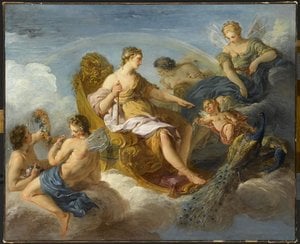
Admire François Lemoyne's masterpiece 'L'Olympe,' a stunning Rococo depiction of mythological figures bathed in ethereal light, inspired by Rubens and executed with meticulous detail.
 Read More
Artist Biography
François Lemoyne (1688-1737): Parisian Rococo painter reviving grand allegories & influenced by Rubens. Explore his legacy of elegance & Baroque splendor!
Hand Made Oil Reproduction
Hand-painted oil on canvas in your size and frame, made to order by our artists. ( Switch to Print Switch to Digital Image)
More about this painting
 Preview
 Send
Send Share
Share
 Details
 Guide
Guide

 Download
 Similars
 X-Ray
X-Ray Diaporama
 Q&A
Q&A Stats
StatsOrder your painting in four simple steps
Take your time. You can change any answer; the price in your order card follows each choice.
1 Step one of four
Which size would you like?
These sizes keep the proportions of the original painting. The drawing shows your choice on a wall, above a two-metre sofa.
Or give your own measurements
Pick from our preset sizes that match the artwork's original proportions.

Type the width and the height you need, to fit your frame or your wall. This is hand-painted, so for a size with a different shape the artist can paint a bit more around the picture, or cut a bit — you choose. We send you a digital mockup to approve before the painting starts. The picture shown on this page does not show the real result — only the mockup does.
2 Step two of four
How should it be prepared: rolled, stretched or framed?
The prices below are for the size you chose in step one.
Choose the edges of the stretched canvas
Choose your frame

White $1

Blurside $1

Extended $1

P118B $10

P118H $10

P118W $10

P438Z $10

P508JH $12

P508YH $12

P805H $10

P805Z $10

P919BZ $10

P919G $10

P919XJ $10

P959ZH $10

P968JZ $12

W106C $8

W218G $10

W218JH $8

W218Y $10

W307PJ $10

W316G $10

W316PJ $8

W316Y $10

W398PJ $8

W4111J $10

W500HY $15

W500JH $15

W692G $12

W849H $8

W940BG $15

W953PJ $8

H24-GOLD $30

H24-SILVER $30

H36-GOLD $45

H36-SILVER $45
Framed
Moulding: . Overall size with the frame: .
3 Step three of four
Would you like anything changed in the painting?
Most people answer no. Because each painting is made by hand, our artist can also adapt it for you.
After order, ArtsDot.com team will email client for instructions and provide a mockup preview
4 Step four of four
A few finishing options
All of them are optional. The answers already selected cost nothing extra.
Who paints it?
Worldwide Delivery () in 3/4 weeks instead of standard 5 weeks. (4 November). No compromise on quality.
A nameplate, as in a museum?
Engraved Bronze Plaque Details
This elegant plaque features the artist's name and the title of the artwork, finely engraved for a timeless presentation.
It is made from bronze with a refined, elegant finish. The text is precisely laser-engraved for a sharp and permanent result. Measuring 9x2 cm, the plaque is compact yet easy to read. It's built to be durable and scratch-resistant, offering a professional, museum-quality look. Mounting is simple thanks to the included adhesive backing.
Transparent Acrylic Plaque Details
The plaque includes essential engraved details such as the artist's name, the title of the artwork, the date it was created, the type of media used-like oil on canvas or watercolor-a brief description of the piece, and a QR code that links to the complete artwork information.
It is crafted from clear acrylic, offering a sleek, modern appearance. The text is UV-engraved in black to ensure strong visual contrast. With a size of 10x15 cm, it ensures optimal readability. It comes equipped with two metal hooks for secure wall mounting. The plaque is designed to be weather-resistant, making it suitable for various environments, and it includes interactive features that work seamlessly with smartphone scanning.
Black Acrylic Plaque Details
This elegant plaque includes engraved information such as the artist's name, the title of the artwork, the date it was created, the type of media used (like oil on canvas or watercolor), a short description of the artwork, and a QR code for quick access to more information.
The plaque itself is made from refined black acrylic with a premium finish. The text is laser-engraved in white for high contrast and readability. Its size is 10x15 cm, designed to be easy to read. It comes with two metal hooks for professional mounting. The design is sleek and fits any interior style. It is also weather-resistant and durable, with built-in digital integration for mobile compatibility.
A protective varnish?
When do you need it?
✓ Check and order
Your painting, as you ordered it

L'Olympe
Reproduction Medium
Reproduction Size
-

Elite Senior Artist
More detail, finesse, and extra production time
-

Reproduction Frame
-
-
For artworks or reproductions larger than 105 cm (approximately 41 inches) on any side, the frame will be shipped as a kit, disassembled. This method ensures safe delivery and prevents damage during transport.
Professional assembly required - this is not a DIY product.
The kit must be assembled and the canvas stretched by an experienced professional framer, using wood glue (not supplied), a canvas stretching plier and clamps to hold the bars square while the glue dries. Incorrect assembly or uneven canvas tension can permanently damage the artwork and is not covered by our warranty.
 For artworks or reproductions larger than 105 cm (approximately 41 inches) on any side, the frame will be shipped as a kit, disassembled. This method ensures safe delivery and prevents damage during transport.
All solid wood bars are included, precisely cut to size.
Assembled with the screws provided, plus wood glue for the corner joints, which is not supplied and must be sourced by your framer.
Professional tools are required and not included: a canvas stretching plier (tensioner) and clamps to hold the bars square while the glue dries.
Important:
The corner joints require wood glue, the bars must be held with clamps until the glue is fully dry, and tightening the canvas on the assembled frame requires a canvas stretching plier. None of these are included in the kit. Please arrange an experienced professional framer before ordering this size.

Nameplate
-
-

Protective Varnish
Glossy Varnish (enhances colors, protects against light/moisture)
-

Customize My Artwork
Examples of what can be changed: Replace face with customer photo; Add pet (e.g., replace cat with dog); Include hidden message in background; Change background landscape or elements.
-

Urgent
Worldwide Delivery () in 3/4 weeks instead of standard 5 weeks. (4 November). No compromise on quality.
-
Express Shipping
Worldwide Delivery () in 5 weeks. (11 November).
Included
Total Price
$ 613
Glass option is only available in size under 110 CM
Included with every order
- Free Worldwide Express Shipping
- High-Quality Linen Canvas
- Full Shipping Insurance
- Customs Tax Refund Guarantee
- True Color Matching Guarantee
- 100-Day Return Policy (Defects Only)
- 100% Money-Back Guarantee
- Bulk Discount Offer


L'Olympe: A Baroque Echo in Rococo Elegance
François Lemoyne’s “L’Olympe,” created around 1730, stands as a testament to the artistic fervor of Louis XV’s court and embodies the complex fusion of styles that characterized Rococo art. Unlike the monumental grandeur of Baroque predecessors championed by Bernini and Caravaggio, Lemoyne opted for a more intimate scale—a rectangular canvas measuring approximately 39.4 x 25.6 inches—yet he achieved an astonishing level of visual richness and emotional depth. This artwork isn’t merely decorative; it's a carefully crafted meditation on divine majesty filtered through the lens of humanist sensibilities, reflecting the prevailing intellectual currents of its time.Composition and Style: A Dynamic Dialogue Between Tradition and Innovation
The painting’s composition immediately draws the viewer into a swirling vortex of figures—a deliberate departure from the static hierarchies typical of earlier artistic conventions. Lemoyne skillfully employs asymmetrical balance, placing dominant groupings of nude or partially clothed deities in positions that command attention without resorting to rigid formality. The absence of a central focal point encourages contemplation and invites viewers to explore the intricate relationships between the characters depicted. This dynamic arrangement aligns with Baroque principles of movement and theatricality but is tempered by the delicate brushwork and pastel hues characteristic of Rococo, signaling Lemoyne’s embrace of a more refined aesthetic. Influenced profoundly by Rubens' dramatic chiaroscuro technique, Lemoyne nevertheless prioritized luminosity and ethereal beauty—a hallmark of his distinctive style.Color Palette and Technique: Light as Divine Inspiration
Lemoyne’s masterful manipulation of color contributes significantly to the artwork’s emotive power. The dominant palette consists of soft blues, creams, pinks, and golds—colors that coalesce into a luminous effect suggestive of divine radiance. These hues are layered with subtle variations in tone and shade, creating an illusion of depth and volume that transcends mere surface appearance. Delicate brushstrokes meticulously blend pigments to achieve seamless transitions between shades, enhancing the overall sense of fluidity and grace. Lemoyne’s technique involved applying thin glazes of oil paint—a painstaking process designed to maximize luminosity and capture the subtle nuances of light—demonstrating a dedication to mastering the highest standards of artistic craftsmanship.Symbolism and Emotional Resonance: Reflections of Celestial Glory
“L’Olympe” is replete with symbolic references to classical mythology, portraying scenes from Olympus—the abode of Zeus and his Olympian gods—that resonate with themes of power, beauty, and immortality. The figures themselves embody idealized forms of human perfection, reflecting the humanist ideals prevalent during Lemoyne's era. Their poses convey a sense of serenity and contemplation, inviting viewers to contemplate the sublime grandeur of creation. More than just an aesthetically pleasing spectacle, “L’Olympe” communicates profound emotional resonance—a feeling of awe and wonder at the majesty of divine presence—solidifying Lemoyne’s legacy as one of the foremost artists of his generation.Historical Context: The Courtly Embrace of Baroque Legacy
Created during Louis XV's reign, "L'Olympe" exemplifies the Rococo movement's ambition to recapture the grandeur and theatricality of Baroque art while simultaneously prioritizing elegance and refinement. Lemoyne’s work stands as a pivotal moment in artistic history—a harmonious blend of stylistic influences that cemented Rococo’s position as the dominant aesthetic sensibility of the French court. Its enduring appeal testifies to the timeless beauty of classical ideals combined with humanist sensibilities, ensuring “L'Olympe” continues to inspire admiration and contemplation centuries after its creation.Questions & Answers
Toward which tone does "L'Olympe" lean?
An ochre to sepia hue runs through "L'Olympe" by François Lemoyne.
What other names is François Lemoyne known by?
Other names recorded for François Lemoyne, creator of "L'Olympe", include François Le Moine.
Where does "L'Olympe" stand among François Lemoyne's recurring subjects?
"L'Olympe" depicts mythology, celestial figures, allegory, classical influence, religious symbolism, decorative art, baroque style, while François Lemoyne's recorded themes are inspired by rubens’ grandeur, religious allegory, divine grace, reflecting aristocratic taste, central to lemoyne’s legacy. Comparing the two shows how the work relates to the artist's usual subjects.
Related Artworks


François Lemoyne
1688 - 1737, France
Artist Biography
A Parisian Legacy in Rococo Splendor
François Lemoyne, a name perhaps less immediately recognized than those of his contemporaries Boucher or Watteau, nevertheless occupies a significant position within the tapestry of 18th-century French art. Born in Paris in 1688, Lemoyne dedicated his life to reviving the grandeur of large-scale allegorical painting—a tradition that had somewhat waned since the era of Charles Le Brun, whom Lemoyne deeply admired and sought to emulate. His ambition was not merely to decorate, but to create works imbued with intellectual weight and emotional resonance, reflecting the complex spirit of the Rococo period while simultaneously harking back to a more classical ideal. From his early training under his stepfather, Robert le Vrac, and later within the rigorous environment of the Académie Royale de peinture et de sculpture, Lemoyne demonstrated a dedication to mastering both technical skill and artistic expression. His formal education with Louis Galloche and Pierre-Jacques Cazes proved formative, particularly in developing his nuanced understanding of color—a characteristic that would become increasingly prominent throughout his career. The coveted Prix de Rome in 1711 marked a pivotal moment, though financial constraints initially delayed his journey to Italy; a trip he eventually undertook in 1723 accompanying François Berger.Italian Echoes and Rococo Flourishes
The sojourn to Italy proved transformative for Lemoyne. Immersing himself in the works of Renaissance masters like Raphael, Correggio, and Titian, he absorbed their techniques and aesthetic principles, enriching his artistic vocabulary. However, it was the dynamic energy of Peter Paul Rubens that left an indelible mark on his style—evident in his vibrant color palettes and dramatic compositions. Exposure to Venetian painting within Pierre Crozat’s renowned collection further refined his sensibilities, fostering a love for rich textures and atmospheric effects. These influences coalesced into a distinctly Rococo aesthetic characterized by elegance, ornamentation, and a focus on decorative beauty. Yet, Lemoyne never fully abandoned the ambition of grand narrative that defined earlier French academic painting; he sought to synthesize these seemingly disparate elements—the lightness and grace of the Rococo with the intellectual rigor of the classical tradition. This unique blend is what sets his work apart and contributes to its enduring appeal.Versailles and Royal Recognition
Lemoyne’s artistic prowess found its most spectacular expression in his monumental ceiling frescoes, notably L'Apothéose d'Hercule (The Apotheosis of Hercules) at the Salon d’Hercule within the Palace of Versailles. This masterpiece—a dazzling display of illusionistic technique and dynamic composition—immediately garnered widespread acclaim. Contemporaries like Voltaire and Cardinal Fleury lauded its brilliance, recognizing Lemoyne as a master of his craft. Beyond Versailles, he also undertook significant religious commissions, such as The Transfiguration in the chancel of the Jacobin Church (now Parish Church of St. Thomas d’Aquin) in Paris, demonstrating his versatility and ability to adapt his style to different subject matter. In 1736, Lemoyne reached the pinnacle of his career with his appointment as Premier peintre du roi (First Painter to the King) under Louis XV—a testament to his artistic achievements and standing within the French court.A Tragic End and Lasting Influence
Despite achieving such heights, Lemoyne’s life was tragically cut short by suicide in 1737. His untimely death marked not only a personal loss but also signaled a shift in artistic tastes; it coincided with a decline in popularity for the large-scale allegorical ceiling paintings he so passionately championed. Nevertheless, his legacy endured through his students, including prominent artists such as Charles-Joseph Natoire and François Boucher, to whom he imparted his knowledge and skills. While perhaps not as universally celebrated today as some of his contemporaries, Lemoyne’s contributions to French Rococo art are increasingly appreciated for their technical mastery, artistic ambition, and the unique synthesis of classical ideals with the prevailing aesthetic sensibilities of his time. His works remain a testament to a dedicated artist who sought to elevate painting to its highest form—a legacy that continues to inspire and captivate audiences centuries later.Key Works & Artistic Contributions
- Ceiling Frescoes: Lemoyne’s most celebrated achievements, exemplified by L'Apothéose d'Hercule, showcase his mastery of illusionistic techniques and dynamic composition.
- Mythological Scenes: Works like Hercules and Omphale demonstrate his ability to depict classical narratives with both dramatic intensity and sensual grace.
- Religious Paintings: The Transfiguration exemplifies his skill in rendering religious subjects with emotional depth and technical precision.
- Portraiture: His portrait of Head of King Louis XV, reveals a subtle understanding of character and a mastery of charcoal and pastel techniques.



Related Articles

Simon Vouet: A Baroque Master's Journey from Italian Influence to French Classicism
Explore the life & art of Simon Vouet, a pivotal French Baroque painter who introduced Italian styles to France. Discover his masterpieces and lasting influence on 17th-century art.

Rococo's Radiant Legacy: 10 Masterpieces for Your Home |
Indulge in the elegance of Rococo! Explore 10 masterpieces by Fragonard, Boucher & Watteau. Discover the stories behind these iconic paintings and bring timeless art to your home with museum-quality reproductions from .

The Rococo Aesthetic: Opulence, Rebellion & the Pursuit of Pleasure in 18th-Century Art
Explore the opulent world of Rococo art! Discover its origins, key artists like Watteau & Boucher, and lasting influence on design. Expert insights for collectors & enthusiasts.