Preview
 Send
Send Share
Share
 Details

 Download
 Similars
 X-Ray
X-Ray Diaporama
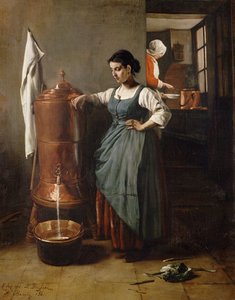
Peasant knitting
 Read More
Hand Made Oil Reproduction
Hand-painted oil on canvas in your size and frame, made to order by our artists. ( Switch to Print Switch to Image)




































Pick from our preset sizes that match the artwork's original proportions.

You may enter your own dimensions to fit a specific frame or space. If your selected size does not match the original image's proportions, we will either crop the artwork or extend the painting with additional hand-painted elements. A digital mockup will be sent for your approval before production begins.
Please note that the on-screen preview does not reflect the actual cropping or extension. Only the mockup will accurately show the final composition.
While custom sizes are available, we recommend selecting a dimension from the predefined list to preserve the original proportions.
After order, ArtsDot.com team will email client for instructions and provide a mockup preview
Worldwide Delivery () in 3/4 weeks instead of standard 5 weeks. (11 August). No compromise on quality.

Free Worldwide Express Shipping

High-Quality Linen Canvas

Full Shipping Insurance

Customs Tax Refund Guarantee

True Color Matching Guarantee

60-Day Return Policy (Defects Only)

100% Money-Back Guarantee

Bulk Discount Offer
 Glass option is only available in size under 110 CM

Peasant knitting
Reproduction Medium
Reproduction Size
-


Total Price
$ 263
Artist Biography
The Quiet Observer: The Life and Legacy of François Bonvin
In the bustling, transformative landscape of nineteenth-century Paris, where the shadows of the Industrial Revolution began to lengthen over the city's cobblestone streets, there existed a painter who found profound beauty in the most unassuming corners of existence. François Bonvin (1817–1887) was not a chronicler of grand historical battles or mythological epodes; instead, he was a master of the intimate, a realist whose brush captured the silent dignity of the everyday. His life, marked by early hardship and a resilient spirit, mirrored the very subjects he painted—unadorned, honest, and deeply human.
Born into humble circumstances as the son of a police officer and a seamstress, Bonvin’s childhood was far from the romanticized version of Parisian life often depicted in literature. The loss of his mother to tuberculosis when he was only four years old left him vulnerable to a world of scarcity and neglect. Raised in a crowded household with numerous siblings and facing the harsh realities of an undernourished upbringing, these early struggles instilled in him a profound empathy for the marginalized. It was this sensitivity that would later define his artistic vision, allowing him to see the poetic weight in a simple basket of fruit or the quiet labor of a domestic worker.
A Journey Through Light and Shadow
Bonvin’s path to artistry was as much a product of grit as it was of talent. While his formal education began at the École de dessin, supported by the generosity of a family friend, much of his true development occurred through solitary devotion and self-study. His time apprenticed to a printer provided him with a disciplined eye for detail, but it was his frequent pilgrimages to the Louvre that truly sculpted his soul. There, amidst the masterpieces of the past, he found his spiritual ancestors. He became deeply enamored with the Dutch Old Masters, particularly the dramatic chiaroscuro of Rembrandt and the spirited brushwork of Frans Hals.
This fascination with Northern European traditions allowed Bonvin to develop a technique that was uniquely his own—a blend of French precision and Dutch tonal depth. He mastered the art of capturing light as it falls upon varied textures: the cold sheen of a metal cup, the soft fuzz of a ripening strawberry, or the heavy, organic weight of an oyster shell. His work often features a muted, earthy palette that avoids the garishness of contemporary trends, opting instead for a nuanced gradation of tones that creates a sense of palpable atmosphere and stillness.
The Art of the Everyday
The significance of Bonvin’s oeuvre lies in its ability to elevate the mundane to the monumental. His paintings often function as windows into the private, domestic spheres of nineteenth-century France. Whether depicting a still life with four fruits or the poignant scene of A Woman Ironing, there is an unmistakable sense of presence and respect for the subject matter. He did not seek to embellish reality but to honor it.
His contributions to the Realist movement can be summarized through several key artistic hallmarks:
- Mastery of Texture: An exquisite ability to render the tactile qualities of food, ceramics, and cloth.
- Chiaroscuro Influence: The use of dramatic light and shadow to create depth and emotional resonance.
- Empathetic Realism: A focus on the dignity of ordinary life and the beauty found in domesticity.
- Tonal Nuance: A sophisticated approach to color that favors subtle, atmospheric transitions over bold pigments.
Though he may not have achieved the widespread fame of his contemporaries like Courbet, François Bonvin remains a vital figure for those who seek the soul within the ordinary. His legacy is found in every stroke that celebrates the quiet, the overlooked, and the enduringly beautiful aspects of our shared human experience.

françois bonvin
1817 - 1887 , France
Quick Facts
- Artistic Movement Or Style: Realism
- Artists Or Movements Influenced By This Artist: ['Dutch Masters']
- Artists Who Influenced This Artist: ['François Granet']
- Date Of Birth: Paris, France (1817)
- Date Of Death: 1887
- Full Name: François Bonvin
- Nationality: French
- Notable Artworks:
- Still life, François Bonvin, 1871
- Stilleven met vier vruchten, glas en aardewerk, François Bonvin, 1827 - 1887
- A woman ironing
- Place Of Birth: Paris