


The picture follows your choices: , .
Collectible Description
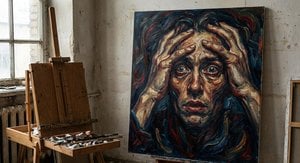
Francis Bacon’s Study for a Portrait captures the unsettling intimacy of expressionism, portraying a solitary man amidst scattered papers and a watchful gaze – a haunting glimpse into the artist's emotionally charged vision of postwar Britain. Explore this iconic piece and bring its visceral beauty home.
 Read More
Artist Biography
Bacon used disturbing realism in Three Studies for Figures at the Base of a Crucifixion. Discover his visceral and powerful paintings now.
Hand Made Oil Reproduction
Hand-painted oil on canvas in your size and frame, made to order by our artists. ( Switch to Print Switch to Digital Image)
This Artwork Is Under Copyright Protection
The artwork displayed on this page is protected by copyright law, which means we cannot legally create or sell an identical reproduction. This protection is enforced under international agreements such as the Berne Convention and by national laws, including those outlined by the U.S. Copyright Law - Title 17.
As a respectful and legal alternative, we offer custom, hand-painted artworks inspired by the original. Our skilled and professional artists carefully study the original's style, mood, and artistic essence to create a new, unique piece that evokes the same feeling - while remaining an original creation in its own right.
This method fully complies with copyright regulations because it does not involve copying or duplicating the protected artwork. Instead, it is a creative reinterpretation - a new painting that is influenced by the original but not identical to it.
More about this painting
 Preview
 Send
Send Share
Share
 Details
 Guide
Guide

 Download
 Similars
 X-Ray
X-Ray Diaporama
 Q&A
Q&A Stats
StatsOrder your painting in four simple steps
Take your time. You can change any answer; the price in your order card follows each choice.
1 Step one of four
Which size would you like?
These sizes keep the proportions of the original painting. The drawing shows your choice on a wall, above a two-metre sofa.
Or give your own measurements
Pick from our preset sizes that match the artwork's original proportions.

Type the width and the height you need, to fit your frame or your wall. This is hand-painted, so for a size with a different shape the artist can paint a bit more around the picture, or cut a bit — you choose. We send you a digital mockup to approve before the painting starts. The picture shown on this page does not show the real result — only the mockup does.
2 Step two of four
How should it be prepared: rolled, stretched or framed?
The prices below are for the size you chose in step one.
Choose the edges of the stretched canvas
Choose your frame

White $1

Blurside $1

Extended $1

P118B $10

P118H $10

P118W $10

P438Z $10

P508JH $12

P508YH $12

P805H $10

P805Z $10

P919BZ $10

P919G $10

P919XJ $10

P959ZH $10

P968JZ $12

W106C $8

W218G $10

W218JH $8

W218Y $10

W307PJ $10

W316G $10

W316PJ $8

W316Y $10

W398PJ $8

W4111J $10

W500HY $15

W500JH $15

W692G $12

W849H $8

W940BG $15

W953PJ $8

H24-GOLD $30

H24-SILVER $30

H36-GOLD $45

H36-SILVER $45
Framed
Moulding: . Overall size with the frame: .
3 Step three of four
Would you like anything changed in the painting?
Most people answer no. Because each painting is made by hand, our artist can also adapt it for you.
After order, ArtsDot.com team will email client for instructions and provide a mockup preview
4 Step four of four
A few finishing options
All of them are optional. The answers already selected cost nothing extra.
Who paints it?
Worldwide Delivery () in 3/4 weeks instead of standard 5 weeks. (4 November). No compromise on quality.
A nameplate, as in a museum?
Engraved Bronze Plaque Details
This elegant plaque features the artist's name and the title of the artwork, finely engraved for a timeless presentation.
It is made from bronze with a refined, elegant finish. The text is precisely laser-engraved for a sharp and permanent result. Measuring 9x2 cm, the plaque is compact yet easy to read. It's built to be durable and scratch-resistant, offering a professional, museum-quality look. Mounting is simple thanks to the included adhesive backing.
Transparent Acrylic Plaque Details
The plaque includes essential engraved details such as the artist's name, the title of the artwork, the date it was created, the type of media used-like oil on canvas or watercolor-a brief description of the piece, and a QR code that links to the complete artwork information.
It is crafted from clear acrylic, offering a sleek, modern appearance. The text is UV-engraved in black to ensure strong visual contrast. With a size of 10x15 cm, it ensures optimal readability. It comes equipped with two metal hooks for secure wall mounting. The plaque is designed to be weather-resistant, making it suitable for various environments, and it includes interactive features that work seamlessly with smartphone scanning.
Black Acrylic Plaque Details
This elegant plaque includes engraved information such as the artist's name, the title of the artwork, the date it was created, the type of media used (like oil on canvas or watercolor), a short description of the artwork, and a QR code for quick access to more information.
The plaque itself is made from refined black acrylic with a premium finish. The text is laser-engraved in white for high contrast and readability. Its size is 10x15 cm, designed to be easy to read. It comes with two metal hooks for professional mounting. The design is sleek and fits any interior style. It is also weather-resistant and durable, with built-in digital integration for mobile compatibility.
A protective varnish?
When do you need it?
✓ Check and order
Your painting, as you ordered it

Study for a Portrait 4
Reproduction Medium
Reproduction Size
-

Elite Senior Artist
More detail, finesse, and extra production time
-

Reproduction Frame
-
-
For artworks or reproductions larger than 105 cm (approximately 41 inches) on any side, the frame will be shipped as a kit, disassembled. This method ensures safe delivery and prevents damage during transport.
Professional assembly required - this is not a DIY product.
The kit must be assembled and the canvas stretched by an experienced professional framer, using wood glue (not supplied), a canvas stretching plier and clamps to hold the bars square while the glue dries. Incorrect assembly or uneven canvas tension can permanently damage the artwork and is not covered by our warranty.
 For artworks or reproductions larger than 105 cm (approximately 41 inches) on any side, the frame will be shipped as a kit, disassembled. This method ensures safe delivery and prevents damage during transport.
All solid wood bars are included, precisely cut to size.
Assembled with the screws provided, plus wood glue for the corner joints, which is not supplied and must be sourced by your framer.
Professional tools are required and not included: a canvas stretching plier (tensioner) and clamps to hold the bars square while the glue dries.
Important:
The corner joints require wood glue, the bars must be held with clamps until the glue is fully dry, and tightening the canvas on the assembled frame requires a canvas stretching plier. None of these are included in the kit. Please arrange an experienced professional framer before ordering this size.

Nameplate
-
-

Protective Varnish
Glossy Varnish (enhances colors, protects against light/moisture)
-

Customize My Artwork
Examples of what can be changed: Replace face with customer photo; Add pet (e.g., replace cat with dog); Include hidden message in background; Change background landscape or elements.
-

Urgent
Worldwide Delivery () in 3/4 weeks instead of standard 5 weeks. (4 November). No compromise on quality.
-
Express Shipping
Worldwide Delivery () in 5 weeks. (11 November).
Included
Total Price
$ 263
Glass option is only available in size under 110 CM
Included with every order
- Free Worldwide Express Shipping
- High-Quality Linen Canvas
- Full Shipping Insurance
- Customs Tax Refund Guarantee
- True Color Matching Guarantee
- 100-Day Return Policy (Defects Only)
- 100% Money-Back Guarantee
- Bulk Discount Offer


A Study in Disquiet: Exploring Francis Bacon’s Portrait Fragment
The painting, tentatively titled “Study for a Portrait,” offers a glimpse into the inner turmoil of one of Britain's most influential artists – Francis Bacon. Captured on canvas sometime between 1948 and 1950, this deceptively simple composition speaks volumes about Bacon’s preoccupation with psychological states and his masterful ability to convey profound emotion through restrained visual language. It’s a piece that transcends mere representation; instead, it invites contemplation and compels us to confront uncomfortable truths about human experience.- Subject Matter: The central figure is seated in a chair, head bowed – an posture immediately suggestive of vulnerability and introspection. Alongside him is another person, positioned on a bed, adding layers of complexity to the scene’s narrative potential.
- Style & Technique: Bacon's signature style—characterized by distorted figures rendered in unsettlingly fleshy tones—is evident here. The artist employs a technique rooted in expressive brushwork and layering, creating textures that mimic skin and bone. This deliberate disregard for anatomical accuracy serves not to diminish the figure’s presence but rather to amplify its emotional impact.
Historical Context: Shadows of War and Existential Angst
Painted during the immediate aftermath of World War II, “Study for a Portrait” reflects the pervasive anxieties of the era. Bacon was deeply affected by the horrors witnessed during the conflict, and this trauma finds its way into his artistic output. The painting embodies the existential questioning that gripped Europe in the years following the war—a preoccupation with mortality, isolation, and the fragility of human consciousness. It’s a visual manifestation of the psychological landscape prevalent at the time, mirroring the anxieties surrounding nuclear weapons and the looming threat of global instability.Symbolism: Layers of Uncertainty
Beyond its formal elements, “Study for a Portrait” is laden with symbolic significance. The scattered papers represent fragments of thought and memory—evidence of an inner life grappling with unresolved issues. The clock serves as a poignant reminder of time’s relentless passage and the inevitability of decay. Most powerfully, however, is the depiction of the figures themselves: their distorted forms convey not just physical discomfort but also emotional distress – fear, pain, and perhaps even despair. Bacon deliberately avoids offering easy answers or comforting illusions; instead, he presents us with a portrait of profound unease.Emotional Impact: Confronting Darkness Within
Ultimately, “Study for a Portrait” succeeds in capturing the essence of human suffering—a darkness that is both unsettling and undeniably compelling. Bacon’s masterful use of color and texture creates an atmosphere of palpable tension, drawing viewers into the scene's psychological drama. It’s not a painting designed to elicit pleasure or admiration; rather, it demands engagement, prompting us to confront our own vulnerabilities and anxieties. Like many of Bacon’s works, this piece lingers in the mind long after viewing, serving as a powerful reminder of the complexities of human emotion and the enduring fascination with portraying the darker side of existence.Questions & Answers
Which period of Francis Bacon's career does "Study for a Portrait 4" belong to?
Within Francis Bacon's career, "Study for a Portrait 4" falls in the Mature Period. The phase helps compare it with the artist's other works.
What is "Study for a Portrait 4" made with?
Francis Bacon used the acrylic technique for "Study for a Portrait 4". The technique defines the material nature of the original work.
What is the dominant hue of "Study for a Portrait 4" by Francis Bacon?
The dominant hue of "Study for a Portrait 4" by Francis Bacon is amber to saffron. The hue is the underlying tone of the palette.
Related Artworks


Francis Bacon
1909 - 1992, Ireland
Artist Biography
The Brutality of the Human Image
To look at a Francis Bacon canvas is to encounter a direct assault on the nervous system. He did not seek to decorate; he sought to capture the raw, often terrifying reality of existence through a distinctive and disturbing realism. While his contemporaries drifted toward the safety of abstraction, Bacon anchored himself in the human form, though he stripped that form of any dignity or comfort. His work functions as a visceral response to the mid-twentieth century, translating anxiety and physical vulnerability into smeared, violent colors and contorted limbs.
The power of his imagery stems from a refusal to look away from degradation. He utilized oils with a fluidity that allowed for the depiction of flesh that seems to be dissolving or bruising under pressure. By placing figures within geometric structures—transparent cages or architectural space-frames—he forced a sense of claustrophobia upon the viewer. These frames were not mere compositional tools; they were devices to concentrate the image and trap the subject in a state of permanent isolation.
A Life of Displacement and Design
Bacon’s path to the canvas was far from academic. Born in Dublin, Ireland, his early years were marked by instability and a difficult relationship with his parents. He moved through London, Berlin, and Paris, living a life that was often as turbulent as his later paintings. Before he was recognized as a painter, he worked as an interior designer and decorator. This period of his life produced tangible, structured objects:
- Royal Wilton rugs featuring abstract motifs.
- Cocktail shelves and room screens with geometric silhouettes.
- Calfskin pouffes and tubular steel furniture.
This background in design provided a structural foundation that would later manifest in his use of cubic, architectural framing. He was a self-taught artist who bypassed the traditional art school route, instead absorbing influences through direct observation and chance encounters. His transition from decorator to painter was catalyzed by seeing Picasso’s work in Paris, which revealed the possibilities of using organic, bone-like structures to distort the human image.
The Mechanics of Terror
Bacon’s visual language was built from a specific set of cinematic and classical references. He did not invent his horrors in a vacuum; he reconfigured existing imagery to suit a more primal purpose. The screaming face, a recurring motif, finds its roots in the visceral imagery of Sergei Eisenstein's film Battleship Potemkin. Similarly, his fascination with the distortion of the body was informed by the works of Picasso and the studies of motion by Eadweard Muybridge.
His most famous reinterpretations involved taking established authority and breaking it. In his series of works based on Velázquez’s Portrait of Pope Innocent X, he transformed a dignified papal figure into a nightmarish, screaming specter. He used the concept of the crucifixion not as a religious statement, but as an armature to hang sensations of suffering. This approach allowed him to explore universal themes of mortality and the human condition without the distraction of spiritual solace.
The Final Verdict
Bacon’s significance lies in his ability to confront the darker corners of the soul with brutal honesty. He rejected the polished beauty of traditional portraiture in favor of an unflinching portrayal of agony and isolation. His later works, while often utilizing lighter colors, maintained this core intensity, focusing on the psychological weight of his subjects, including his lover George Dyer. He remains a central figure because he provided a visual language for the twentieth century's deepest anxieties, ensuring that the image of the suffering human remains impossible to ignore.


Related Articles
Figurative Expressionism: Emotional Intensity & Subjective Reality in 20th-Century Art
Explore the powerful world of Figurative Expressionism with ArtsDot. Discover key artists like Kirchner & Beckmann, understand its emotional depth, and learn how to collect this influential 20th-century art movement.

German Expressionism's 10 Defining Masterpieces | Art for Your Home
Explore 10 defining German Expressionism masterpieces – from Munch's 'The Scream' to Kandinsky’s abstracts. Discover the artists, stories & bold colors behind this powerful art movement. Find museum-quality reproductions at ArtsDot.com.

The Raw Power of Fear: Top 25 Masterpieces by Francis Bacon
Explore 25 visceral Francis Bacon masterpieces. Discover the raw power of his distorted figures on ArtsDot.com.