

 Preview
 Send
Send Share
Share
 Details
 Guide
Guide

 Download
 Similars
 X-Ray
X-Ray Diaporama
 Q&A
Q&A Stats
StatsComposition
 Read More
The artwork displayed on this page is protected by copyright law, which means we cannot legally create or sell an identical reproduction. This protection is enforced under international agreements such as the Berne Convention and by national laws, including those outlined by the U.S. Copyright Law - Title 17.
This method fully complies with copyright regulations because it does not involve copying or duplicating the protected artwork. Instead, it is a creative reinterpretation - a new painting that is influenced by the original but not identical to it.
Giclée / Art Print
Museum-quality giclée or canvas print with fast production and flexible finish options. ( Buy Hand Made Painting Switch to Digital Image)




































Pick from our preset sizes that match the artwork's original proportions.

Type the width and the height you need, to fit your frame or your wall. A print can only be cut, never made bigger than the picture, so a size with a different shape loses a part of the image. We send you a digital mockup to approve before we print anything. The picture shown on this page does not show the real cut — only the mockup does.
Worldwide Delivery () in 2 weeks instead of standard 4/5 weeks. (9 November)

Free Worldwide Express Shipping

High-Quality Linen Canvas

Full Shipping Insurance

Customs Tax Refund Guarantee

True Color Matching Guarantee

100-Day Return Policy (Defects Only)

100% Money-Back Guarantee

Bulk Discount Offer
 Glass option is only available in size under 110 CM

Composition
Giclée / Art Print
Reproduction Size
-


Total Price
$ 63
Related Artworks


Artist Biography
Emilio Pettoruti: A Pioneer of Argentine Modernism
- Born: La Plata, Argentina (October 1, 1892)
- Died: Paris, France (October 16, 1971)
Emilio Pettoruti was a pivotal figure in the development of modern art in Argentina. His career, marked by innovation and controversy, significantly shaped the artistic landscape of his country during the 20th century. He is remembered for his unique blend of European avant-garde influences—Cubism, Futurism, Constructivism, and Abstraction—adapted to a distinctly Latin American sensibility.
Early Life and Artistic Training
- Family Background: Born into a prosperous Italian immigrant family in La Plata, Pettoruti's early environment fostered an appreciation for modern design and urban aesthetics. The geometric layout of the city deeply influenced his artistic vision.
- Formal Education: At fourteen, he enrolled at the local Academy of Fine Arts but quickly left, believing self-directed study would be more beneficial.
- Mentorship with Emilio Coutaret: He studied caricature portraits under architect and drawing instructor Emilio Coutaret at the Museum of Natural History's drawing school. A successful caricature of Rodolfo Sarrat secured him a travel scholarship to Italy in 1913.
- Italian Renaissance Influence: In Florence, Pettoruti immersed himself in the study of Renaissance masters like Fra Angelico, Masaccio, and Giotto. He was profoundly impacted by fourteenth-century art, particularly its emphasis on geometric proportion and equilibrium, which became foundational elements in his own style.
European Influences and Artistic Development
- Futurism: While in Italy, Pettoruti engaged with the burgeoning Futurist movement, absorbing its dynamism and focus on speed and technology. He read *Lacerba*, a Florentine futurist magazine.
- Cubism: In Paris, he encountered Juan Gris, who significantly influenced his adoption of Cubist principles—fragmentation, multiple perspectives, and geometric abstraction.
- Der Sturm Gallery: Exhibiting at Herwarth Walden's Der Sturm gallery in Berlin exposed him to a wider range of European avant-garde art.
- Friendship with Jose Carlos Mariategui: A long-standing friendship developed with the Peruvian writer Jose Carlos Mariategui, further enriching his intellectual and artistic perspectives.
Return to Argentina and Artistic Scandal
- Introduction of Modernism: Pettoruti returned to Buenos Aires in 1924, aiming to introduce European modernism to a largely conservative Argentine art scene.
- The 1924 Exhibition Controversy: His first exhibition sparked considerable controversy and scandal due to its radical departure from traditional Argentine artistic themes—landscapes, gauchos, cattle, etc. The Buenos Aires public was not yet ready for such an avant-garde display.
- Xul Solar's Assessment: Despite the initial resistance, fellow artist Xul Solar recognized Pettoruti’s significance, stating that his work served as a “great stimulating force and a point of departure for our own future artistic evolution.”
- Focus on Urban Themes: His compositions frequently featured vertical city streets, reflecting his fascination with urban landscapes and modern architecture.
Later Career and Legacy
- Museum Directorship: From 1930 to 1947, he served as director of the Museo Provincial de Bellas Artes in La Plata.
- International Recognition: His work gained international acclaim, with a major exhibition in San Francisco in 1942 leading to increased demand for his art worldwide.
- Return to Europe: Facing political pressures and conservative artistic trends in Argentina, he returned to Europe in 1952.
- Autobiography: He wrote his autobiography, *Un pintor ante el espejo* (A Painter Before the Mirror), in Paris in 1968.
- Lasting Impact: Emilio Pettoruti’s innovative approach to art had a profound and lasting impact on Argentine art, opening doors for other artists and audiences to explore new artistic territories. He is considered one of the most influential artists in Argentina's 20th-century history.

Emilio Pettoruti
1892 - 1971 , Argentina
Quick Facts
- Full Name: Emilio Pettoruti
- Nationality: Argentine
- Date Of Birth: 1892
- Date Of Death: 1971
- Place Of Birth: La Plata, Argentina
- Artistic Movement Or Style:
- Cubism
- Futurism
- Constructivism
- Artists Who Influenced This Artist:
- Fra Angelico
- Masaccio
- Giotto
- Juan Gris
- Artists Or Movements Influenced By This Artist: ['Argentine Modern Art']
Related Articles

Lorenzo Lotto: Unveiling the Enigma of a Venetian Master's Portraits
Explore the captivating world of Lorenzo Lotto, a Venetian Renaissance master renowned for his psychologically insightful portraits & enigmatic symbolism. Discover his life, style, and rediscovered legacy with ArtsDot.
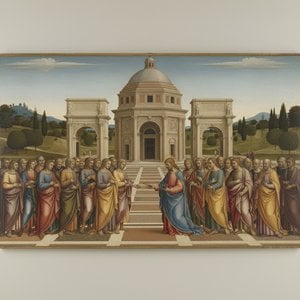
Pietro Perugino: Umbrian Master of Serenity & Precursor to Raphael's High Renaissance
Explore the life & art of Pietro Perugino, a pivotal Renaissance master and Raphael’s influential teacher. Discover his serene compositions, Sistine Chapel frescoes, and lasting legacy with ArtsDot.

Pietro Perugino: A Renaissance Master's Legacy of Grace & Spiritual Depth
Explore the serene beauty & spiritual depth of Pietro Perugino's Renaissance masterpieces. Discover his influence on Raphael, key works like 'Baptism of Christ,' and legacy as a leading Umbrian painter.

Translating Vision into Visual Form: Exploring Artistic Interpretation and Client Collaboration in Custom Art Creation
Transform your vision into a timeless masterpiece with ArtsDot's custom art services. Expert artists, museum-quality materials & personalized collaboration. Discover the perfect artwork for your space.

Emotional Transmutation in Visual Art: A Study of Affective Representation Through Color, Form, and Texture
Explore the fascinating intersection of art & emotion! Discover how color, form, and texture convey feelings in masterpieces. Expert analysis for collectors & enthusiasts.


