


The picture follows your choices: , .
Collectible Description
 Read More
Artist Biography
Explore the emotionally charged Expressionist art of Egon Schiele (1890-1918): bold portraits, psychological themes & unique lines. Discover reproductions now!
Hand Made Oil Reproduction
Hand-painted oil on canvas in your size and frame, made to order by our artists. ( Switch to Print Switch to Digital Image)
More about this painting
 Preview
 Send
Send Share
Share
 Details
 Guide
Guide

 Download
 Similars
 X-Ray
X-Ray Diaporama
 Q&A
Q&A Stats
StatsOrder your painting in four simple steps
Take your time. You can change any answer; the price in your order card follows each choice.
1 Step one of four
Which size would you like?
These sizes keep the proportions of the original painting. The drawing shows your choice on a wall, above a two-metre sofa.
Or give your own measurements
Pick from our preset sizes that match the artwork's original proportions.

Type the width and the height you need, to fit your frame or your wall. This is hand-painted, so for a size with a different shape the artist can paint a bit more around the picture, or cut a bit — you choose. We send you a digital mockup to approve before the painting starts. The picture shown on this page does not show the real result — only the mockup does.
2 Step two of four
How should it be prepared: rolled, stretched or framed?
The prices below are for the size you chose in step one.
Choose the edges of the stretched canvas
Choose your frame

White $1

Blurside $1

Extended $1

P118B $10

P118H $10

P118W $10

P438Z $10

P508JH $12

P508YH $12

P805H $10

P805Z $10

P919BZ $10

P919G $10

P919XJ $10

P959ZH $10

P968JZ $12

W106C $8

W218G $10

W218JH $8

W218Y $10

W307PJ $10

W316G $10

W316PJ $8

W316Y $10

W398PJ $8

W4111J $10

W500HY $15

W500JH $15

W692G $12

W849H $8

W940BG $15

W953PJ $8

H24-GOLD $30

H24-SILVER $30

H36-GOLD $45

H36-SILVER $45
Framed
Moulding: . Overall size with the frame: .
3 Step three of four
Would you like anything changed in the painting?
Most people answer no. Because each painting is made by hand, our artist can also adapt it for you.
After order, ArtsDot.com team will email client for instructions and provide a mockup preview
4 Step four of four
A few finishing options
All of them are optional. The answers already selected cost nothing extra.
Who paints it?
Worldwide Delivery () in 3/4 weeks instead of standard 5 weeks. (4 November). No compromise on quality.
A nameplate, as in a museum?
Engraved Bronze Plaque Details
This elegant plaque features the artist's name and the title of the artwork, finely engraved for a timeless presentation.
It is made from bronze with a refined, elegant finish. The text is precisely laser-engraved for a sharp and permanent result. Measuring 9x2 cm, the plaque is compact yet easy to read. It's built to be durable and scratch-resistant, offering a professional, museum-quality look. Mounting is simple thanks to the included adhesive backing.
Transparent Acrylic Plaque Details
The plaque includes essential engraved details such as the artist's name, the title of the artwork, the date it was created, the type of media used-like oil on canvas or watercolor-a brief description of the piece, and a QR code that links to the complete artwork information.
It is crafted from clear acrylic, offering a sleek, modern appearance. The text is UV-engraved in black to ensure strong visual contrast. With a size of 10x15 cm, it ensures optimal readability. It comes equipped with two metal hooks for secure wall mounting. The plaque is designed to be weather-resistant, making it suitable for various environments, and it includes interactive features that work seamlessly with smartphone scanning.
Black Acrylic Plaque Details
This elegant plaque includes engraved information such as the artist's name, the title of the artwork, the date it was created, the type of media used (like oil on canvas or watercolor), a short description of the artwork, and a QR code for quick access to more information.
The plaque itself is made from refined black acrylic with a premium finish. The text is laser-engraved in white for high contrast and readability. Its size is 10x15 cm, designed to be easy to read. It comes with two metal hooks for professional mounting. The design is sleek and fits any interior style. It is also weather-resistant and durable, with built-in digital integration for mobile compatibility.
A protective varnish?
When do you need it?
✓ Check and order
Your painting, as you ordered it

untitled (427)
Reproduction Medium
Reproduction Size
-

Elite Senior Artist
More detail, finesse, and extra production time
-

Reproduction Frame
-
-
For artworks or reproductions larger than 105 cm (approximately 41 inches) on any side, the frame will be shipped as a kit, disassembled. This method ensures safe delivery and prevents damage during transport.
Professional assembly required - this is not a DIY product.
The kit must be assembled and the canvas stretched by an experienced professional framer, using wood glue (not supplied), a canvas stretching plier and clamps to hold the bars square while the glue dries. Incorrect assembly or uneven canvas tension can permanently damage the artwork and is not covered by our warranty.
 For artworks or reproductions larger than 105 cm (approximately 41 inches) on any side, the frame will be shipped as a kit, disassembled. This method ensures safe delivery and prevents damage during transport.
All solid wood bars are included, precisely cut to size.
Assembled with the screws provided, plus wood glue for the corner joints, which is not supplied and must be sourced by your framer.
Professional tools are required and not included: a canvas stretching plier (tensioner) and clamps to hold the bars square while the glue dries.
Important:
The corner joints require wood glue, the bars must be held with clamps until the glue is fully dry, and tightening the canvas on the assembled frame requires a canvas stretching plier. None of these are included in the kit. Please arrange an experienced professional framer before ordering this size.

Nameplate
-
-

Protective Varnish
Glossy Varnish (enhances colors, protects against light/moisture)
-

Customize My Artwork
Examples of what can be changed: Replace face with customer photo; Add pet (e.g., replace cat with dog); Include hidden message in background; Change background landscape or elements.
-

Urgent
Worldwide Delivery () in 3/4 weeks instead of standard 5 weeks. (4 November). No compromise on quality.
-
Express Shipping
Worldwide Delivery () in 5 weeks. (11 November).
Included
Total Price
$ 263
Glass option is only available in size under 110 CM
Included with every order
- Free Worldwide Express Shipping
- High-Quality Linen Canvas
- Full Shipping Insurance
- Customs Tax Refund Guarantee
- True Color Matching Guarantee
- 100-Day Return Policy (Defects Only)
- 100% Money-Back Guarantee
- Bulk Discount Offer


A Vision of Urban Tension: Decoding Egon Schiele’s Untitled (427)
Egon Schiele's "Untitled (427)" stands as a haunting testament to the anxieties simmering beneath the surface of early 20th-century Vienna – a city grappling with rapid industrialization, social upheaval, and an increasingly fraught relationship with tradition. Painted in 1915 during the tumultuous period of World War I, this striking monochrome composition transcends mere depiction; it’s an exploration of psychological depth and visceral emotion rendered with Schiele's signature expressive line and unsettling perspective. The artwork immediately captivates with its stark contrast between black and yellow hues, creating a dramatic backdrop for a cityscape dominated by towering buildings—a deliberate echo of the castle architecture prevalent in Vienna at the time, symbolizing both grandeur and confinement.Composition and Technique: A Masterclass in Distortion
Schiele’s masterful technique is evident in every brushstroke. He employs a heavily textured surface achieved through impasto – applying paint thickly onto the canvas – which lends physicality to the scene and amplifies its emotional intensity. The cityscape itself isn't rendered realistically; instead, Schiele distorts proportions and exaggerates architectural features, mirroring the artist’s preoccupation with psychological distortion. Lines twist and curve unpredictably, conveying a sense of unease and instability. Notably, the central building is presented as an imposing fortress, emphasizing the feeling of vulnerability amidst overwhelming power—a recurring motif in Schiele's oeuvre reflecting his profound engagement with themes of mortality and repression.Symbolism Within the Frame: Faces of Isolation
Beyond its formal qualities, "Untitled (427)" pulsates with symbolic resonance. The two figures positioned within the cityscape represent individuals grappling with existential concerns—isolated yet inextricably linked to their surroundings. Their postures convey a palpable tension, hinting at unspoken desires and anxieties. Schiele’s deliberate use of nude anatomy – a hallmark of his artistic style – isn't merely sensual; it serves as a vehicle for confronting uncomfortable truths about human vulnerability and the inevitability of death. The yellow hue subtly underscores this preoccupation with mortality, mirroring the color often associated with decay and transformation.Historical Context: Vienna at War
The painting’s creation coincided with Austria-Hungary’s involvement in World War I—a period marked by profound social anxieties and psychological trauma. Schiele's artistic output during this time reflects a broader cultural preoccupation with confronting mortality and exploring the darker recesses of human consciousness. Influenced heavily by Gustav Klimt, Schiele embraced Expressionism as a means of conveying emotion rather than representing reality objectively – a stylistic choice that cemented his place among the most influential artists of his generation.Emotional Impact: A Portrait of Inner Turmoil
Ultimately, "Untitled (427)" compels viewers to confront uncomfortable emotions—fear, vulnerability, and longing—much like Schiele himself wrestled with internal demons throughout his life. It’s a painting that lingers in the mind long after viewing, prompting contemplation on themes of isolation, repression, and the human condition. Reproductions of this artwork offer an opportunity to experience Schiele's visionary style and profound psychological insight within the comfort of one's own home—a powerful reminder of art's ability to communicate complex emotions and challenge conventional perceptions.Questions & Answers
Are the colors of "untitled (427)" by Egon Schiele saturated or muted?
"untitled (427)" by Egon Schiele is recorded with a balanced soft saturation.
Where can I download "untitled (427)" by Egon Schiele?
"untitled (427)" by Egon Schiele can be downloaded from the artwork's Download page, as a high-resolution digital image download.
Can I order an oil reproduction of "untitled (427)"?
"untitled (427)" is available as a hand-painted oil reproduction on linen canvas. The order can be placed on its Hand-Painted Reproduction page, with a choice of sizes.
Related Artworks


Egon Schiele
1890 - 1918, Croatia
Artist Biography
A Life Forged in Expression
Born in 1890 in the Austrian town of Tulln an der Donau, Egon Schiele’s life was a tempestuous journey marked by both extraordinary artistic vision and profound personal hardship. His early years were shadowed by illness and loss; his father succumbed to syphilis when Egon was just fourteen, a tragedy that would deeply resonate within his work, fueling an obsession with mortality and the fragility of existence. Raised initially by his mother and then under the somewhat controlling guardianship of his uncle Leopold Czihaczek, Schiele’s childhood lacked conventional stability but fostered a fiercely independent spirit. Even as a boy, he displayed an intense fascination with trains—a motif that subtly reappeared in later paintings—and a burgeoning talent for drawing, though this was initially met with disapproval from his father who saw it as a distraction from more practical pursuits. The early death of his sister Elvira also cast a long shadow over the young artist’s psyche. These formative experiences instilled within him a sensitivity and an emotional rawness that would become hallmarks of his artistic expression, a constant grappling with themes of life, death, and the human condition.
The Crucible of Vienna: Artistic Development
Schiele's formal artistic training began at the Kunstgewerbeschule (School of Arts and Crafts) in Vienna, but he quickly found himself stifled by its conservative approach. He transferred to the Akademie der bildenden Künste (Academy of Fine Arts), only to become further disillusioned with its rigid academic traditions. This dissatisfaction led him to abandon formal training altogether, choosing instead to forge his own path, a testament to his unwavering artistic conviction. The influence of Gustav Klimt was pivotal during these early years; Schiele admired Klimt’s decorative style and exploration of symbolism, even receiving mentorship from the established artist. However, Schiele soon diverged from Klimt's aesthetic, developing a distinctly individual voice characterized by its stark honesty and psychological intensity. He co-founded the Neues Wiener Kunstgruppe (New Viennese Art Group) in 1909, aligning himself with other progressive artists who challenged the prevailing artistic norms. His early works, often unsettling portraits and self-portraits, began to emerge as powerful statements of emotional turmoil, featuring distorted figures and a palpable sense of vulnerability. These paintings were not merely representations of physical form but explorations of the inner landscape—the anxieties, desires, and fears that haunted the human psyche. He sought to depict not what he *saw*, but what he *felt*.
Raw Emotion and Unflinching Truth
Egon Schiele’s art is immediately recognizable for its raw honesty and psychological depth. He fearlessly confronted themes often considered taboo – sexuality, death, anxiety, isolation – with an unflinching gaze. His distinctive style features elongated figures, contorted poses, and expressive lines that convey a sense of unease and emotional intensity. The human form, particularly the nude, became his primary subject, not as an object of idealized beauty but as a vessel for exploring the complexities of human experience. Self-portraits constitute a significant portion of his oeuvre, offering intimate glimpses into his inner world—a world often marked by loneliness and self-doubt. He didn’t shy away from depicting himself in unflattering or vulnerable poses, revealing a profound level of self-awareness and introspection. Beyond self-portraiture, Schiele created numerous portraits of others, capturing their likenesses with an unsettling realism that seemed to penetrate beneath the surface. His landscapes, while less central to his work than his figurative paintings, demonstrate his mastery of form and color, often reflecting the same emotional intensity as his portraits. The use of line is particularly striking in Schiele’s work; it's not merely a tool for defining shape but an expressive force that conveys emotion and psychological tension. Recurring motifs like the *Physalis* plant – symbolizing death and transience with its delicate, papery husk – further underscore this preoccupation with mortality.
A Legacy Cut Short: Achievements & Significance
Despite facing censorship and legal challenges – including a brief imprisonment for allegedly corrupting minors with his art – Schiele gained recognition within Vienna’s avant-garde circles. His work challenged the conventions of the time, provoking both admiration and outrage. By the time of his untimely death during the Spanish flu pandemic in 1918 at the age of twenty-eight, he had established himself as a leading figure in Austrian Expressionism. Significant works such as Self-Portrait with Physalis, Couple Embracing, and Field Landscape (Kreuzberg near Krumau) stand as testaments to his artistic genius. His influence on subsequent generations of artists is undeniable, particularly those interested in exploring psychological themes and challenging conventional artistic norms. Schiele’s bold approach to form and subject matter continues to resonate with audiences today, making him one of the most important and influential figures in early 20th-century art. His paintings are now held in major museum collections worldwide, including the Leopold Museum in Vienna and the Egon Schiele Art Centrum in Český Krumlov, ensuring his artistic legacy endures. He left behind a body of work that is not merely aesthetically compelling but profoundly human—a testament to the power of art to confront the complexities of existence with honesty, courage, and unwavering vision.
- Key Themes: Mortality, sexuality, isolation, psychological turmoil.
- Influences: Gustav Klimt, Viennese Secession, personal trauma.
- Style Characteristics: Elongated figures, contorted poses, expressive lines, raw emotion.


Related Articles

Egon Schiele: Expressionism, Anxiety & the Modern Condition – A Comprehensive Exploration
Explore the emotionally charged world of Egon Schiele (1890-1918). Discover his Expressionist masterpieces, psychological themes, and lasting impact on modern art. A comprehensive guide for collectors & enthusiasts.
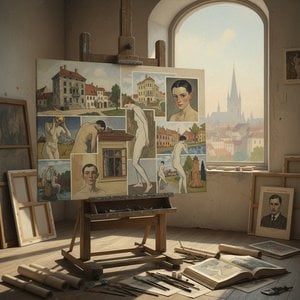
Unveiling Raw Emotion: The Top 25 Masterpieces by Egon Schiele
Explore 25 raw Expressionist masterpieces by Egon Schiele. Discover the full collection online at ArtsDot.com.

Expressionism's Soul: 10 Masterpieces for Your Home |
Journey into the soul of Expressionism! Explore 10 iconic paintings by Munch, Kirchner, Kandinsky & more. Discover their stories, bold colors & lasting impact. Find museum-quality art reproductions at .