Preview
 Send
Send Share
Share
 Details
 Guide
Guide

 Download
 Similars
 X-Ray
X-Ray Diaporama
 Stats
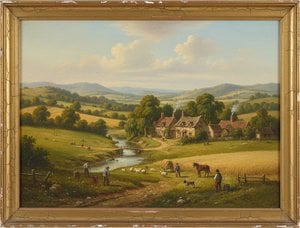
StatsLandscape With Peasant

 Read More
Giclée / Art Print
Museum-quality giclée or canvas print with fast production and flexible finish options. ( Buy Hand Made Painting Switch to Digital Image)




































Pick from our preset sizes that match the artwork's original proportions.

You may enter your own dimensions to fit a specific frame or space. If your selected size does not match the original image's proportions, we will either crop the artwork or extend the image with a mirrored or solid-fill edge. A digital mockup will be sent for your approval before production begins.
Please note that the on-screen preview does not reflect the actual cropping or extension. Only the mockup will accurately show the final composition.
While custom sizes are available, we recommend selecting a dimension from the predefined list to preserve the original proportions.
Worldwide Delivery () in 2 weeks instead of standard 4/5 weeks. (27 September)

Free Worldwide Express Shipping

High-Quality Linen Canvas

Full Shipping Insurance

Customs Tax Refund Guarantee

True Color Matching Guarantee

100-Day Return Policy (Defects Only)

100% Money-Back Guarantee

Bulk Discount Offer
 Glass option is only available in size under 110 CM

Landscape With Peasant
Giclée / Art Print
Reproduction Size
-


Total Price
$ 63
Related Artworks


Artist Biography
The Atmospheric Vision of Edwin Ellis
Born in the industrial heart of Nottingham in 1841, Edwin Ellis emerged as a profound voice within the British landscape tradition, capturing the fleeting soul of the nineteenth-century countryside. His artistic journey began not with the brush, but with the precise eye of a lace draughtsman, a formative period that instilled in him a meticulous attention to detail and structural accuracy. This foundational discipline would later serve as the backbone for his more expansive, atmospheric explorations of nature. As he transitioned from the technical rigors of drafting to the fluid possibilities of watercolor and oil, Ellis developed a style that bridged the gap between the precise observation of the British Watercolor School and the emotive, sweeping gestures of the Romantic movement.
Ellis’s evolution as an artist was deeply intertwined with his travels across the British Isles. He possessed a unique ability to translate the rugged textures of the coast and the tranquil stillness of inland waters onto the canvas. His works often focused on the dramatic intersections of land and sea, particularly along the Whitby Coastline, the Norfolk Broads, and the windswept reaches of Wales and Cornwall. In these scenes, one does not merely see a landscape; one feels the salt spray of a churning Atlantic or the heavy, humid stillness of a summer afternoon by a riverbank. His mastery lay in his ability to manipulate light and atmosphere, using subtle gradations of color to evoke the shifting moods of the English weather.
Influences and the Spirit of Realism
While Ellis’s roots were firmly planted in the English tradition, his artistic vision was significantly enriched by the continental influences of the Barbizon School. The works of masters such as Jean-François Millet and Théodore Rousseau resonated deeply with his own desire to depict nature without the veil of excessive idealization. Like the Barbizon painters, Ellis sought a certain unvarnished honesty in his subjects. He found beauty not in mythological grandeur, but in the quiet dignity of the everyday: the rhythmic labor of fishermen hauling nets, the solitary figure of a farmer tending a field, and the humble presence of windmills silhouetted against a twilight sky.
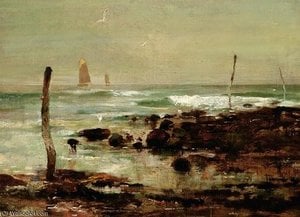
This commitment to realism allowed him to create works that were both deeply personal and universally relatable. His technique often employed a broad, almost impressionistic brushwork in his oil paintings—seen in evocative pieces like Seascape—which contrasted beautifully with the delicate, translucent layers of his watercolors. This duality enabled him to capture both the monumental power of a storm-tossed sea and the intimate, serene details of a local pond. Through this balance, Ellis achieved a sense of naturalism that felt lived-in and authentic, reflecting the Victorian era's growing fascination with the direct observation of the natural world.
Legacy and Artistic Achievement
The professional trajectory of Edwin Ellis was marked by significant recognition within the prestigious art circles of his time. His election as a member of the Royal Society of British Artists in 1875 stands as a testament to his technical prowess and his standing among his peers. He was a frequent exhibitor at the Royal Academy and various other prominent London galleries, ensuring that his depictions of the British landscape reached a wide and discerning audience. His ability to navigate both the delicate medium of watercolor and the robust demands of oil painting allowed him to leave behind a diverse and substantial oeuvre.
Today, the significance of Ellis’s work lies in its enduring ability to transport the viewer to a vanished era of English pastoral life. His paintings serve as historical windows, preserving the light, the textures, and the quiet rhythms of the nineteenth-century landscape. The following elements define his lasting contribution to art history:
- Atmospheric Mastery: An unparalleled skill in rendering the nuances of light, mist, and maritime weather.
- Narrative Realism: A dedication to portraying the honest, unembellished beauty of rural and coastal life.
- Technical Versatility: The seamless transition between precise watercolor detail and expressive, impressionistic oil painting.
- Cultural Connection: A bridge between the traditional British landscape school and the emotive influences of European Realism.
Through his approximately 150 surviving works, Edwin Ellis remains a vital figure for those seeking to understand the emotional depth of the Victorian landscape tradition, offering a legacy that is as much about feeling the wind and water as it is about seeing them.

edwin ellis
1841 - 1895 , United Kingdom
Quick Facts
- Artistic Movement Or Style: Watercolor Art
- Date Of Birth: 1841
- Full Name: Edwin Ellis
- Nationality: British
- Notable Artworks:
- Gorleston
- Landscape With Peasant
- The Approaching Storm, Whitby
- Place Of Birth: Nottingham, United Kingdom
Related Articles

Cultivating Visions: A Historical Journey Through Rural Landscapes in Art
Explore the rich history of rural landscape painting with ArtsDot. Discover Impressionist masterpieces, key artists & movements. Find your perfect serene artwork and bring nature's beauty home.

John Constable's Masterpieces: Explore 25 Iconic Landscapes for Your Home
Journey through John Constable's 25 most celebrated landscapes. Explore Romanticism, Dedham Vale & his masterful use of light in iconic paintings like 'Hay Wain'. Find museum-quality art reproductions and elevate your home decor on ArtsDot.com.

Echoes of Rural Life: Art's Enduring Representations of the Countryside
Explore the rich history of rural life in art! Discover masterpieces from Millet to Mauve & beyond. Learn about Realism, Barbizon School & find inspiration for your home with ArtsDot.

Sir Alfred Munnings' Masterpieces: 25 Paintings That Define Equine Art | ArtsDot
Explore 25 iconic Sir Alfred Munnings paintings! Discover the beauty of British Impressionism, equine art & rural England. Find museum-quality reproductions and elevate your home decor with ArtsDot. Explore the full collection online.
Evocations of Rural Life: A Historical Journey Through Landscape Painting
Explore the rich history of rural life in painting! Discover Impressionist masterpieces, Italian Macchiaioli scenes & the enduring appeal of pastoral landscapes. Find your perfect artwork at ArtsDot.