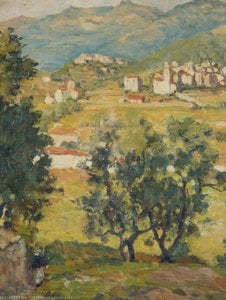
- 36.0 x 36.0 cm


The picture follows your choices: , .
Artist Biography
Edgar Wood (1860-1935) was a prominent British architect & artist of the Arts and Crafts movement. Known for domestic designs, churches, & masterful use of vernacular Lancashire styles. Discover his legacy & influence on Manchester architecture!
 Read More
Hand Made Oil Reproduction
Hand-painted oil on canvas in your size and frame, made to order by our artists. ( Switch to Print Switch to Digital Image)
More about this painting
 Preview
 Send
Send Share
Share
 Details
 Guide
Guide

 Download
 Similars
 X-Ray
X-Ray Diaporama
 Q&A
Q&A Stats
StatsOrder your painting in four simple steps
Take your time. You can change any answer; the price in your order card follows each choice.
1 Step one of four
Which size would you like?
These sizes keep the proportions of the original painting. The drawing shows your choice on a wall, above a two-metre sofa.
Or give your own measurements
Pick from our preset sizes that match the artwork's original proportions.

Type the width and the height you need, to fit your frame or your wall. This is hand-painted, so for a size with a different shape the artist can paint a bit more around the picture, or cut a bit — you choose. We send you a digital mockup to approve before the painting starts. The picture shown on this page does not show the real result — only the mockup does.
2 Step two of four
How should it be prepared: rolled, stretched or framed?
The prices below are for the size you chose in step one.
Choose the edges of the stretched canvas
Choose your frame

White $1

Blurside $1

Extended $1

P118B $10

P118H $10

P118W $10

P438Z $10

P508JH $12

P508YH $12

P805H $10

P805Z $10

P919BZ $10

P919G $10

P919XJ $10

P959ZH $10

P968JZ $12

W106C $8

W218G $10

W218JH $8

W218Y $10

W307PJ $10

W316G $10

W316PJ $8

W316Y $10

W398PJ $8

W4111J $10

W500HY $15

W500JH $15

W692G $12

W849H $8

W940BG $15

W953PJ $8

H24-GOLD $30

H24-SILVER $30

H36-GOLD $45

H36-SILVER $45
Framed
Moulding: . Overall size with the frame: .
3 Step three of four
Would you like anything changed in the painting?
Most people answer no. Because each painting is made by hand, our artist can also adapt it for you.
After order, ArtsDot.com team will email client for instructions and provide a mockup preview
4 Step four of four
A few finishing options
All of them are optional. The answers already selected cost nothing extra.
Who paints it?
Worldwide Delivery () in 3/4 weeks instead of standard 5 weeks. (4 November). No compromise on quality.
A nameplate, as in a museum?
Engraved Bronze Plaque Details
This elegant plaque features the artist's name and the title of the artwork, finely engraved for a timeless presentation.
It is made from bronze with a refined, elegant finish. The text is precisely laser-engraved for a sharp and permanent result. Measuring 9x2 cm, the plaque is compact yet easy to read. It's built to be durable and scratch-resistant, offering a professional, museum-quality look. Mounting is simple thanks to the included adhesive backing.
Transparent Acrylic Plaque Details
The plaque includes essential engraved details such as the artist's name, the title of the artwork, the date it was created, the type of media used-like oil on canvas or watercolor-a brief description of the piece, and a QR code that links to the complete artwork information.
It is crafted from clear acrylic, offering a sleek, modern appearance. The text is UV-engraved in black to ensure strong visual contrast. With a size of 10x15 cm, it ensures optimal readability. It comes equipped with two metal hooks for secure wall mounting. The plaque is designed to be weather-resistant, making it suitable for various environments, and it includes interactive features that work seamlessly with smartphone scanning.
Black Acrylic Plaque Details
This elegant plaque includes engraved information such as the artist's name, the title of the artwork, the date it was created, the type of media used (like oil on canvas or watercolor), a short description of the artwork, and a QR code for quick access to more information.
The plaque itself is made from refined black acrylic with a premium finish. The text is laser-engraved in white for high contrast and readability. Its size is 10x15 cm, designed to be easy to read. It comes with two metal hooks for professional mounting. The design is sleek and fits any interior style. It is also weather-resistant and durable, with built-in digital integration for mobile compatibility.
A protective varnish?
When do you need it?
✓ Check and order
Your painting, as you ordered it

Florence
Reproduction Medium
Reproduction Size
-

Elite Senior Artist
More detail, finesse, and extra production time
-

Reproduction Frame
-
-
For artworks or reproductions larger than 105 cm (approximately 41 inches) on any side, the frame will be shipped as a kit, disassembled. This method ensures safe delivery and prevents damage during transport.
Professional assembly required - this is not a DIY product.
The kit must be assembled and the canvas stretched by an experienced professional framer, using wood glue (not supplied), a canvas stretching plier and clamps to hold the bars square while the glue dries. Incorrect assembly or uneven canvas tension can permanently damage the artwork and is not covered by our warranty.
 For artworks or reproductions larger than 105 cm (approximately 41 inches) on any side, the frame will be shipped as a kit, disassembled. This method ensures safe delivery and prevents damage during transport.
All solid wood bars are included, precisely cut to size.
Assembled with the screws provided, plus wood glue for the corner joints, which is not supplied and must be sourced by your framer.
Professional tools are required and not included: a canvas stretching plier (tensioner) and clamps to hold the bars square while the glue dries.
Important:
The corner joints require wood glue, the bars must be held with clamps until the glue is fully dry, and tightening the canvas on the assembled frame requires a canvas stretching plier. None of these are included in the kit. Please arrange an experienced professional framer before ordering this size.

Nameplate
-
-

Protective Varnish
Glossy Varnish (enhances colors, protects against light/moisture)
-

Customize My Artwork
Examples of what can be changed: Replace face with customer photo; Add pet (e.g., replace cat with dog); Include hidden message in background; Change background landscape or elements.
-

Urgent
Worldwide Delivery () in 3/4 weeks instead of standard 5 weeks. (4 November). No compromise on quality.
-
Express Shipping
Worldwide Delivery () in 5 weeks. (11 November).
Included
Total Price
$ 263
Glass option is only available in size under 110 CM
Included with every order
- Free Worldwide Express Shipping
- High-Quality Linen Canvas
- Full Shipping Insurance
- Customs Tax Refund Guarantee
- True Color Matching Guarantee
- 100-Day Return Policy (Defects Only)
- 100% Money-Back Guarantee
- Bulk Discount Offer


Related Artworks


Edgar Wood
1860 - 1935
Artist Biography
The Architect of the Arts and Crafts Movement
Born into the industrial heart of Middleton on May 17, 1860, Edgar Wood emerged as a defining figure of the British Arts and Crafts movement. His life was shaped by the tension between tradition and individual ambition; while his father, a strict mill owner, envisioned a future for Edgar within the family cotton business, the young man possessed an irrepressible artistic spirit. This early conflict eventually yielded to a compromise that would define his legacy: he would train as an architect, allowing him to marry structural precision with the soulful, decorative aesthetics of a true artist. Educated at the local Queen Elizabeth Grammar School, Wood’s path was paved through his articles at Mills and Murgatroyd, a prestigious Manchester firm where he honed the technical mastery that would later allow him to breathe life into stone and timber.
Wood's creative philosophy was deeply rooted in the vernacular traditions of Lancashire. Unlike architects who sought to impose grand, foreign styles upon the landscape, Wood found beauty in the local, the domestic, and the tactile. His work is characterized by a profound respect for materials and a desire to integrate architecture with the natural environment. As a proponent of the Arts and Crafts movement, he championed the idea that every element of a building—from its structural bones to its smallest ornamental detail—should be crafted with care and integrity. This devotion to craftsmanship saw him focusing primarily on smaller-scale projects, such as domestic residences and churches, which allowed him to maintain personal control over the design process and ensure that his artistic vision remained uncompromised.
A Legacy Carved in Lancashire
The breadth of Wood's influence extended far beyond the borders of a single city, though Manchester remained his spiritual and professional anchor. His architectural footprint can be found scattered across the towns of Rochdale, Oldham, and Middleton, as well as in more outlying districts like Bramhall and Hale. Through his work, he transformed the local landscape, creating buildings that felt both timeless and deeply connected to their surroundings. His contributions were not merely structural but also communal; as a founder of the Northern Art Workers' Guild in 1896, he helped foster a vibrant ecosystem for provincial artists, ensuring that the spirit of craftsmanship would endure in the North of England.
Wood’s professional achievements were marked by leadership and recognition within his field. His tenure as President of the Manchester Society of Architects from 1911 to 1912 stands as a testament to the respect he commanded among his peers. Even as the architectural landscape shifted toward more modern, industrial styles in the early 20th century, Wood remained steadfast in his commitment to the principles of beauty and utility. Today, his legacy is preserved through the many listed buildings that stand as monuments to his skill. To study the work of Edgar Wood is to witness a masterclass in how architecture can serve as an extension of the human soul, blending the ruggedness of industrial Lancashire with the delicate elegance of fine art.