

 Send
Send Share
Share
 Details
 Guide
Guide

 Download
 Similars
 Diaporama
 Q&A
Q&A Stats
StatsProphet Jeremiah


 Read More
Giclée / Art Print
Museum-quality giclée or canvas print with fast production and flexible finish options. ( Buy Hand Made Painting Switch to Digital Image)




































Pick from our preset sizes that match the artwork's original proportions.

Type the width and the height you need, to fit your frame or your wall. A print can only be cut, never made bigger than the picture, so a size with a different shape loses a part of the image. We send you a digital mockup to approve before we print anything. The picture shown on this page does not show the real cut — only the mockup does.
Worldwide Delivery () in 2 weeks instead of standard 4/5 weeks. (10 November)

Free Worldwide Express Shipping

High-Quality Linen Canvas

Full Shipping Insurance

Customs Tax Refund Guarantee

True Color Matching Guarantee

100-Day Return Policy (Defects Only)

100% Money-Back Guarantee

Bulk Discount Offer
 Glass option is only available in size under 110 CM

Prophet Jeremiah
Giclée / Art Print
Reproduction Size
-


Total Price
$ 63
The Weight of Prophecy: Contemplating Donatello's Jeremiah
To stand before Donatello’s Prophet Jeremiah is to encounter not merely carved stone, but the very weight of human contemplation. This marble masterpiece transports us into a moment suspended between divine revelation and profound personal sorrow. The figure commands attention through its palpable sense of introspection; his posture speaks volumes without uttering a single word. Donatello, a titan of the early Renaissance, masterfully captures the transition from classical idealism to raw, deeply felt human emotion. Observe the drapery—it does not simply hang; it seems to fall with the weary grace of someone who has borne too much truth. The interplay between the flowing, organic curves of Jeremiah’s robes and the rigid geometry of the surrounding architectural niche creates a visual tension that mirrors the struggle between divine mandate and mortal frailty.
Renaissance Naturalism and Emotional Depth
The genius of this work lies in its unflinching commitment to naturalism. Donatello eschews idealized perfection for something far more resonant: authentic feeling. Jeremiah’s downcast gaze, though captured in cold marble, suggests a soul burdened by foresight—the melancholy inherent in knowing what sorrow awaits humanity. This emotional resonance is characteristic of the Florentine Renaissance spirit, which sought to infuse classical forms with contemporary psychological depth. The artist was not content merely to replicate the human form; he aimed to excavate the inner life. For those who appreciate art that speaks directly to the complexities of the human condition, this sculpture offers an unparalleled study in pathos and dignity.
Materiality and Technique: Marble as Narrative
The choice of marble itself contributes profoundly to the artwork's narrative power. The photograph reveals a breathtaking study in tonal variation—a monochromatic symphony of grays that allow the subtle textures of the stone to become visible. One can almost feel the cool, slightly rough surface under one’s fingertips. Donatello’s technique here is nothing short of revolutionary; he carved not just outward from the block, but seemed to reveal the spirit trapped within it. The contrast between the polished smoothness suggested in some areas and the matte texture of the drapery folds demonstrates a virtuosity that speaks to decades of study in classical sculpture, yet always pushing beyond established boundaries.
A Touch for the Modern Collector
Bringing the solemnity of Jeremiah into a contemporary space is an act of curatorial poetry. Whether placed against a stark modern wall or nestled within richly paneled interiors, this piece anchors a room with intellectual gravity. It serves as a silent meditation point, inviting viewers to pause their hurried lives and consider themes of fate, wisdom, and endurance. Owning a reproduction of Prophet Jeremiah is acquiring more than just an object; it is adopting a conversation starter—a tangible link to the profound artistic awakening that defined the dawn of the Renaissance.
Questions & Answers
What kind of piece is "Prophet Jeremiah"?
In the catalog, "Prophet Jeremiah" by Donatello is filed as sculpture. The category helps find similar works.
At what age did Donatello make "Prophet Jeremiah"?
Donatello made "Prophet Jeremiah" at the age of 37. The artist was born in 1386 and the work is dated 1423.
Does "Prophet Jeremiah" show strong light-dark contrasts?
The contrast level of "Prophet Jeremiah" by Donatello is statement.
Related Artworks


Artist Biography
The Life and Identity of Donatello
Born as Donato di Niccolò di Betto Bardi, the man known to history as Donatello spent his life within the walls of Florence, Italy. He arrived in the world around 1386, a time when the city was beginning to reshape its own image through stone and bronze. His presence in the Florentine landscape was constant, marked by a steady hand and a focus on the physical reality of his subjects. He was an Italian Renaissance sculptor who understood the weight of the materials he handled, from the hardness of marble to the fluidity of wax.
His work was not a solitary pursuit of perfection but a series of responses to the needs of his time. He moved through the streets of Florence, working in various mediums and leaving behind a trail of figures that captured a specific, human presence. While he was known to be amiable and well-liked by those around him, he struggled with the practicalities of running a business. He often took on more work than his hands could finish in a timely manner, sometimes leaving the final touches to others or delivering pieces later than expected. This tendency toward over-commitment suggests a man more concerned with the act of creation than the management of a workshop.
Donatello died in Florence on December 13, 1466. He left behind a body of work that changed how sculptors approached the human form, moving away from the rigid traditions of the past toward something more grounded and expressive. His life was tied to the city, and his identity remains inseparable from the Florentine soil where he lived and worked.
Early Life and Artistic Training
Born in Florence, Italy, Donatello grew up in a city that acted as the primary epicenter for the burgeoning Renaissance. This environment provided the essential cultural energy for his development. He spent his early years immersed in the local atmosphere, where the shift away from rigid medieval traditions was already taking hold. His connection to the Florentine landscape was deep, as the city's evolving values shaped his early approach to form and figure.
His training involved a close study of classical sculpture. This focus on antiquity helped him move toward a new style that prioritized realism and humanism. Before finding his own voice, he learned the International Gothic style from Lorenzo Ghiberti. This period of learning allowed him to master the technical skills of his craft before he began to deviate from those established traditions. He worked with various materials, including stone, bronze, wood, clay, stucco, and wax, often using glass in inventive ways to achieve specific effects.
Patrons, Workshop and Commissions
Donatello’s hands were often full. He had a habit of accepting more work than his schedule could hold, a tendency that sometimes meant projects were finished late or handed off to others to complete. This heavy workload required a steady presence in his workshop, where he worked alongside several assistants. A group of four was a typical number for his studio, helping him manage the physical demands of stone, bronze, and clay.
The Medici family provided steady support, offering the kind of patronage that allowed him to work through different phases of his life. His reach extended far beyond the streets of Florence; he traveled to work on commissions in Rome, Padua, and Siena. This movement between cities meant his practice was never confined to a single place, as he carried his methods and his assistants to various centers of activity.
- Equestrian Statue of Gattamelata (1447)
- David (1409)
- St. Mark (1411)
- Saint George (1416)
Innovative Techniques and Artistic Style
Donatello’s approach to sculpture moved away from the rigid traditions of the International Gothic style. He developed an Early Renaissance style that favored a new kind of realism. This was often achieved through a deep understanding of the human form and the way light hits a surface. He was not limited to a single medium, working instead with stone, bronze, wood, clay, stucco, and wax. He even found ways to use glass in inventive ways to add detail to his figures.
One of his most specific technical contributions was the development of rilievo stiacciato. This is a very shallow type of bas-relief where the carving is so slight that it creates an illusion of depth through subtle shifts in thickness. By using this method, he could suggest perspective and distance on a nearly flat surface. His work often shows a tension between the physical weight of the material and the expressive movement of the subject. He could make marble appear as soft as skin or bronze carry a sense of heavy, muscular energy.
- David (bronze)
- Equestrian Monument of Gattamelata
- Saint George (marble)
Key Sculptural Masterpieces
In 1416, he finished Saint George, a marble figure that captures a sense of resolute courage. The sculpture depicts the knight in armor, balancing on the balls of his feet rather than standing in a traditional contrapposto. There is a palpable sense of the muscular body working beneath the surface of the stone. This work was one of many commissioned by the guilds of Florence to decorate the external niches of the Orsanmichele Church.
His bronze David remains a significant point in the history of sculpture. It is the first freestanding nude male sculpture produced since antiquity. The figure is depicted with an enigmatic smile, standing with a foot placed upon the severed head of Goliath. While the marble version of this subject was an early commission, the bronze version is noted for its delicate, androgynous physique and the way it uses the youth's nakedness to contrast with the heavy sword in hand.
Later in his career, he moved toward different materials and scales. The Equestrian Monument of Gattamelata, created in 1453, is a massive bronze work located in Padua. Around 1440, he produced the Penitent Magdalene, a wooden sculpture carved from white poplar. This figure is gaunt and emaciated, departing from the typical depictions of a beautiful young woman. The carving is stark and highly detailed, showing a different side of his technical skill.
- Saint George, 1416
- David (bronze), c. 1440
- Penitent Magdalene, c. 1440
- Equestrian Monument of Gattamelata, 1453
Legacy and Artistic Influence
Donatello's approach to form did not find immediate acceptance within his community. His work moved through distinct phases, starting with a focus on classical monumentality and a growing sense of expressiveness. As his career progressed, this style gained traction, eventually becoming the most popular way of working in the region. His influence reached far beyond the borders of Florence, spreading to other Italian courts and affecting artists across Europe.
The way he handled materials allowed for a range of emotional depths. He moved from the heavy, solid presence of his early marble figures to more stark, even brutal works in his later years. This shift showed a willingness to explore the human condition through varied textures, from the smooth surfaces of stone to the textured, emaciated wood of his later religious carvings. His ability to capture a sense of movement and psychological weight changed how sculptors approached the human figure.
- David (bronze)
- Equestrian Statue of Gattamelata
- Saint George
- Penitent Magdalene

Donatello
1386 - 1466 , Italy
Quick Facts
- Artistic Movement Or Style: Early Renaissance
- Artists Or Movements Influenced By This Artist:
- Italian Renaissance
- European artists
- Full Name: Donato di Niccolò di Betto Bardi
- Nationality: Italian
- Notable Artworks:
- David
- St. Louis of Toulouse
- The sacrifice of Isaac
- Crucifix
- Equestrian Statue of Gattamelata
- Place Of Birth: Florence, Italy
- Date Of Birth: 1386
- Date Of Death: 1466
Related Articles

The Enduring Form: Exploring Themes & Techniques in Sculpture Across Historical Periods
Explore the rich history of sculpture from ancient masterpieces to contemporary innovations. Discover key techniques, influential artists & investment potential for discerning art collectors.

Bronze Age to Modern Masters: 10 Sculptures That Redefined Art | ArtsDot
Journey through art history with 10 legendary bronze sculptures – from Michelangelo's David to Rodin’s Thinker. Explore the stories, techniques & timeless beauty of these masterpieces. Find museum-quality reproductions & elevate your home decor on ArtsDot.com.

Bronze Sculptures That Defined Art History | ArtsDot
Journey through art history with our Top 10 bronze sculptures! Explore masterpieces by Rodin, Michelangelo & more. Discover stories behind iconic statues and find museum-quality reproductions for your home decor at ArtsDot.com.

The Enduring Form: Sculpture Across History, Technique & Emotional Resonance
Explore the rich history of sculpture with ArtsDot. Discover key techniques, influential artists & investment potential for discerning collectors. Expert insights into valuing and collecting timeless masterpieces.
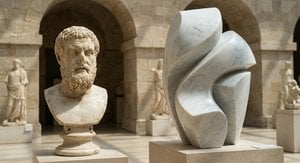
The Enduring Allure of Marble in Art History: From Classical Sculpture to Modern Abstraction
Explore the captivating history of marble sculpture from ancient Greece to modern art. Discover renowned artists like Canova & Michelangelo, carving techniques, and investment insights at ArtsDot.


