


 Preview
 Send
Send Share
Share
 Details
 Guide
Guide

 Download
 Similars
 X-Ray
X-Ray Diaporama
 Stats
StatsSilent Conversation


 Read More
The artwork displayed on this page is protected by copyright law, which means we cannot legally create or sell an identical reproduction. This protection is enforced under international agreements such as the Berne Convention and by national laws, including those outlined by the U.S. Copyright Law - Title 17.
As a respectful and legal alternative, we offer custom, hand-painted artworks inspired by the original. Our skilled and professional artists carefully study the original's style, mood, and artistic essence to create a new, unique piece that evokes the same feeling - while remaining an original creation in its own right.
This method fully complies with copyright regulations because it does not involve copying or duplicating the protected artwork. Instead, it is a creative reinterpretation - a new painting that is influenced by the original but not identical to it.
Hand Made Oil Reproduction
Hand-painted oil on canvas in your size and frame, made to order by our artists. ( Switch to Print Switch to Digital Image)




P118B $10

P118H $10

P118W $10

P438Z $10

P508JH $12

P508YH $12

P805H $10

P805Z $10

P919BZ $10

P919G $10

P919XJ $10

P959ZH $10

P968JZ $12

W106C $8

W218G $10

W218JH $8

W218Y $10

W307PJ $10

W316G $10

W316PJ $8

W316Y $10

W398PJ $8

W4111J $10

W500HY $15

W500JH $15

W692G $12

W849H $8

W940BG $15

W953PJ $8




Pick from our preset sizes that match the artwork's original proportions.

Type the width and the height you need, to fit your frame or your wall. This is hand-painted, so for a size with a different shape the artist can paint a bit more around the picture, or cut a bit — you choose. We send you a digital mockup to approve before the painting starts. The picture shown on this page does not show the real result — only the mockup does.
After order, ArtsDot.com team will email client for instructions and provide a mockup preview
Worldwide Delivery () in 3/4 weeks instead of standard 5 weeks. (24 October). No compromise on quality.

Free Worldwide Express Shipping

High-Quality Linen Canvas

Full Shipping Insurance

Customs Tax Refund Guarantee

True Color Matching Guarantee

100-Day Return Policy (Defects Only)

100% Money-Back Guarantee

Bulk Discount Offer
 Glass option is only available in size under 110 CM

Silent Conversation
Reproduction Medium
Reproduction Size
-


Total Price
$ 263
Silent Conversation – A Portrait of Intimacy Amidst Modernity
Dattatray Gundo Kulkarni’s “Silent Conversation” stands as a remarkable achievement in Indian modernist art, encapsulating a profound exploration of human connection against the backdrop of a rapidly changing world. Painted circa 1970, this monochrome masterpiece transcends mere representation; it delves into the subtleties of unspoken communication and invites contemplation on the complexities of relationships. The artwork’s enduring appeal lies not only in its aesthetic beauty but also in its ability to resonate with viewers across generations.Subject Matter & Composition
The painting depicts a group of individuals seated around a chair, engaged in what appears to be a serious discussion. While faces are deliberately obscured—a stylistic choice characteristic of Kulkarni’s oeuvre—the postures and gestures convey palpable emotion. The central figure leans slightly forward, suggesting vulnerability and openness, while others maintain attentive gazes, mirroring the importance of their exchange. This deliberate framing emphasizes the intimacy of the scene, prioritizing psychological depth over literal depiction.Style & Technique – Minimalism Embraced
Kulkarni’s artistic approach aligns squarely with the tenets of minimalism, a movement gaining momentum globally during the 1960s and 70s. He eschewed elaborate ornamentation or vibrant hues, opting instead for a stark monochrome palette—primarily shades of grey—to heighten the painting's impact. The artist skillfully employs tonal gradations to sculpt form and create depth within the composition. Brushstrokes are deliberate yet understated, conveying texture without distracting from the core message: a quiet contemplation on shared experience.Historical Context & Influences
“Silent Conversation” emerged during a period of significant artistic experimentation in India following independence. The Progressive Artists’ Group (PAG), to which Kulkarni briefly belonged, championed abstraction and challenged traditional artistic conventions—a reaction against colonial influences and a desire to forge an independent Indian aesthetic. This movement sought inspiration from Western modernist masters like Picasso and Matisse, adapting their techniques while retaining distinctly Indian sensibilities. The painting reflects this spirit of innovation, prioritizing emotional resonance over stylistic imitation.Symbolism & Emotional Resonance
The chair itself serves as a potent symbol—representing stability amidst uncertainty, perhaps mirroring the individuals’ shared predicament or aspiration. More importantly, however, “Silent Conversation” speaks to universal themes of empathy and understanding. The absence of facial expressions compels viewers to project their own emotions onto the figures, fostering a personal connection with the artwork. It's a piece that encourages introspection—a reminder that communication extends beyond words, encompassing gestures, glances, and unspoken feelings.Conclusion: An Enduring Legacy
Dattatray Gundo Kulkarni’s “Silent Conversation” remains an evocative testament to modernist Indian art. Its minimalist style, coupled with its masterful depiction of human interaction, continues to captivate audiences today. A reproduction of this artwork would undoubtedly bring a touch of contemplative elegance into any interior space—a celebration of quiet beauty and the enduring power of unspoken connection.Questions & Answers
Where can I find artworks similar to "Silent Conversation" by Dattatray Gundo Kulkarni?
Artworks similar to "Silent Conversation" by Dattatray Gundo Kulkarni are gathered on the artwork's Similars page.
What is the dominant hue of "Silent Conversation" by Dattatray Gundo Kulkarni?
The dominant hue of "Silent Conversation" by Dattatray Gundo Kulkarni is amber to saffron. The hue is the underlying tone of the palette.
What does "Silent Conversation" by Dattatray Gundo Kulkarni bring to an interior?
The serene atmosphere of "Silent Conversation" by Dattatray Gundo Kulkarni matches its recommended space: a living room.
Related Artworks


Artist Biography
The Independent Spirit: The Life and Legacy of Dattatray Gundo Kulkarni
Dattatray Gundo Kulkarni, known to the art world by the evocative moniker Dizi, remains one of the most compelling and singular voices in twentieth-century Indian modernism. Born on December 28, 1921, in the village of Shedbal, Karnataka, his life was a profound testament to the pursuit of artistic truth over external acclaim. While many of his contemporaries sought refuge in established movements, Dizi maintained a fiercely independent path, characterized by an unwavering commitment to his own creative vision. His journey was not merely one of aesthetic evolution but also one of personal resilience; during the Quit India movement of 1942, his patriotic fervor led to imprisonment, an experience that left him with a lifelong limp but perhaps deepened the raw intensity found within his work.
His formal artistic foundation was laid at the prestigious Sir Jamsetjee Jeejebhoy School of Art in Mumbai. It was during these formative years that he balanced the practical necessity of working as an illustrator and cartoonist with his burgeoning passion for fine art. This dual existence allowed him to master the precision of line and the wit of caricature, skills that would later inform the structural integrity of his paintings and sculptures. The name Dizi emerged from this period, becoming a symbol of an artist whose personality and style were inextricably linked. Though he held brief affiliations with the Progressive Artists’ Group and the Bombay Group, he never allowed himself to be subsumed by any single school, preferring instead to exist in the vibrant, often turbulent, center of India's modernizing art scene.
A Mastery of Form and Evolution of Tone
The evolution of Dizi’s technique is a fascinating study in artistic maturation. In his early career, his palette was characterized by a certain brightness—vibrant, gay, and light colors that captured the energy of a young artist exploring the possibilities of medium. However, as he matured, his work underwent a profound transformation. He began to eschew superficial ornamentation and flamboyant color in favor of a more sombre and meditative representation. This shift toward deeper tones, mass, and volume allowed him to explore the very essence of form, creating works that felt grounded and monumental even in their most minimalist expressions.
His versatility was truly remarkable, spanning three distinct media: drawing, painting, and sculpture. Whether he was capturing nuanced details in an intricate drawing, exploring abstract depths in a painting, or manipulating physical space through sculpture, his core philosophy remained constant. He sought to convey an honest representation of inner truth, a goal shared by his close friends and contemporaries, V. S. Gaitonde and S. B. Palsikar. His work often reflected a minimalist approach, reminiscent of the post-war European movements, where simplicity was used as a tool to probe the complexities of human psychology and existence. In his art, one finds a deliberate rejection of the decorative, replaced by a search for a core essence that resonates far beyond the canvas.
Honors and Historical Significance
Dizi’s contribution to Indian art is marked by both his technical mastery and his philosophical depth. He was an artist who believed in surrendering to the center of life without losing one's individual identity, a sentiment that permeates his entire oeuvre. His ability to mirror his own personality through his artistic style made him a unique figure—a rebel with a refined sensibility. This dedication to integrity did not go unnoticed by the institutional art community, which recognized his profound impact on the landscape of Indian modernism.
Throughout his career, he received several prestigious accolades that honored his lifelong commitment to excellence:
- Lalit Kala Akademi Award (1967): A significant recognition of his contribution to the national art scene in India.
- Maharashtra Gaurav Puraskar (1990): An honor reflecting his deep connection to and impact on the cultural heritage of Maharashtra.
Today, the legacy of Dattatray Gundo Kulkarni lives on through works that continue to challenge and inspire. His ability to blend traditional Indian aesthetics with modernist experimentation ensures his place in the canon of great modernists. He remains a symbol of the artist as an independent thinker—one who navigates the complexities of history, politics, and personal struggle to emerge with a voice that is unmistakably, and eternally, his own.

Dattatray Gundo Kulkarni
1921 - 1992 , India
Quick Facts
- Full Name: Dattatray Gundo Kulkarni
- Nationality: Indian
- Date Of Birth: 1921
- Date Of Death: 1992
- Place Of Birth: Shendra, India
- Notable Artworks:
- Dizi's Sculptures
- Dizi's Paintings
- Artistic Movement Or Style: Modernist
- Artists Who Influenced This Artist:
- V. S. Gaitonde
- S. B. Palsikar
- Artists Or Movements Influenced By This Artist: ['Wassily Kandinsky']
Related Articles
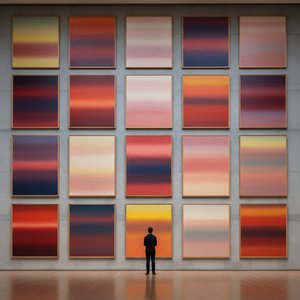
Mark Rothko's Masterpieces: 25 Paintings That Define Abstract Expressionism | ArtsDot
Explore 25 iconic Mark Rothko paintings that define Abstract Expressionism. Discover the stories, colors & emotions behind these masterpieces. Find museum-quality art reproductions and curated decor ideas at ArtsDot.com.

Dark Masterpieces: 10 Iconic Paintings Dominated by Black Tones |
Explore 10 iconic paintings dominated by black tones, from Rembrandt’s chiaroscuro to Goya's dark expressions. Discover the stories behind these masterpieces & find museum-quality art reproductions for your home at .

Kazimir Malevich: 25 Masterpieces of Suprematism & Abstract Art | ArtsDot
Explore 25 iconic artworks by Kazimir Malevich, pioneer of Suprematism & abstract art. Discover the stories behind 'Black Square' and more! Find museum-quality prints & elevate your home decor with ArtsDot.com.

Kandinsky's Masterpieces: 25 Paintings That Define Abstract Art | ArtsDot
Journey through Wassily Kandinsky's 25 most iconic abstract paintings. Explore his revolutionary use of color, form & spiritual expressionism. Find museum-quality Kandinsky reproductions and elevate your home decor with ArtsDot.com. Discover all masterpieces on ArtsDot.com!

White on Canvas: 10 Masterpieces & Timeless Elegance for Your Home Decor
Explore 10 iconic white paintings by Monet, Whistler & Rothko! Discover the stories behind these serene masterpieces and their impact on art history. Find museum-quality reproductions for your home decor at .
