


 Preview
 Send
Send Share
Share
 Details

 Download
 Similars
 X-Ray
X-Ray Diaporama
Breakers
 Impressionism
 1870
1870 12.0 x 20.0 cm
 Read More
Giclée / Art Print
Museum-quality giclée or canvas print with fast production and flexible finish options. ( Buy Hand Made Painting Buy Image)




































Pick from our preset sizes that match the artwork's original proportions.

You may enter your own dimensions to fit a specific frame or space. If your selected size does not match the original image's proportions, we will either crop the artwork or extend the image with a mirrored or solid-fill edge. A digital mockup will be sent for your approval before production begins.
Please note that the on-screen preview does not reflect the actual cropping or extension. Only the mockup will accurately show the final composition.
While custom sizes are available, we recommend selecting a dimension from the predefined list to preserve the original proportions.
Worldwide Delivery () in 2 weeks instead of standard 4/5 weeks. (2 September)

Free Worldwide Express Shipping

High-Quality Linen Canvas

Full Shipping Insurance

Customs Tax Refund Guarantee

True Color Matching Guarantee

60-Day Return Policy (Defects Only)

100% Money-Back Guarantee

Bulk Discount Offer
 Glass option is only available in size under 110 CM

Breakers
Giclée / Art Print
Reproduction Size
-


Total Price
$ 63
Related Artworks


Artist Biography
The Visionary of the Scottish Shore
Born in Glasgow in 1841, Colin Hunter emerged as one of the most evocative voices of the Victorian era, a painter whose soul seemed inextricably linked to the rhythmic pulse of the sea. His early years were shaped by the coastal atmosphere of Helensburgh, where the Firth of Clyde provided a natural classroom for a young boy captivated by the interplay of light and water. Before dedicating himself to the brush, Hunter worked as a clerk in a shipping office, a role that perhaps deepened his intimate understanding of maritime life and the vital connection between humanity and the ocean. This period of observation would later manifest in his canvases as a profound, lived-in realism, far beyond mere academic imitation.
Hunter’s artistic journey was marked by a transition from the structured world of commerce to the boundless freedom of the studio. After leaving his clerical post at twenty, he sought formal training, eventually finding himself in the Parisian studio of Leon Bonnat. While the French influence introduced him to new perspectives on form and light, Hunter remained fundamentally anchored to his Scottish roots. His style evolved into a masterful blend of Luminism and atmospheric realism, where the primary subject was not just the physical landscape, but the very air that moved across it. He possessed a rare ability to capture the ephemeral—the mist clinging to a rugged cliffside, the spray of a breaking wave, or the soft, melancholic glow of dawn over a quiet bay.
Mastery of Light and Maritime Life
The true heart of Hunter’s oeuvre lies in his celebrated seascapes and his tender depictions of coastal communities. He did not merely paint the ocean; he painted the struggle and the serenity of those who lived by its grace. His works often feature the hardworking fisher-folk of the Scottish coast, rendered with a dignity that elevates their daily labors to the level of epic drama. Through subtle gradations of tone and delicate blending, he achieved a sense of movement that makes the water feel alive, capturing both the terrifying dynamism of a storm and the tranquil stillness of a summer morning.
Beyond the shores of Scotland, Hunter’s curiosity led him to explore diverse landscapes, including the breathtaking majesty of Niagara Falls. This versatility demonstrated his ability to adapt his atmospheric technique to different scales of grandeur. His technical prowess was recognized on the global stage, as he exhibited his works in major international arenas such as Berlin, Vienna, and Philadelphia. These exhibitions solidified his reputation as an artist capable of communicating universal emotions through specific, localized scenes.
Legacy and Artistic Circle
Hunter’s significance extends beyond his individual canvases to his role within the vibrant artistic community of late 19th-century London. Residing in the prestigious Melbury Road enclave in Kensington, he lived among a circle of esteemed contemporaries, including:
- Lord Leighton, whose academic excellence complemented Hunter's atmospheric approach.
- George Frederic Watts, a fellow master of symbolic and emotive painting.
- Luke Fildes, with whom he shared a commitment to narrative and social realism.
His ascent within the prestigious Royal Academy, becoming an Associate Member in 1884, stands as a testament to his enduring influence and technical mastery. When Colin Hunter passed away in 1904, he left behind a legacy of paintings that serve as windows into a vanished era of maritime tradition. His work remains a profound meditation on the relationship between man and nature, reminding us that even in the most rugged landscapes, there exists a delicate, luminous beauty waiting to be discovered by those who know how to look.

colin hunter
1841 - 1904
Quick Facts
- Artistic Movement Or Style: Seascape
- Artists Or Movements Influenced By This Artist: ['William Leiper']
- Date Of Death: 1904
- Full Name: Colin Hunter
- Nationality: Scottish
- Notable Artworks: ['Boats at Rest, Coldingham']
- Place Of Birth: Glasgow, Scotland
Related Articles

The Allure of the Horizon: A Comprehensive Exploration of Seascape Art Through History & Emotion
Explore the captivating world of seascape art! Discover its history, key artists & movements – from Dutch Masters to Impressionism. Expert insights for collectors and enthusiasts at ArtsDot.
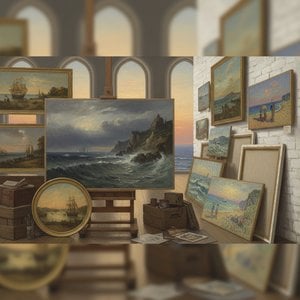
Evoking the Horizon: A Historical & Artistic Exploration of Coastal Scenes in Painting
Explore the rich history of coastal scenes in painting! Discover Impressionist masterpieces, American realism & contemporary visions. Learn about renowned artists and find your perfect seascape at ArtsDot.

The Enduring Legacy of Oil on Canvas: Technique, History & Aesthetic Impact
Explore the rich history & techniques of oil painting – from Renaissance masters to Impressionism. Discover pigments, layering methods, and why this timeless medium endures. Expert insights for artists & art enthusiasts.

Serene Fishing Village Art: Bring Coastal Charm and Seaside Magic to Your Home
Transform your home with the serene beauty of fishing village art. Discover exquisite hand-painted Impressionist seascapes and coastal landscapes designed to bring seaside magic and timeless charm to your interior decor. Explore our curated collection of masterwork reproductions today.

Oil on Canvas: A Historical & Technical Exploration of a Timeless Artistic Medium
Explore the rich history & enduring techniques of oil painting on canvas. Discover the science behind its longevity, conservation practices, and contemporary relevance. Expert insights for art enthusiasts.



