

 Preview
 Send
Send Share
Share
 Details
 Guide
Guide

 Download
 Similars
 X-Ray
X-Ray Diaporama
 Q&A
Q&A Stats
Statsuntitled (3238)


 Read More
Get a print-ready file that goes far beyond the web preview. Every digital image we sell comes from a high-resolution master in our stock database — usually 5,000 to 15,000 pixels wide — so you can print large, crop tightly, or reproduce fine detail with confidence.
No file leaves our studio untouched. A digital expert checks the colors against the original painting and corrects them if needed, then improves clarity and detail with professional retouching tools — always staying faithful to the artist's brushwork and style. The result is an image that looks like the painting, not like a filtered scan.
You approve before you're done: our expert sends the image by e-mail within 72 hours for your review. Not satisfied? Ask for improvements or corrections, or request a refund if the quality falls short.
This is the quality relied on by publishers, design studios, galleries and print shops.
Digital Image
Download a high-resolution file for personal display, printing, and creative projects. ( Switch to Print Buy Hand Made Painting)
Included in Every Digital Image Order
Expert Digital Delivery, Guaranteed
When you choose ArtsDot.com, you're not just getting an image - you're receiving a professionally enhanced digital artwork, crafted with precision and backed by a satisfaction guarantee. Here's everything that comes with your order, automatically:

Fast Email Delivery
Your high-resolution digital image file will be emailed to you within 72 hours of ordering - ready for immediate use.

AI-Enhanced Digital File
Your artwork is professionally optimized using advanced AI tools and manual editing, ensuring maximum detail, clarity, and color accuracy.

Free Lifetime Re-Delivery
Accidentally deleted or lost your file? No worries - we'll resend it to you anytime, free of charge.

No Import Fees - Ever
Enjoy your artwork instantly with zero customs, duties, or delivery fees - digital downloads are always tax-free.

Color Accuracy Guarantee
We ensure your digital image reflects the original colors as closely as possible using professional tools and color management.

100-Day Satisfaction Guarantee
If you're not satisfied with your digital image, we'll revise it or refund 100% within 100 days - no questions asked.

100% Money-Back Guarantee
Not satisfied? Get a full refund within 100 days of receiving your digital file - no questions asked.

Bulk Order Discounts
Buy 3 images, save 10% - Buy 5, save 15% - Buy 10+, save 20%. Great for creative projects, galleries, and agencies.
A Moment Frozen in Light: Claude Monet’s “Untitled (3238)”
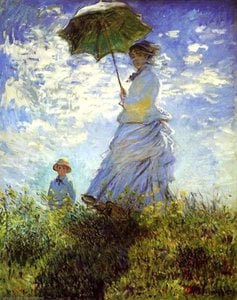
Claude Monet's "Untitled (3238)," a captivating work from the heart of the Impressionist movement, isn’t merely a depiction of a woman in a field; it’s an invitation to experience a fleeting moment, captured with the artist’s signature broken color and atmospheric sensitivity. Painted around 1907, this piece embodies Monet's lifelong pursuit of translating the ephemeral effects of light and atmosphere onto canvas – a core tenet of his revolutionary approach to art. The painting immediately draws the viewer in with its serene palette dominated by pale yellows, soft greens, and hazy blues, creating an immediate sense of tranquility and quiet contemplation. It’s a world bathed in diffused sunlight, suggesting either an overcast day or the gentle glow of early morning or late afternoon.
At first glance, the composition appears simple: a solitary female figure stands within a field of grasses, sheltered beneath an elegant umbrella. However, closer observation reveals a masterful manipulation of form and space. Monet eschews sharp outlines, instead employing loose, flowing brushstrokes to define the woman’s dress, the umbrella's delicate structure, and the undulating forms of the vegetation. This technique, characteristic of Impressionism, prioritizes capturing the *impression* of these objects rather than their precise representation. The background melts into a soft blur, emphasizing the figure in the foreground and creating a sense of depth through atmospheric perspective – a subtle layering of colors that mimics the way light scatters in the air.
The Language of Light: Monet’s Impressionistic Technique
Monet's technique is inextricably linked to his philosophy. He famously abandoned traditional studio painting, opting instead to work *en plein air* – directly from nature. This practice allowed him to observe and record the constantly shifting qualities of light with unparalleled accuracy. In "Untitled (3238)," this dedication is evident in the vibrant yet delicate application of paint. Thick impasto strokes build up texture on the canvas, particularly noticeable in the grasses and umbrella, creating a palpable sense of surface and inviting the viewer to almost feel the warmth of the sun. The broken color—small, distinct brushstrokes of pure pigment applied side-by-side—is key to Monet’s style. Rather than blending colors seamlessly, he deliberately left visible traces of each stroke, allowing them to interact optically on the eye, creating a shimmering effect and conveying the vibrancy of light.
The painting's color choices are not arbitrary; they contribute significantly to its emotional impact. The muted yellows and greens evoke a sense of pastoral beauty and tranquility, while the blues suggest distance and atmospheric haze. Monet’s masterful use of complementary colors—the juxtaposition of yellow and blue, for instance—intensifies the vibrancy of each hue and creates visual harmony within the composition. It's a testament to his ability to capture not just what he *saw*, but also how it *felt* – the warmth, the stillness, the fleeting beauty of a summer’s day.
Symbolism and Narrative in a Fleeting Moment
While seemingly straightforward, "Untitled (3238)" invites contemplation on deeper themes. The umbrella, a recurring motif in Monet's work, can be interpreted as a symbol of protection – shielding the figure from the elements or perhaps representing a desire for solitude and introspection. The woman herself remains enigmatic, her gaze directed towards an unseen horizon. She embodies a sense of quiet contemplation, lost in thought amidst the beauty of nature. The painting’s lack of specific narrative detail encourages viewers to project their own emotions and experiences onto the scene, transforming it into a personal meditation on themes of memory, solitude, and the transient nature of beauty.
Considering Monet's broader oeuvre, particularly his series of paintings depicting water lilies at Giverny, this work resonates with a similar exploration of light, color, and the natural world. It’s a poignant reminder that art can capture not just appearances but also the very essence of a moment in time – a fleeting glimpse of beauty preserved forever on canvas.
Historical Context and Legacy
Painted during a period of significant artistic innovation, "Untitled (3238)" stands as a pivotal example of Impressionism. Emerging in France in the mid-19th century, this movement challenged traditional academic painting conventions by prioritizing subjective perception and capturing the immediate effects of light and color. Monet, along with artists like Renoir and Degas, played a crucial role in establishing Impressionism’s core principles. His dedication to *en plein air* painting, his exploration of optical mixing, and his focus on capturing fleeting moments profoundly influenced subsequent generations of artists.
Today, "Untitled (3238)" is held within the collection of Musée de l'Orangerie in Paris, where it continues to captivate audiences with its luminous beauty and evocative atmosphere. Reproductions of this iconic work are highly sought after by collectors and interior designers alike, offering a chance to bring a touch of Monet’s serene vision into any space.
Questions & Answers
What placement suits the format of "untitled (3238)" by Claude Monet?
The portrait format of "untitled (3238)" by Claude Monet is recommended for a living room. Format and space together guide the placement of a reproduction.
Which artist and which style stand behind "untitled (3238)"?
Behind "untitled (3238)" stand Claude Monet and the Impressionism movement.
What stage of Claude Monet's development does "untitled (3238)" represent?
"untitled (3238)" represents the Mature Period of Claude Monet.
Related Artworks




Artist Biography
Early Life, Family and Training
Born in Paris, France, on 14 November 1840, Claude Monet entered a world of diverging expectations. While his father, Claude-Adolphe Monet, envisioned a more stable professional path for his son, his mother, Louise-Justine Aubrée Monet, offered a quiet support for his burgeoning creative inclinations. The family eventually settled in Le Havre, Normandy, where the coastal atmosphere would leave a lasting impression on the young boy. This period of childhood was marked by an early talent for drawing, a skill that would eventually lead him away from the commercial interests his father preferred.
Tragedy arrived in January 1857, when Monet was sixteen years old. The death of his mother, Louise-Justine, forced a sudden shift in his domestic life. He was sent to live with his aunt, Marie-Jeanne Lecadre, a widow who possessed significant wealth and no children of her own. This transition provided the stability necessary for his formal development. It was during these formative years that he encountered Eugène Boudin, a man who would fundamentally alter his perspective on the purpose of painting. Boudin introduced him to the practice of plein air painting, encouraging him to take his materials outdoors to capture the immediate reality of the natural world.
His training continued in the structured environments of Paris. He sought instruction at the Académie Suisse, studying under the academic history painter Charles Gleyre. This period of study allowed him to refine his technical abilities while navigating the tension between traditional academic methods and the more spontaneous, observational approach he had begun to favor. These early years of instruction and loss shaped the foundation of a career defined by the pursuit of light and atmosphere.
The Impressionist Movement and Style
As a founder of French Impressionism, Claude Monet acted as a key precursor to modernism. He was the most consistent and prolific practitioner of the movement's core philosophy, which sought to express a person's perceptions of nature. This pursuit was defined by plein air landscape painting, a method that required him to work directly on large-scale canvases out of doors. He would often return to his studio to rework and complete these pieces, bridging the gap between the immediate observation of the outdoors and the controlled environment of the studio.
His technical approach relied on unmediated colors and asymmetrical arrangements of forms. Rather than seeking a static representation, he developed a method of painting the same scene many times to capture the shifting effects of light and the passing of the seasons. This repetitive study allowed him to document how atmosphere and weather transformed a single subject. His work moved away from academic precision, focusing instead on the ephemeral qualities of the environment.
- Impression, Sunrise (1873)
- The Road Bridge at Argenteuil (1874)
- The Walk. Lady with a Parasol (1875)
Life and Works in Argenteuil
In 1871, Monet moved to Argenteuil, a village situated northwest of Paris. This period marked a significant shift in his social and creative landscape. As his colleagues frequently joined him in the village, the area became closely associated with the burgeoning Impressionist movement. The setting provided a steady rhythm of life and light that would define much of his output during these years.
His domestic life was deeply intertwined with his artistic practice. His first wife, Camille Doncieux, became a frequent presence in his compositions, serving as a model for his figurative paintings throughout the 1860s and 1870s. In the spring of 1872, he turned his attention to the immediate surroundings of his home, producing several canvases within his own garden. These works captured the seasonal shifts of the local landscape through a lens of direct observation.
- Springtime (1872)
- The Seine at Argenteuil (about 1874)
The Years in Giverny
In 1883, Monet moved to a house and property in Giverny, a village northwest of Paris. This relocation marked the beginning of a forty-three-year residency that would define his later existence. He did not merely inhabit the space; he actively shaped it, embarking on a vast landscaping project that transformed the grounds into a living subject. His hands were as much involved in the cultivation of the earth as they were in the application of pigment, as he planted thousands of flowers and engineered a water-lily pond to serve as a focal point for his observations.
The garden became a sanctuary of light and seasonal change. For the final thirty-one years of his life, his artistic focus narrowed toward the specificities of this environment. He sought to document the way light interacted with the water and the flora, often working directly from the garden to capture the immediate sensations of the landscape. This period was characterized by a devotion to the shifting atmosphere of his private estate, where the boundaries between the cultivated garden and the canvas began to blur.
- Irises in Monet's Garden (1900)
- Pathway in Monet's Garden at Giverny (1902)
- The Japanese Bridge (1918)
Key Works and Series Paintings
Monet’s contribution to the evolution of modern art was cemented by a single work that inadvertently defined an entire movement. His 1873 painting, Impression, Sunrise, provided the name for the Impressionist movement, even as its loose handling and indistinct forms initially drew scorn from the establishment. This work signaled a departure from the rigid expectations of the Salon, favoring the immediate perception of light over the polished finish of academic tradition.
As his career progressed, his focus shifted toward the repetitive study of a single subject to capture the shifting nuances of light, weather, and time. This method of creating series paintings allowed him to document how a single scene transformed under different atmospheric conditions. He applied this rigorous observation to various subjects, including Haystacks, Rouen Cathedrals, and Poplars. Through these studies, he sought to render not just the object itself, but the very air and light that surrounded it.
The most extensive manifestation of this obsession occurred in his later years at Giverny. There, he produced a vast series of approximately 250 oil paintings titled Water Lilies (Nymphéas). These works focused on his flower garden and the water-lily pond, often painted while he contended with failing eyesight. The series represents a profound commitment to the ephemeral, attempting to fix the movement of water and the reflection of clouds upon its surface.
- Impression, Sunrise (1873)
- Water Lilies (Nymphéas)
Circle of Artists and Influences
Monet’s artistic path was shaped by a series of vital encounters and mentorships that moved him away from the rigid constraints of academic tradition. His early training was significantly influenced by Eugène Boudin, who introduced him to the practice of plein air painting. This emphasis on working outdoors allowed him to observe the immediate effects of light on the landscape, a method that would define his entire career. He also drew inspiration from the Dutch landscapist Johan Jongkind, whose approach to nature helped refine his vision of the natural world.
In the studios of Paris, his development was furthered by the company of peers who would become central to the evolution of modern painting. While studying under Charles Gleyre at the Académie Suisse, he was a classmate of Auguste Renoir, alongside Frédéric Bazille and Camille Pissarro. These friendships were more than mere social connections; they were the foundations of a shared rebellion against the established Salon. Throughout his career, he worked and exhibited alongside figures such as Edgar Degas and Édouard Manet, contributing to a collective shift in how light and atmosphere were perceived on canvas.
- Impression, Sunrise (1873)
- The Japanese Bridge (1918)
- Water Lilies (Nymphéas) (1906)
Later Years and Death
The final decades of Monet's life were deeply intertwined with the landscape he had so meticulously cultivated. In 1892, he married Alice Hoschedé, a union that provided a sense of stability as he continued his obsessive study of light and atmosphere. His focus narrowed toward the water garden at Giverny, where the interplay of reflections and flora became his primary preoccupation. This period was marked by a relentless pursuit of the ephemeral, often working through the physical challenges of failing vision to capture the shifting nuances of his surroundings.
As his life drew to a close, the scale of his vision expanded. He moved toward large-scale works that sought to envelop the viewer, particularly through his series of water lily paintings. These works were not merely depictions of a pond but were attempts to record the very act of perception. His death occurred on 5 December 1926, leaving behind a body of work that had fundamentally altered the way nature was observed on canvas.
The transition from his personal life to his public presence was completed shortly after his passing. In May 1927, the Musée de l'Orangerie opened its doors to the public, providing a permanent home for his large-scale murals. This space was designed to honor the specific atmosphere he had spent his final years attempting to translate into paint.
Legacy and Global Influence
The influence of Claude Monet expanded significantly during the second half of the 20th century, as his presence in the global consciousness grew. He remains an undisputed titan of Impressionism, having been a key figure in the movement that transformed French painting during the latter half of the nineteenth century. His approach to light and atmosphere fundamentally altered how painters perceived the natural world, moving away from academic rigidity toward a more immediate, sensory experience of the landscape.
His late-career focus on the water-lily paintings produced a body of work that is among the most recognised and celebrated of the 20th century. These works, often characterized by their scale and focus on the reflections within his Giverny garden, moved beyond mere landscape to explore the very essence of perception. By documenting the shifting qualities of light through repetitive study, he provided a blueprint for modernism, influencing generations of artists who sought to capture the ephemeral nature of sight and color.

Claude Monet
1840 - 1926 , France
Quick Facts
- Artistic Movement Or Style: Impressionism
- Artists Or Movements Influenced By This Artist: ['Modernism']
- Artists Who Influenced This Artist:
- Eugène Boudin
- Johan Jongkind
- Full Name: Oscar-Claude Monet
- Nationality: French
- Notable Artworks:
- Impression, Sunrise
- Water Lilies
- Haystacks
- Rouen Cathedral
- Place Of Birth: Paris, France
- Date Of Birth: 1840
- Date Of Death: 1926