

- 170.0 x 170.0 cm


The picture follows your choices: , .
Collectible Description
Discover Claude Monet’s ‘Turkeys’ (1876), a stunning Impressionist oil painting of vibrant turkeys in a serene landscape. Explore its technique & beauty at the Musée d'Orsay!
 Read More
Artist Biography
Impressionist master Claude Monet is famous for his Water Lilies series. Discover the beauty of his light-filled landscapes today.
Hand Made Oil Reproduction
Hand-painted oil on canvas in your size and frame, made to order by our artists. ( Switch to Print Switch to Digital Image)
More about this painting
 Preview
 Send
Send Share
Share
 Details
 Guide
Guide

 Download
 Similars
 X-Ray
X-Ray Diaporama
 Q&A
Q&A Stats
StatsOrder your painting in four simple steps
Take your time. You can change any answer; the price in your order card follows each choice.
1 Step one of four
Which size would you like?
These sizes keep the proportions of the original painting. The drawing shows your choice on a wall, above a two-metre sofa.
Or give your own measurements
Pick from our preset sizes that match the artwork's original proportions.

Type the width and the height you need, to fit your frame or your wall. This is hand-painted, so for a size with a different shape the artist can paint a bit more around the picture, or cut a bit — you choose. We send you a digital mockup to approve before the painting starts. The picture shown on this page does not show the real result — only the mockup does.
2 Step two of four
How should it be prepared: rolled, stretched or framed?
The prices below are for the size you chose in step one.
Choose the edges of the stretched canvas
Choose your frame

White $1

Blurside $1

Extended $1

P118B $10

P118H $10

P118W $10

P438Z $10

P508JH $12

P508YH $12

P805H $10

P805Z $10

P919BZ $10

P919G $10

P919XJ $10

P959ZH $10

P968JZ $12

W106C $8

W218G $10

W218JH $8

W218Y $10

W307PJ $10

W316G $10

W316PJ $8

W316Y $10

W398PJ $8

W4111J $10

W500HY $15

W500JH $15

W692G $12

W849H $8

W940BG $15

W953PJ $8

H24-GOLD $30

H24-SILVER $30

H36-GOLD $45

H36-SILVER $45
Framed
Moulding: . Overall size with the frame: .
3 Step three of four
Would you like anything changed in the painting?
Most people answer no. Because each painting is made by hand, our artist can also adapt it for you.
After order, ArtsDot.com team will email client for instructions and provide a mockup preview
4 Step four of four
A few finishing options
All of them are optional. The answers already selected cost nothing extra.
Who paints it?
Worldwide Delivery () in 3/4 weeks instead of standard 5 weeks. (10 November). No compromise on quality.
A nameplate, as in a museum?
Engraved Bronze Plaque Details
This elegant plaque features the artist's name and the title of the artwork, finely engraved for a timeless presentation.
It is made from bronze with a refined, elegant finish. The text is precisely laser-engraved for a sharp and permanent result. Measuring 9x2 cm, the plaque is compact yet easy to read. It's built to be durable and scratch-resistant, offering a professional, museum-quality look. Mounting is simple thanks to the included adhesive backing.
Transparent Acrylic Plaque Details
The plaque includes essential engraved details such as the artist's name, the title of the artwork, the date it was created, the type of media used-like oil on canvas or watercolor-a brief description of the piece, and a QR code that links to the complete artwork information.
It is crafted from clear acrylic, offering a sleek, modern appearance. The text is UV-engraved in black to ensure strong visual contrast. With a size of 10x15 cm, it ensures optimal readability. It comes equipped with two metal hooks for secure wall mounting. The plaque is designed to be weather-resistant, making it suitable for various environments, and it includes interactive features that work seamlessly with smartphone scanning.
Black Acrylic Plaque Details
This elegant plaque includes engraved information such as the artist's name, the title of the artwork, the date it was created, the type of media used (like oil on canvas or watercolor), a short description of the artwork, and a QR code for quick access to more information.
The plaque itself is made from refined black acrylic with a premium finish. The text is laser-engraved in white for high contrast and readability. Its size is 10x15 cm, designed to be easy to read. It comes with two metal hooks for professional mounting. The design is sleek and fits any interior style. It is also weather-resistant and durable, with built-in digital integration for mobile compatibility.
A protective varnish?
When do you need it?
✓ Check and order
Your painting, as you ordered it

Turkeys
Reproduction Medium
Reproduction Size
-

Elite Senior Artist
More detail, finesse, and extra production time
-

Reproduction Frame
-
-
For artworks or reproductions larger than 105 cm (approximately 41 inches) on any side, the frame will be shipped as a kit, disassembled. This method ensures safe delivery and prevents damage during transport.
Professional assembly required - this is not a DIY product.
The kit must be assembled and the canvas stretched by an experienced professional framer, using wood glue (not supplied), a canvas stretching plier and clamps to hold the bars square while the glue dries. Incorrect assembly or uneven canvas tension can permanently damage the artwork and is not covered by our warranty.
 For artworks or reproductions larger than 105 cm (approximately 41 inches) on any side, the frame will be shipped as a kit, disassembled. This method ensures safe delivery and prevents damage during transport.
All solid wood bars are included, precisely cut to size.
Assembled with the screws provided, plus wood glue for the corner joints, which is not supplied and must be sourced by your framer.
Professional tools are required and not included: a canvas stretching plier (tensioner) and clamps to hold the bars square while the glue dries.
Important:
The corner joints require wood glue, the bars must be held with clamps until the glue is fully dry, and tightening the canvas on the assembled frame requires a canvas stretching plier. None of these are included in the kit. Please arrange an experienced professional framer before ordering this size.

Nameplate
-
-

Protective Varnish
Glossy Varnish (enhances colors, protects against light/moisture)
-

Customize My Artwork
Examples of what can be changed: Replace face with customer photo; Add pet (e.g., replace cat with dog); Include hidden message in background; Change background landscape or elements.
-

Urgent
Worldwide Delivery () in 3/4 weeks instead of standard 5 weeks. (10 November). No compromise on quality.
-
Express Shipping
Worldwide Delivery () in 5 weeks. (17 November).
Included
Total Price
$ 263
Glass option is only available in size under 110 CM
Included with every order
- Free Worldwide Express Shipping
- High-Quality Linen Canvas
- Full Shipping Insurance
- Customs Tax Refund Guarantee
- True Color Matching Guarantee
- 100-Day Return Policy (Defects Only)
- 100% Money-Back Guarantee
- Bulk Discount Offer


A Pastoral Vision: Claude Monet’s “Turkeys”
Claude Monet's 1876 painting, *Turkeys*, is a captivating example of Impressionism at its most serene and evocative. Measuring 170 x 170 cm, this oil on canvas currently resides in the prestigious Musée d'Orsay in Paris, offering viewers a glimpse into a fleeting moment of rural life. The artwork isn’t simply a depiction of birds; it’s an exploration of light, color, and atmosphere that defines Monet’s revolutionary approach to painting.Subject and Composition
The scene unfolds with a flock of at least thirteen turkeys leisurely roaming within a lush field. Their forms are scattered across the canvas, some clustered together while others venture independently, creating a sense of natural movement. A stately mansion subtly appears in the background, partially obscured by trees, adding depth and hinting at a cultivated landscape beyond the wilder foreground. The composition is deliberately informal, mirroring the spontaneity of an observed moment rather than a rigidly constructed scene.Impressionistic Technique
Monet’s mastery lies in his innovative technique. He eschews precise detail in favor of capturing the *impression* of light and color. Short, broken brushstrokes – a hallmark of Impressionism – are layered to create a vibrant surface that seems to shimmer with life. The colors aren't blended smoothly; instead, they exist as distinct touches, allowing the viewer’s eye to mix them optically. This technique lends an immediacy and freshness to the painting, conveying the fleeting effects of natural light on the landscape and the birds themselves.Historical Context & The Impressionist Movement
Painted in 1876, *Turkeys* emerged during a pivotal period for art history – the rise of Impressionism. Rejecting the academic conventions of the Salon system, Monet and his contemporaries sought to depict modern life and landscapes with honesty and spontaneity. They prioritized capturing the subjective experience of seeing, focusing on light, color, and atmosphere over precise representation. This radical approach initially faced criticism but ultimately revolutionized painting, paving the way for modern art. Monet was a leading figure in this movement, consistently pushing its boundaries through his dedication to *plein air* painting – working outdoors directly from nature.Symbolism & Emotional Impact
While seemingly straightforward, *Turkeys* invites subtle interpretations. The turkeys themselves can be seen as symbols of abundance and the simple pleasures of rural life. Their relaxed presence evokes a sense of tranquility and harmony with nature. The painting’s overall effect is one of peaceful contemplation. It's an invitation to slow down, observe, and appreciate the beauty of the everyday world – a core tenet of Impressionist philosophy. The soft lighting and muted palette contribute to this calming atmosphere, making it a visually soothing work.Monet’s Legacy & Collecting Considerations
Claude Monet remains one of the most beloved and influential artists in history. His works are highly sought after by collectors and institutions worldwide. Beyond *Turkeys*, notable paintings include The Tuileries (study), also housed in a Parisian museum, and other depictions of turkeys that demonstrate his fascination with this subject. A high-quality reproduction of *Turkeys* can bring the serenity and beauty of Monet’s vision into any interior space, adding a touch of timeless elegance and artistic sophistication. Its harmonious color palette makes it particularly well-suited for living rooms, bedrooms, or studies seeking a calming ambiance.Further Exploration
- Related Works: Explore Monet’s other series paintings, such as the Haystacks and Rouen Cathedral series, to understand his innovative approach to capturing light and atmosphere.
- Impressionist Masters: Discover the works of Monet's contemporaries – Renoir, Degas, and Cassatt – to gain a broader understanding of the Impressionist movement.
- Musée d’Orsay Collection: Visit the Musée d’Orsay website for more information about their extensive collection of Impressionist and Post-Impressionist art.
Questions & Answers
In which movement and which era is "Turkeys" by Claude Monet placed?
"Turkeys" by Claude Monet is placed in the Impressionism movement, within the 19th-Century era of its creator.
Where can I buy a digital image of "Turkeys" by Claude Monet?
"Turkeys" is available as a high-resolution digital image download, purchased directly on its Digital Image page.
What is "Turkeys" made with, and in which style?
"Turkeys" by Claude Monet combines the oil on canvas technique with the Impressionism style. Technique and movement describe the making and the style of the work.
Related Artworks


Claude Monet
1840 - 1926, France
Artist Biography
The Early Life of Claude Monet
To understand the mechanics of modern perception, one must look at the specific, often turbulent, origins of Claude Monet. Born on 14 November 1840 in Paris, France, he was the second son of Claude-Adolphe Monet and Louise-Justine Aubrée Monet. His entry into the world was marked by a formal baptism on 20 May 1841 at Notre-Dame-de-Lorette, Paris, where he was recorded under the name Oscar-Claude. This early Parisian existence was short-lived. By 1845, the family had relocated to Le Havre, Normandy, a move that shifted his environment from the urban center to the salt-misted atmosphere of the coast.
The stability of his youth was fractured by personal loss. In January 1857, when he was only sixteen years old, his mother died. This event stripped away a primary source of support during his formative years. While his father initially intended for him to enter the world of commerce, the trajectory of his life was already moving toward a different, more visual preoccupation. The shift from the structured life of a Parisian household to the unpredictable elements of Normandy provided the raw, environmental data that would eventually define his entire approach to light and atmosphere.
Artistic Training and Early Influences
Monet’s technical foundation was built on a series of practical, unglamorous lessons that prioritized direct observation over academic theory. His formal education began when he entered the Le Havre secondary school of the arts on 1 April 1851. Before the structured environment of the school, he received his first drawing lessons from Jacques-François Ochard. These early exercises provided the basic dexterity required for a professional career, but they were merely the starting point for a much more radical approach to the medium.
The real shift occurred through his connection with Eugène Boudin. Boudin did more than teach him how to handle oil paints; he introduced the concept of painting en plein air. This insistence on working outdoors, facing the elements, stripped away the safety of the studio. By the time Monet moved to Paris and studied under Charles Gleyre in 1862, his trajectory was already set toward the immediate and the perceptual. In Gleyre’s studio, he was not an isolated student but part of a specific cohort of painters, including classmates Auguste Renoir and Frédéric Bazille. These associations were not merely social; they were the crucible for a new way of seeing that rejected the dark, controlled environments of the traditional Salon.
The Rebellion of Impressionism
The art establishment of the 19th century relied on the rigid, dark constraints of the academic Salon, but Monet chose a different path. In 1874, he joined a group of artists to organize an independent exhibition, a direct challenge to the conservative standards of the time. This was not a mere disagreement over technique; it was a fundamental break from tradition. By seeking to record the world as it was actually perceived by the eye, he became a key precursor to modernism. He moved away from the polished, photographic realism demanded by the academies to focus on the subjective sensation of a scene.
The movement eventually took its name from a single work: Impression, Sunrise. Originally, the term "Impressionism" was intended as a mockery by critics who viewed his loose brushstrokes and unfinished appearance with derision. Monet did not fight the label. He embraced it, using the concept to define a style centered on the fleeting, transient moment. He replaced traditional dark grounds with light-colored primers, allowing light to dictate the composition rather than strict linear perspective.
- Impression, Sunrise (1873)
Life in Argenteuil and Vétheuil
The period between 1871 and 1878 in Argenteuil was a time of intense observation. Living near the Seine, Monet focused on the domestic and the immediate. This era produced works like The Promenade at Argenteuil, Soleil Couchant (1874), which captured the specific light of a sunset. His life here was defined by the presence of his wife, Camille, and their son, Jean. This stability provided a foundation for his experiments with light and color before the movement's social pressures intensified.
Tragedy disrupted this rhythm. Following the death of Camille in 1879, Monet moved to Vétheuil, where he remained until 1881. This transition marked a shift in his personal and professional trajectory. The loss of his wife coincided with a period of significant change in his domestic life and his approach to the landscape. He moved next to Poissy, staying there from 1881 until 1883. These years were not merely transitional; they were essential for an artist refining his ability to translate sensory perception into paint.
- The Promenade at Argenteuil, Soleil Couchant (1874)
- Camille Monet On Her Deathbed (1879)
The Sanctuary of Giverny
Monet’s move to Giverny in 1883 marked a shift from observing nature to actively constructing it. He spent the next 43 years transforming this property into a controlled environment designed for visual study. This was no casual gardening; he engineered an elaborate landscape featuring a water lily pond and a Japanese bridge. By manipulating the terrain, he created a living laboratory where light and water interacted under his specific terms. He was not merely a spectator of the landscape but its architect.
The focus of his later years centered on this aquatic environment. For the final 31 years of his life, the water lily pond became his primary subject. He used the garden to document the way light dissolved forms and how shadows moved across the surface. This period of intense observation resulted in a massive output of canvases that stripped away traditional perspective. His work from this era remains a direct record of his obsession with the ephemeral qualities of his own creation.
- Irises in Monet's Garden (1900)
- The Japanese Bridge (1918)
Technique and Artistic Style
Monet’s approach to the canvas was a rejection of the dark, controlled environments of the traditional studio. He prioritized en plein air painting, taking his easel directly into the unpredictable elements of nature to capture light as it actually functioned. This commitment to immediacy required a specific technical vocabulary. He utilized rapid, visible brushstrokes and a method of broken color, applying unmixed pigments side-by-side. This forced the viewer's eye to perform the blending, creating an optical truth that a smooth, blended surface could never achieve. He abandoned the heavy, dark grounds favored by the Academy, opting instead for light-colored primers that maximized the luminosity of his palette.
His compositions often discarded the safety of linear perspective. Instead, he favored asymmetrical arrangements, a structural choice heavily influenced by the flattened planes of Japanese woodblock prints. This shift moved his work away from traditional three-dimensional modeling and toward a more direct, sensory experience of the subject. He was less interested in the solid form of an object and more focused on how sunlight and atmosphere dissolved those forms into shifting color. His method was a calculated attempt to record the subjective sensation of a scene rather than a photographic likeness.
- Impression, Sunrise (1872/1873)
- The Walk. Lady with a Parasol (1875)
- Grainstacks in the Sunlight, Midday (1890)
The Monumental Water Lilies Series
The final decades of Monet's life were consumed by a singular, obsessive focus: the water lily pond at his home in Giverny. This was not a casual subject. He produced approximately 250 oil paintings of these lilies, a massive output that defined his late-stage artistic production. The series moved away from traditional landscape structures, focusing instead on the immediate, shifting surface of the water. This period of work was complicated by his physical decline, as many of these canvases were painted while he struggled with cataracts. This visual impairment likely influenced the abstraction and the heavy emphasis on color and light that characterize the series.
The scale and repetition of the works reveal a commitment to documenting the specific, transient qualities of his garden. He did not merely paint a pond; he recorded the way light and atmosphere interacted with the water over time. The resulting collection is a massive, cohesive body of work that prioritizes the sensory experience of the environment over clear, defined outlines. This was his most sustained effort, a relentless attempt to capture the essence of a single, changing subject through sheer volume and repetition.
- le bassin aux nympheas - reflets verts (1920)
- Reflections of Clouds on the Water-Lily Pond (tryptich, center panel) (1920)
Legacy and Modern Influence
Monet fundamentally altered the trajectory of modern art. He is a key precursor to modernism, having shifted the focus of painting from the depiction of solid objects to the recording of visual perception. This shift forced a departure from the rigid, dark constraints of academic tradition. His insistence on capturing the subjective sensation of a scene changed how artists approached the canvas. He did not merely paint landscapes; he documented the way light and atmosphere dissolve form.
His popularity and fame soared during the second half of the 20th century. This resurgence solidified his position as a primary influence for many generations of artists. His method of using unmixed colors and broken brushstrokes provided a new visual language that moved toward a near-abstract state. This evolution is most evident in his late works, where the horizon line vanishes and the viewer is immersed in shifting color. His ability to translate the transient nature of light into a permanent medium remains a central point of study for those examining the roots of modern visual thought.
Where to See His Works Today
To witness the physical reality of his impact, one must travel to Paris. The Musée Marmottan Monet holds the world's largest collection of his paintings, providing a concentrated look at his evolution. Nearby, the Musée d'Orsay contains 45 of his works, offering a significant density of his output within a single institution. These collections allow for a direct comparison of how his handling of light changed over decades.
The reach of his influence extends far beyond France. In the United States, the Metropolitan Museum of Art in New York holds 25 of his works, while the Art Institute of Chicago maintains 17. These holdings ensure his visual language remains accessible to a global audience. Seeing these canvases in person reveals the actual texture of his brushwork, which often looks different under museum lighting than it does in digital reproductions.
- Impression, Sunrise (1873)
- The Walk. Lady with a Parasol (1875)
- The Japanese Bridge (1918)


Related Articles
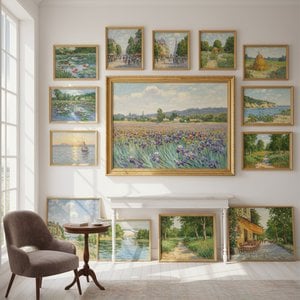
Impressionist Landscapes: 10 Masterpieces for Your Home | ArtsDot
Journey through 10 iconic Impressionist landscapes by Monet, Renoir & Degas. Explore the history, techniques & emotions behind these masterpieces. Find museum-quality reproductions for your home at ArtsDot.com – where art comes to life! Discover all masterpieces on ArtsDot.com

Impressionistic Landscapes: 10 Masterpieces That Changed Art & Decor
Journey into the heart of Impressionism! Explore 10 masterpieces by Monet, Renoir & Degas that revolutionized landscape art. Discover their stories, techniques & find museum-quality reproductions to elevate your home decor on ArtsDot.com.

The Enduring Legacy of Oil on Canvas: Technique, History & Aesthetic Impact
Explore the rich history & techniques of oil painting – from Renaissance masters to Impressionism. Discover pigments, layering methods, and why this timeless medium endures. Expert insights for artists & art enthusiasts.