Preview
 Send
Send Share
Share
 Details
 Guide
Guide

 Download
 Similars
 X-Ray
X-Ray Diaporama
 Stats
StatsSpringime


 Read More
Giclée / Art Print
Museum-quality giclée or canvas print with fast production and flexible finish options. ( Buy Hand Made Painting Switch to Digital Image)




P118B $10

P118H $10

P118W $10

P438Z $10

P508JH $12

P508YH $12

P805H $10

P805Z $10

P919BZ $10

P919G $10

P919XJ $10

P959ZH $10

P968JZ $12

W106C $8

W218G $10

W218JH $8

W218Y $10

W307PJ $10

W316G $10

W316PJ $8

W316Y $10

W398PJ $8

W4111J $10

W500HY $15

W500JH $15

W692G $12

W849H $8

W940BG $15

W953PJ $8




Pick from our preset sizes that match the artwork's original proportions.

Type the width and the height you need, to fit your frame or your wall. A print can only be cut, never made bigger than the picture, so a size with a different shape loses a part of the image. We send you a digital mockup to approve before we print anything. The picture shown on this page does not show the real cut — only the mockup does.
Worldwide Delivery () in 2 weeks instead of standard 4/5 weeks. (19 October)

Free Worldwide Express Shipping

High-Quality Linen Canvas

Full Shipping Insurance

Customs Tax Refund Guarantee

True Color Matching Guarantee

100-Day Return Policy (Defects Only)

100% Money-Back Guarantee

Bulk Discount Offer
 Glass option is only available in size under 110 CM

Springime
Giclée / Art Print
Reproduction Size
-


Total Price
$ 63
A Moment of Renewal: Introducing Charles Edward Conder’s “Springime”
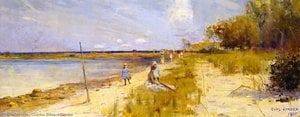
Charles Edward Conder's "Springime," painted in 1892, isn’t merely a depiction of springtime; it’s an immersion into the very essence of renewal. This oil on canvas, currently residing within the hallowed halls of the Tate Gallery in London, captures a fleeting moment of vibrant beauty – a celebration of burgeoning life against a backdrop of warm, inviting hues. Conder, a pivotal figure in Australia's Heidelberg School movement, masterfully blends Impressionistic techniques with a distinctly Australian sensibility, creating an artwork that resonates with both tranquility and dynamic energy.
The painting immediately draws the eye to its foreground: a profusion of delicate pink blossoms clustered around a graceful tree. These aren’t simply flowers; they are symbols of rebirth, mirroring the season's promise of new beginnings. Behind this vibrant display, a smaller, more distant tree provides depth and scale, anchoring the scene within a broader landscape. The careful layering of colors – from the warm yellows dominating the sky to the subtle greens of the foliage – establishes a harmonious balance between light and shadow, creating an atmosphere that is both luminous and deeply felt.
The Heidelberg School: A New Vision of Australian Art
To fully appreciate “Springime,” it’s crucial to understand its context within the Heidelberg School. Emerging in late 19th-century Australia, this group of artists sought to capture the unique beauty and spirit of their homeland – a landscape vastly different from the European traditions dominating the art world at the time. Rejecting academic formality, they embraced *plein air* painting, working directly outdoors to observe and record nature’s nuances with immediacy and sensitivity. Conder, along with Tom Roberts and Frederick McCubbin, became central figures in this movement, developing a distinctive style characterized by loose brushstrokes, vibrant colors, and an emphasis on everyday Australian life.
Conder's work often reflected his own experiences – his early years in India, his move to Australia, and his travels throughout Europe. “Springime,” however, feels distinctly rooted in the Australian landscape, capturing not just a visual representation but also a feeling of optimism and connection to the natural world. The painting’s composition subtly evokes the vastness of the Australian outback, hinting at both its beauty and its inherent challenges.
Technique and Symbolism: A Dance of Light and Color
Conder's masterful use of color is a defining characteristic of “Springime.” He employs broken brushstrokes to create an impressionistic effect, allowing the colors to blend and shimmer in the viewer’s eye. The warm yellows and oranges of the sky are juxtaposed with the cooler greens and pinks of the foliage, creating a dynamic interplay of light and shadow. The artist's attention to detail is evident in the delicate rendering of the flowers and leaves, as well as the subtle variations in tone that suggest depth and texture.
Beyond its aesthetic qualities, “Springime” carries symbolic weight. The blossoming tree represents hope and regeneration, while the distant landscape suggests a connection to something larger than oneself. The painting’s overall mood is one of serenity and contemplation – an invitation to pause and appreciate the simple beauty of nature. It's a testament to Conder's ability to capture not just what he saw but also what he felt.
Bringing “Springime” Home: Reproductions and Artistic Inspiration
“Springime” is more than just a painting; it’s an experience. High-quality reproductions offer a remarkable way to bring this captivating artwork into your home or office, adding a touch of timeless beauty and tranquility to any space. Whether you're drawn to the painting's vibrant colors, its evocative symbolism, or simply its undeniable charm, “Springime” is sure to inspire and delight.
Questions & Answers
Does the copyright of "Springime" by Charles Edward Conder allow reproductions?
"Springime" by Charles Edward Conder, held at the Tate Gallery, is in the public domain - its copyright has expired. This status determines whether reproductions of the image may be made.
Which room is "Springime" by Charles Edward Conder recommended for, given its colors?
Considering its earthy colors, "Springime" is suggested for a living room.
Is "Springime" by Charles Edward Conder in the public domain, and why?
"Springime" by Charles Edward Conder is in the public domain - its copyright has expired. Copyright duration runs from the artist's death, which occurred in 1909.
Related Artworks


Artist Biography
early life and artistic journey
charles edward conder, a british-born painter, lithographer, and designer, left an indelible mark on the art world. born in tottenham, middlesex, on october 24, 1868, conder's early life was marked by his mother's passing in india when he was just four years old.artistic career in australia
in 1884, at 16, conder moved to sydney, australia, working for his uncle as a land surveyor. however, he soon discovered his true passion lay in drawing the landscape rather than surveying it. by 1886, he had become an artist for the illustrated sydney news, alongside notable artists like albert henry fullwood and frank mahony.the heidelberg school and notable works
conder's masterpiece, departure of the orient – circular quay (1888), showcased his newfound mastery of form and brushwork. this dockside scene, depicting the bustling harbour at sydney cove, was quickly purchased by the art gallery of new south wales, making it conder's first work to enter a public collection.- a holiday at mentone (1888), a fun-loving painting showcasing men and women relaxing on the beach, is another notable example of conder's work.
- conder's association with g. p. nerli, an itinerant italian painter, significantly influenced his development as an artist.
- his contributions to the 9 by 5 impression exhibition in melbourne, alongside tom roberts and arthur streeton, solidified his position within the heidelberg school movement.
legacy and later life
conder's later years were plagued by poor health, including paralysis and a bout of delirium tremens. despite this, he continued to paint, leaving behind a legacy as a key figure in the heidelberg school. his art was better received in england than in paris, with his portrait being painted by henri de toulouse-lautrec in 1892. view conder's works at the art gallery of new south wales or explore more about the heidelberg school on ArtsDot's charles edward conder page.- discover more about conder's life and works on wikipedia's charles conder page.
- explore ArtsDot's collection of conder's paintings, including a holiday at mentone (1888) and departure of the orient – circular quay (1888), on ArtsDot's website.
conclusion
charles edward conder's impact on australian impressionism is undeniable. his legacy, marked by his captivating paintings and association with the heidelberg school, continues to inspire art enthusiasts worldwide.
Charles Edward Conder
1868 - 1909 , United Kingdom
Quick Facts
- Full Name: Charles Edward Conder
- Nationality: British
- Date Of Birth: 1868
- Date Of Death: 1909
- Place Of Birth: Tottenham, United Kingdom
- Notable Artworks:
- Departure of the Orient – Circular Quay
- A holiday at Mentone
- Under The Southern Sun
- Artistic Movement Or Style: Heidelberg School
- Artists Who Influenced This Artist:
- Alfred Daplyn
- Victor Mann
- Julian Ashton
Related Articles

John Constable's Masterpieces: Explore 25 Iconic Landscapes for Your Home
Journey through John Constable's 25 most celebrated landscapes. Explore Romanticism, Dedham Vale & his masterful use of light in iconic paintings like 'Hay Wain'. Find museum-quality art reproductions and elevate your home decor on ArtsDot.com.

Romantic Landscapes: 10 Masterpieces for Your Home | ArtsDot
Journey through 10 Romantic landscape masterpieces by Friedrich, Turner & Cole. Explore emotional art, sublime nature scenes & iconic 19th-century paintings. Find museum-quality reproductions for your home at ArtsDot.com – discover the full collection online!

Stephen Bone: A Reassessment of Colour, Form & the British Neo-Romantic Landscape Tradition
Explore the vibrant world of Stephen Bone (1904-1958), a key figure in British Neo-Romanticism. Discover his captivating landscapes, impactful war art & unique artistic style. Learn about his life, influences & legacy.

Edward Hopper's Masterpieces: 25 Iconic Paintings & Their Enduring Legacy | ArtsDot
Explore 25 iconic Edward Hopper paintings & their stories. Discover American realism, urban loneliness, and timeless beauty through his masterpieces. Find museum-quality art reproductions & curated decor ideas at ArtsDot.com.

Edward Wilkins Waite: A Victorian Vision of Surrey's Serene Landscapes & Artistic Legacy
Explore the serene landscapes of Edward Wilkins Waite (1854-1924), a prolific Victorian painter celebrated for his depictions of Surrey's countryside. Discover his artistic influences, career highlights & collecting guide.