

 Preview
 Send
Send Share
Share
 Details
 Guide
Guide

 Download
 Similars
 X-Ray
X-Ray Diaporama
 Q&A
Q&A Stats
Statsneubrandenburg

 Read More
Giclée / Art Print
Museum-quality giclée or canvas print with fast production and flexible finish options. ( Buy Hand Made Painting Switch to Digital Image)




P118B $10

P118H $10

P118W $10

P438Z $10

P508JH $12

P508YH $12

P805H $10

P805Z $10

P919BZ $10

P919G $10

P919XJ $10

P959ZH $10

P968JZ $12

W106C $8

W218G $10

W218JH $8

W218Y $10

W307PJ $10

W316G $10

W316PJ $8

W316Y $10

W398PJ $8

W4111J $10

W500HY $15

W500JH $15

W692G $12

W849H $8

W940BG $15

W953PJ $8




Pick from our preset sizes that match the artwork's original proportions.

Type the width and the height you need, to fit your frame or your wall. A print can only be cut, never made bigger than the picture, so a size with a different shape loses a part of the image. We send you a digital mockup to approve before we print anything. The picture shown on this page does not show the real cut — only the mockup does.
Worldwide Delivery () in 2 weeks instead of standard 4/5 weeks. (12 November)

Free Worldwide Express Shipping

High-Quality Linen Canvas

Full Shipping Insurance

Customs Tax Refund Guarantee

True Color Matching Guarantee

100-Day Return Policy (Defects Only)

100% Money-Back Guarantee

Bulk Discount Offer
 Glass option is only available in size under 110 CM

neubrandenburg
Giclée / Art Print
Reproduction Size
-


Total Price
$ 63
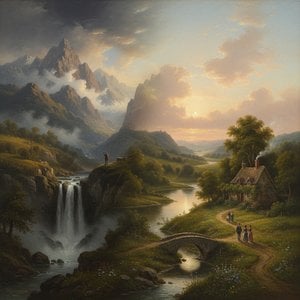
A Vista of Quietude: Exploring Caspar David Friedrich’s *neubrandenburg*
This evocative landscape by Caspar David Friedrich transports viewers to a serene yet subtly melancholic world. *neubrandenburg* is not merely a depiction of a town and its cathedral; it's an exploration of humanity’s place within the vastness of nature, a hallmark of the Romantic era. The painting presents a distant view of Neubrandenburg, dominated by the imposing spire of its cathedral, set against a dramatic skyscape.Style & Historical Context
Friedrich was a pivotal figure in the German Romantic movement (early 19th century), a period characterized by an emphasis on emotion, individualism, and the sublime power of nature. Rejecting the Enlightenment’s focus on reason, Romantics sought spiritual truth through experiencing the natural world. *neubrandenburg* exemplifies this ethos. The painting's style leans heavily into Romantic ideals – it isn’t a precise topographical rendering but rather an emotional response to the landscape. This was a time of significant societal shifts; the rise of industrialization and urbanization led many to yearn for a connection with the unspoiled beauty of nature, which Friedrich masterfully captures. His work often served as a counterpoint to the increasingly materialistic world.Composition & Technique
The composition is powerfully structured around horizontal lines – the horizon dividing the scene into foreground, middle ground and background. This reinforces the sense of expansive space. The small figures in the lower right corner are crucial; they provide a scale reference, emphasizing the immensity of the landscape and subtly suggesting human insignificance within it. Friedrich’s technique is characterized by loose brushstrokes and a muted color palette. He expertly employs atmospheric perspective – colors become paler and less saturated with distance – to create a convincing illusion of depth. The oil on canvas medium allows for rich texture and nuanced tonal variations, particularly in the swirling clouds that dominate the sky.Symbolism & Interpretation
The cathedral spire is arguably the focal point, rising above the town as a symbol of faith and spiritual aspiration. However, its distance and relative smallness within the vast landscape suggest a questioning of traditional religious authority. The dramatic sky, transitioning from dark greys to golden hues, can be interpreted as representing both hope and uncertainty – the transient nature of life itself. The figures in the foreground, seemingly lost in contemplation, invite viewers to share their quiet introspection. Friedrich frequently used landscapes not just as representations of places but as mirrors reflecting inner emotional states.Emotional Impact & Legacy
*neubrandenburg* evokes a sense of peaceful solitude and contemplative melancholy. It’s a painting that encourages viewers to pause, reflect, and connect with the natural world on a deeper level. The work's enduring appeal lies in its ability to tap into universal human emotions – awe, wonder, and a longing for something beyond the material realm. Friedrich’s influence can be seen in subsequent artistic movements, including Symbolism and Expressionism, and his landscapes continue to inspire artists and viewers alike today. A reproduction of this painting would bring a sense of tranquility and intellectual depth to any interior space.Questions & Answers
What underlying hue runs through "neubrandenburg" by Caspar David Friedrich?
The dominant hue of "neubrandenburg" by Caspar David Friedrich is ochre to sepia. The hue is the underlying tone of the palette.
What luminance does "neubrandenburg" by Caspar David Friedrich have?
The colors of "neubrandenburg" show a gentle luminance luminance.
Is "neubrandenburg" by Caspar David Friedrich a portrait, landscape or square composition?
"neubrandenburg" by Caspar David Friedrich is a portrait composition. The proportions are worth checking before choosing a print size.
Related Artworks


Artist Biography
A Solitary Vision
Born in the Baltic port city of Greifswald in 1774, Caspar David Friedrich’s early years were shaped by a profound sense of loss. The deaths of his mother and siblings cast a long shadow over his youth, fostering a sensitivity to mortality that would become a central theme in his work. He began his training under his brother Christian before pursuing art and theology at the University of Leipzig. Though he did not complete either degree, this dual interest in the visual and the spiritual would define his creative path. His technical skills were further honed in Copenhagen, where he was exposed to landscape traditions that he would eventually transform into a medium for expressing inner emotional states.
His approach to the landscape moved away from the meticulous detail favored by his predecessors. Instead, he sought to imbue scenery with symbolic meaning, using natural elements to represent the human soul. He often employed Rückenfiguren—figures seen from behind—to invite the viewer to share in a contemplative experience. His palette, frequently composed of muted blues, grays, and browns, enhanced the mood of introspection and solemnity that pervades his oeuvre. He did not merely paint what he saw; he painted the internal weather of the human spirit.
The Language of the Sublime
Friedrich’s work emphasizes the sublime, seeking a spiritual connection through the scale of the natural world. His compositions often place solitary figures against a vast, often overwhelming, landscape. In "Wanderer above the Sea of Fog" (c. 1818), the silhouetted figure confronts a swirling sea of mist, embodying the tension between human presence and the infinite. "The Sea of Ice" (1824) presents a chilling Arctic wasteland, a depiction of nature’s immense power and its indifference to human fate. These works reflect a preoccupation with the fragility of existence and the search for meaning within the landscape.
His paintings often utilize specific elements to convey these internal states:
- "The Abbey in the Oakwood" (1809-1810), where a ruined churchyard and bare trees suggest mortality and spiritual decay.
- "Chalk Cliffs on Rügen" (1818), which uses atmospheric light to define the coast.
- "The Watzmann," a depiction of mountain majesty.
- "Evening Landscape with Two Men" (1830), a quiet scene of twilight contemplation.
Legacy and Rediscovery
The trajectory of Friedrich’s career was not a steady ascent. While he achieved recognition during his lifetime, his popularity waned as artistic tastes shifted toward other movements. He died in Dresden in 1840, and for a time, his name faded from the forefront of the art world. His reputation underwent a significant rediscovery in the late 20th century, as he was recognized as a central figure in German Romanticism. His emphasis on subjective experience and emotional expression paved the way for later movements, including Symbolism and Surrealism.
His influence extended to artists who sought to explore the inner world through visual means. By rejecting Enlightenment rationalism in favor of emotion and imagination, he captured the spirit of an era. His landscapes served as symbols of national identity during a period of political fragmentation in Germany. Today, his work continues to resonate, reminding audiences of the profound connection between humanity and the natural world.

Caspar David Friedrich
1774 - 1840 , Germany
Quick Facts
- Full Name: Caspar David Friedrich
- Nationality: German
- Date Of Birth: 1774
- Date Of Death: 1840
- Place Of Birth: Greifswald, Germany
- Notable Artworks:
- Abbey in the Oakwood
- Wanderer above the Sea...
- Chalk Cliffs on Rügen
- The Sea of Ice
- Artistic Movement Or Style: Romanticism
- Artists Who Influenced This Artist:
- Dutch Masters
- J.C. Dahl
- Artists Or Movements Influenced By This Artist:
- Symbolists
- Surrealists
Related Articles

Evoking Nature's Sublime: A Comprehensive Exploration of 19th-Century Landscape Painting
Explore the captivating world of 19th-century landscape painting! Discover renowned artists like Friedrich & Monet, key movements, and find the perfect artwork to bring nature's serenity into your home. Expert insights at ArtsDot.

The Sublime and the Picturesque: Exploring Emotion & Nature in Romantic Landscape Painting
Explore the emotional power of Romantic landscape painting! Discover the sublime & picturesque traditions, key artists like Friedrich & Cole, and find your perfect artwork at ArtsDot.

Romantic Landscapes: 10 Masterpieces for Your Home | ArtsDot
Journey through 10 Romantic landscape masterpieces by Friedrich, Turner & Cole. Explore emotional art, sublime nature scenes & iconic 19th-century paintings. Find museum-quality reproductions for your home at ArtsDot.com – discover the full collection online!
The Sublime and the Picturesque: Exploring Emotion & Nature in Romantic Landscape Painting
Explore the emotional power of Romantic landscape painting! Discover the sublime & picturesque aesthetics, key artists like Friedrich & Cole, and lasting influence on art history. Find your perfect piece at ArtsDot.

Caspar David Friedrich: Romanticism's Master of Landscape & the Sublimity of Inner Experience
Explore the profound landscapes of Caspar David Friedrich, a master of German Romanticism. Discover the symbolism, themes & enduring influence of this iconic artist. A deep dive into his life and work.


