

- 48.0 x 27.0 cm


The picture follows your choices: , .
Collectible Description
A satirical depiction of a man lost in literature, Carl Spitzweg's The Bookworm captures the Biedermeier era with charming detail and invites you to explore this masterpiece of German Romanticism for your collection.
 Read More
Artist Biography
Discover Carl Spitzweg (1808-1885), a leading German Romanticist painter of the Biedermeier era. Explore his charming genre scenes, humorous depictions of everyday life & iconic works like 'The Poor Poet'.
Hand Made Oil Reproduction
Hand-painted oil on canvas in your size and frame, made to order by our artists. ( Switch to Print Switch to Digital Image)
More about this painting
 Preview
 Send
Send Share
Share
 Details
 Guide
Guide

 Download
 Similars
 X-Ray
X-Ray Diaporama
 Q&A
Q&A Stats
StatsOrder your painting in four simple steps
Take your time. You can change any answer; the price in your order card follows each choice.
1 Step one of four
Which size would you like?
These sizes keep the proportions of the original painting. The drawing shows your choice on a wall, above a two-metre sofa.
Or give your own measurements
Pick from our preset sizes that match the artwork's original proportions.

Type the width and the height you need, to fit your frame or your wall. This is hand-painted, so for a size with a different shape the artist can paint a bit more around the picture, or cut a bit — you choose. We send you a digital mockup to approve before the painting starts. The picture shown on this page does not show the real result — only the mockup does.
2 Step two of four
How should it be prepared: rolled, stretched or framed?
The prices below are for the size you chose in step one.
Choose the edges of the stretched canvas
Choose your frame

White $1

Blurside $1

Extended $1

P118B $10

P118H $10

P118W $10

P438Z $10

P508JH $12

P508YH $12

P805H $10

P805Z $10

P919BZ $10

P919G $10

P919XJ $10

P959ZH $10

P968JZ $12

W106C $8

W218G $10

W218JH $8

W218Y $10

W307PJ $10

W316G $10

W316PJ $8

W316Y $10

W398PJ $8

W4111J $10

W500HY $15

W500JH $15

W692G $12

W849H $8

W940BG $15

W953PJ $8

H24-GOLD $30

H24-SILVER $30

H36-GOLD $45

H36-SILVER $45
Framed
Moulding: . Overall size with the frame: .
3 Step three of four
Would you like anything changed in the painting?
Most people answer no. Because each painting is made by hand, our artist can also adapt it for you.
After order, ArtsDot.com team will email client for instructions and provide a mockup preview
4 Step four of four
A few finishing options
All of them are optional. The answers already selected cost nothing extra.
Who paints it?
Worldwide Delivery () in 3/4 weeks instead of standard 5 weeks. (6 November). No compromise on quality.
A nameplate, as in a museum?
Engraved Bronze Plaque Details
This elegant plaque features the artist's name and the title of the artwork, finely engraved for a timeless presentation.
It is made from bronze with a refined, elegant finish. The text is precisely laser-engraved for a sharp and permanent result. Measuring 9x2 cm, the plaque is compact yet easy to read. It's built to be durable and scratch-resistant, offering a professional, museum-quality look. Mounting is simple thanks to the included adhesive backing.
Transparent Acrylic Plaque Details
The plaque includes essential engraved details such as the artist's name, the title of the artwork, the date it was created, the type of media used-like oil on canvas or watercolor-a brief description of the piece, and a QR code that links to the complete artwork information.
It is crafted from clear acrylic, offering a sleek, modern appearance. The text is UV-engraved in black to ensure strong visual contrast. With a size of 10x15 cm, it ensures optimal readability. It comes equipped with two metal hooks for secure wall mounting. The plaque is designed to be weather-resistant, making it suitable for various environments, and it includes interactive features that work seamlessly with smartphone scanning.
Black Acrylic Plaque Details
This elegant plaque includes engraved information such as the artist's name, the title of the artwork, the date it was created, the type of media used (like oil on canvas or watercolor), a short description of the artwork, and a QR code for quick access to more information.
The plaque itself is made from refined black acrylic with a premium finish. The text is laser-engraved in white for high contrast and readability. Its size is 10x15 cm, designed to be easy to read. It comes with two metal hooks for professional mounting. The design is sleek and fits any interior style. It is also weather-resistant and durable, with built-in digital integration for mobile compatibility.
A protective varnish?
When do you need it?
✓ Check and order
Your painting, as you ordered it

The bookworm
Reproduction Medium
Reproduction Size
-

Elite Senior Artist
More detail, finesse, and extra production time
-

Reproduction Frame
-
-
For artworks or reproductions larger than 105 cm (approximately 41 inches) on any side, the frame will be shipped as a kit, disassembled. This method ensures safe delivery and prevents damage during transport.
Professional assembly required - this is not a DIY product.
The kit must be assembled and the canvas stretched by an experienced professional framer, using wood glue (not supplied), a canvas stretching plier and clamps to hold the bars square while the glue dries. Incorrect assembly or uneven canvas tension can permanently damage the artwork and is not covered by our warranty.
 For artworks or reproductions larger than 105 cm (approximately 41 inches) on any side, the frame will be shipped as a kit, disassembled. This method ensures safe delivery and prevents damage during transport.
All solid wood bars are included, precisely cut to size.
Assembled with the screws provided, plus wood glue for the corner joints, which is not supplied and must be sourced by your framer.
Professional tools are required and not included: a canvas stretching plier (tensioner) and clamps to hold the bars square while the glue dries.
Important:
The corner joints require wood glue, the bars must be held with clamps until the glue is fully dry, and tightening the canvas on the assembled frame requires a canvas stretching plier. None of these are included in the kit. Please arrange an experienced professional framer before ordering this size.

Nameplate
-
-

Protective Varnish
Glossy Varnish (enhances colors, protects against light/moisture)
-

Customize My Artwork
Examples of what can be changed: Replace face with customer photo; Add pet (e.g., replace cat with dog); Include hidden message in background; Change background landscape or elements.
-

Urgent
Worldwide Delivery () in 3/4 weeks instead of standard 5 weeks. (6 November). No compromise on quality.
-
Express Shipping
Worldwide Delivery () in 5 weeks. (13 November).
Included
Total Price
$ 263
Glass option is only available in size under 110 CM
Included with every order
- Free Worldwide Express Shipping
- High-Quality Linen Canvas
- Full Shipping Insurance
- Customs Tax Refund Guarantee
- True Color Matching Guarantee
- 100-Day Return Policy (Defects Only)
- 100% Money-Back Guarantee
- Bulk Discount Offer


A Sanctuary of Silent Pages
In the quiet corners of history, few images capture the essence of intellectual retreat as poignantly as Carl Spitzweg’s The Bookworm. Painted around 1850, this masterpiece serves as a window into a world where time seems to suspend itself amidst the scent of aged parchment and leather bindings. The scene presents us with a solitary figure, perched precariously yet comfortably upon a ladder, his entire being consumed by the text before him. There is an undeniable intimacy in this composition; the viewer is not merely an observer but a silent companion in this private moment of discovery. Spitzweg, a master of the Biedermeier era, utilizes a delicate, realistic technique to render every detail—from the soft light filtering through an unseen window to the dusty spines of countless volumes—creating a sense of atmosphere that is both nostalgic and profoundly peaceful.
Beyond its surface beauty, the painting functions as a brilliant piece of social satire. During the mid-19th century, Europe was navigating a period of intense political tension and shifting societal norms. Through the figure of the scholar, Spitzweg offers a gentle yet biting commentary on the conservative mindset of his time. The man’s physical detachment from the world—symbolized by his face buried in a book and a globe tucked away in a corner—suggests a deliberate withdrawal from contemporary reality into the safety of traditional knowledge. The sign reading "Metaphysics" above the shelf further emphasizes this retreat into abstract thought, far removed from the pressing political revolutions occurring outside his library walls. It is a study of escapism, capturing the tension between the comfort of the known and the chaos of the changing world.
A Masterpiece for the Modern Collector
For the discerning collector or interior designer, The Bookworm offers much more than mere decoration; it provides a focal point of intellectual depth and warmth. The painting’s color palette, rich with warm ambers, deep wood tones, and soft highlights, possesses a unique ability to ground a room, lending an air of academic sophistication and timelessness to any study, library, or living space. The meticulous detail characteristic of Spitzweg’s style ensures that the piece remains captivating upon close inspection, rewarding the eye with the intricate textures of cloth, wood, and paper.
Integrating a high-quality reproduction of this work into a contemporary interior allows for a beautiful dialogue between historical narrative and modern aesthetics. Whether placed in a minimalist setting to provide a touch of classical warmth or within a traditional library to enhance its scholarly atmosphere, The Bookworm evokes an emotional response of curiosity and tranquility. It invites anyone who gazes upon it to pause, to breathe, and to rediscover the profound joy found in the quiet pursuit of knowledge.
Questions & Answers
Is "The bookworm" by Carl Spitzweg in the public domain?
The copyright answer for "The bookworm" by Carl Spitzweg: the work is in the public domain - its copyright has expired. This determines whether reproductions of the image may be freely made.
What feeling does "The bookworm" by Carl Spitzweg convey?
"The bookworm" by Carl Spitzweg conveys a reflective feeling within an overall nostalgic mood.
What technique and size is the original "The bookworm" by Carl Spitzweg?
The medium of "The bookworm" by Carl Spitzweg is oil on canvas, and its recorded dimensions are 48 x 27 cm.
Related Artworks


Carl Spitzweg
1808 - 1885, Germany
Artist Biography
A Life Dedicated to Gentle Observation: The World of Carl Spitzweg
Born in the Bavarian village of Unterpfaffenhofen near Munich on February 5, 1808, Carl Spitzweg’s path to artistic renown was anything but conventional. Initially destined for a practical life – first as an apprentice pharmacist following his father's wishes – fate intervened in the form of illness and recovery, during which a latent passion for painting blossomed. This wasn’t a sudden conversion, however; it was a gradual unfolding nurtured by copying the works of Flemish masters, absorbing their meticulous detail and atmospheric depth. The early years were marked by a dutiful adherence to his father's plans, yet even within the confines of pharmaceutical study, Spitzweg’s artistic inclinations persisted, hinting at a spirit that yearned for creative expression. His family background was one of comfortable prosperity; his father, Simon Spitzweg, a successful merchant, and his mother, Franziska Schmutzer, from an affluent family, provided a stable foundation, though perhaps not initially understanding of their son’s artistic leanings. The inheritance he eventually received would prove pivotal, granting him the financial freedom to fully dedicate himself to painting in 1833.From Pharmacy to Palette: Developing a Unique Artistic Voice
Spitzweg's self-taught approach was crucial in shaping his distinctive style. He wasn’t bound by academic constraints or the prevailing trends of grand historical painting; instead, he forged his own path, focusing on the everyday lives of ordinary people with a gentle humor and keen observational skill. His travels throughout Europe – to Prague, Venice, Paris, London, and Belgium – were not merely sightseeing tours but immersive studies of light, color, and human character. These journeys broadened his artistic horizons, yet he remained firmly rooted in the Biedermeier aesthetic, a style characterized by its intimacy, domesticity, and focus on middle-class life. He absorbed influences from Dutch Golden Age painters like Nicolaes Berchem and Gonzales Coques, evident in his meticulous attention to detail and warm, earthy palettes. However, Spitzweg wasn’t simply imitating; he was synthesizing these influences into something uniquely his own – a blend of realism, fancy, and subtle satire that captured the spirit of his time. His early contributions to satirical magazines honed his ability to distill complex observations into concise, visually engaging narratives.The Charm of Biedermeier: Themes and Techniques
Spitzweg’s paintings are windows into a bygone era, offering glimpses of 19th-century German life with an endearing charm. He excelled at depicting eccentric characters – the bookworm lost in his studies, the hypochondriac consumed by anxieties, the butterfly hunter absorbed in his pursuit – individuals who embody both the quirks and vulnerabilities of human nature. These weren’t caricatures meant to ridicule but rather affectionate portraits that celebrated individuality. The Poor Poet, perhaps his most iconic work, exemplifies this approach; it's a poignant depiction of solitude and intellectual passion, rendered with remarkable sensitivity. His technique is characterized by meticulous detail, delicate brushwork, and a masterful use of light and shadow to create atmosphere and mood. He wasn’t interested in dramatic narratives or grand gestures; instead, he found beauty and meaning in the mundane, elevating everyday scenes to the level of art. His paintings are not merely representations of reality but interpretations imbued with his own gentle wit and empathetic understanding.Legacy and Enduring Appeal
Carl Spitzweg’s influence extends beyond the realm of 19th-century German painting. While often overlooked in mainstream art historical narratives, his work has resonated with generations of artists and viewers alike. His ability to capture the essence of everyday life with humor and compassion continues to captivate audiences today. The enduring popularity of paintings like The Butterfly Hunter and The Convent-School Outing testifies to their timeless appeal. Spitzweg’s legacy is also evident in the work of later artists, including Norman Rockwell, who paid homage to The Poor Poet with his own rendition of the subject. His paintings can be found in prominent museums and collections worldwide, including the Schackgalerie in Munich and the Wolfgang-gurlitt-museum in Linz, Austria, ensuring that his artistic vision continues to inspire and delight for years to come. He passed away on September 23, 1885, leaving behind a rich body of work – over 1,500 paintings and drawings – that stands as a testament to his unique talent and enduring contribution to the world of art.


Related Articles
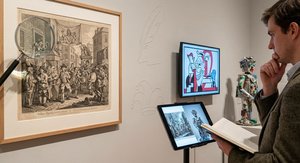
The Sharpest Wit: A Critical Exploration of Satire in Art History – From Hogarth to Contemporary Critique
Explore the history of satire in art! From Hogarth's London to contemporary critique, discover how artists use wit & visual power to reflect and challenge society. Expert insights at ArtsDot.

The Sharpest Wit: A Historical Exploration of Satire in Visual Culture
Explore the history of satire in art! From ancient masters like Aristophanes to Goya & Grosz, discover how artists use wit and critique to reflect—and challenge—society. Expert insights at ArtsDot.

William Hogarth: Satire, Social Commentary & the Birth of Modern British Art
Explore the satirical world of William Hogarth, pioneering British painter & engraver. Discover his iconic works like *A Rake's Progress* and insightful social commentary on 18th-century London life.