


The picture follows your choices: , .
Collectible Description
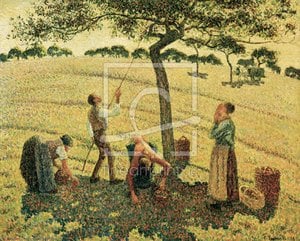
Camille Pissarro Delve into Impressionism with Camille Pissarro’s "Fields," capturing the beauty of rural France in vibrant hues and loose brushstrokes. Explore exquisite hand-painted reproductions at ArtsDot.
 Read More
Artist Biography
A pioneer of Impressionism, Camille Pissarro captured the fleeting light of the French countryside. Discover his timeless masterpieces today.
Hand Made Oil Reproduction
Hand-painted oil on canvas in your size and frame, made to order by our artists. ( Switch to Print Switch to Digital Image)
More about this painting
 Preview
 Send
Send Share
Share
 Details
 Guide
Guide

 Download
 Similars
 X-Ray
X-Ray Diaporama
 Q&A
Q&A Stats
StatsOrder your painting in four simple steps
Take your time. You can change any answer; the price in your order card follows each choice.
1 Step one of four
Which size would you like?
These sizes keep the proportions of the original painting. The drawing shows your choice on a wall, above a two-metre sofa.
Or give your own measurements
Pick from our preset sizes that match the artwork's original proportions.

Type the width and the height you need, to fit your frame or your wall. This is hand-painted, so for a size with a different shape the artist can paint a bit more around the picture, or cut a bit — you choose. We send you a digital mockup to approve before the painting starts. The picture shown on this page does not show the real result — only the mockup does.
2 Step two of four
How should it be prepared: rolled, stretched or framed?
The prices below are for the size you chose in step one.
Choose the edges of the stretched canvas
Choose your frame

White $1

Blurside $1

Extended $1

P118B $10

P118H $10

P118W $10

P438Z $10

P508JH $12

P508YH $12

P805H $10

P805Z $10

P919BZ $10

P919G $10

P919XJ $10

P959ZH $10

P968JZ $12

W106C $8

W218G $10

W218JH $8

W218Y $10

W307PJ $10

W316G $10

W316PJ $8

W316Y $10

W398PJ $8

W4111J $10

W500HY $15

W500JH $15

W692G $12

W849H $8

W940BG $15

W953PJ $8

H24-GOLD $30

H24-SILVER $30

H36-GOLD $45

H36-SILVER $45
Framed
Moulding: . Overall size with the frame: .
3 Step three of four
Would you like anything changed in the painting?
Most people answer no. Because each painting is made by hand, our artist can also adapt it for you.
After order, ArtsDot.com team will email client for instructions and provide a mockup preview
4 Step four of four
A few finishing options
All of them are optional. The answers already selected cost nothing extra.
Who paints it?
Worldwide Delivery () in 3/4 weeks instead of standard 5 weeks. (9 November). No compromise on quality.
A nameplate, as in a museum?
Engraved Bronze Plaque Details
This elegant plaque features the artist's name and the title of the artwork, finely engraved for a timeless presentation.
It is made from bronze with a refined, elegant finish. The text is precisely laser-engraved for a sharp and permanent result. Measuring 9x2 cm, the plaque is compact yet easy to read. It's built to be durable and scratch-resistant, offering a professional, museum-quality look. Mounting is simple thanks to the included adhesive backing.
Transparent Acrylic Plaque Details
The plaque includes essential engraved details such as the artist's name, the title of the artwork, the date it was created, the type of media used-like oil on canvas or watercolor-a brief description of the piece, and a QR code that links to the complete artwork information.
It is crafted from clear acrylic, offering a sleek, modern appearance. The text is UV-engraved in black to ensure strong visual contrast. With a size of 10x15 cm, it ensures optimal readability. It comes equipped with two metal hooks for secure wall mounting. The plaque is designed to be weather-resistant, making it suitable for various environments, and it includes interactive features that work seamlessly with smartphone scanning.
Black Acrylic Plaque Details
This elegant plaque includes engraved information such as the artist's name, the title of the artwork, the date it was created, the type of media used (like oil on canvas or watercolor), a short description of the artwork, and a QR code for quick access to more information.
The plaque itself is made from refined black acrylic with a premium finish. The text is laser-engraved in white for high contrast and readability. Its size is 10x15 cm, designed to be easy to read. It comes with two metal hooks for professional mounting. The design is sleek and fits any interior style. It is also weather-resistant and durable, with built-in digital integration for mobile compatibility.
A protective varnish?
When do you need it?
✓ Check and order
Your painting, as you ordered it

Fields
Reproduction Medium
Reproduction Size
-

Elite Senior Artist
More detail, finesse, and extra production time
-

Reproduction Frame
-
-
For artworks or reproductions larger than 105 cm (approximately 41 inches) on any side, the frame will be shipped as a kit, disassembled. This method ensures safe delivery and prevents damage during transport.
Professional assembly required - this is not a DIY product.
The kit must be assembled and the canvas stretched by an experienced professional framer, using wood glue (not supplied), a canvas stretching plier and clamps to hold the bars square while the glue dries. Incorrect assembly or uneven canvas tension can permanently damage the artwork and is not covered by our warranty.
 For artworks or reproductions larger than 105 cm (approximately 41 inches) on any side, the frame will be shipped as a kit, disassembled. This method ensures safe delivery and prevents damage during transport.
All solid wood bars are included, precisely cut to size.
Assembled with the screws provided, plus wood glue for the corner joints, which is not supplied and must be sourced by your framer.
Professional tools are required and not included: a canvas stretching plier (tensioner) and clamps to hold the bars square while the glue dries.
Important:
The corner joints require wood glue, the bars must be held with clamps until the glue is fully dry, and tightening the canvas on the assembled frame requires a canvas stretching plier. None of these are included in the kit. Please arrange an experienced professional framer before ordering this size.

Nameplate
-
-

Protective Varnish
Glossy Varnish (enhances colors, protects against light/moisture)
-

Customize My Artwork
Examples of what can be changed: Replace face with customer photo; Add pet (e.g., replace cat with dog); Include hidden message in background; Change background landscape or elements.
-

Urgent
Worldwide Delivery () in 3/4 weeks instead of standard 5 weeks. (9 November). No compromise on quality.
-
Express Shipping
Worldwide Delivery () in 5 weeks. (16 November).
Included
Total Price
$ 263
Glass option is only available in size under 110 CM
Included with every order
- Free Worldwide Express Shipping
- High-Quality Linen Canvas
- Full Shipping Insurance
- Customs Tax Refund Guarantee
- True Color Matching Guarantee
- 100-Day Return Policy (Defects Only)
- 100% Money-Back Guarantee
- Bulk Discount Offer


Fields by Camille Pissarro: A Symphony of Light and Rural Tranquility
Camille Pissarro’s “Fields,” painted in 1877, stands as a cornerstone of Impressionist art—a testament to the movement's core principles: capturing fleeting moments of natural beauty and prioritizing subjective perception over meticulous realism. More than just a depiction of a meadow dotted with yellow wildflowers, this canvas embodies Pissarro’s profound understanding of how light transforms landscapes and imbues them with emotion.
The Artist’s Vision and Impressionist Technique
Born Jacob Abraham Camille Pissarro in Charlotte Amalie, St. Thomas (then Danish West Indies), Pissarro’s artistic journey began amidst a rich cultural heritage—a blend of Portuguese Jewish mercantile tradition and French familial influence. Rejecting the academic conventions prevalent at the time, he embraced a revolutionary approach championed by Claude Monet and fellow Impressionists: abandoning detailed rendering for loose brushstrokes that prioritized color and atmosphere. As evidenced in works like “Landscape,” Eragny” (available on ArtsDot.com), Pissarro’s technique is characterized by visible pigment particles—a deliberate defiance of artistic dogma.
- Loose Brushwork: The artist eschewed smooth blending, opting for short, broken strokes that allowed light to dance across the canvas surface.
- Color Palette: Dominant hues of greens and yellows harmonize with subtle accents of red and orange, creating a vibrant yet balanced visual experience.
- Texture: The textured surface conveys a palpable sense of movement—the rustling grasses, the gentle breeze—bringing the scene to life for the viewer.
Historical Context and Symbolism
Painted during the height of Impressionism’s ascendancy, “Fields” reflects the broader societal shift toward valuing sensory experience and capturing everyday life. The idyllic rural setting speaks to a yearning for simplicity and connection with nature—themes that resonated deeply within the artistic community of the era. Beyond its aesthetic beauty, the painting subtly communicates a contemplative mood, inviting viewers to pause and appreciate the ephemeral qualities of existence.
Emotional Impact and Inspiration
"Fields" continues to captivate audiences today due to its masterful execution and evocative portrayal of tranquility. Similar to “The Rainbow,” Pontoise” (available on ArtsDot.com) and “The Fields of Eragny,” this piece exemplifies Pissarro’s ability to distill complex emotions into a single image—a celebration of beauty, serenity, and the enduring power of observation. Consider commissioning a hand-painted reproduction from ArtsDot.com to bring this timeless masterpiece into your home or studio.
Questions & Answers
Which room is "Fields" by Camille Pissarro recommended for?
"Fields" by Camille Pissarro is recommended for a living room. This suggestion is based on the work's subject, colors and mood.
Does "Fields" show strong light-dark contrasts?
The light-dark contrast of "Fields" is recorded as balanced. Contrast describes how strongly light and dark areas differ.
What type of artwork is "Fields" by Camille Pissarro?
"Fields" by Camille Pissarro is classified as wall art. The category describes the kind of artwork the original is.
Related Artworks


Camille Pissarro
1830 - 1903, France
Artist Biography
Early Life, Family and Training
Camille Pissarro enters the world on July 10, 1830, in Charlotte Amalie, Saint Thomas. His origins are a convergence of identities. His father, Frederick Abraham Gabriel Pissarro, is a man of Portuguese Jewish descent holding French nationality. His mother, Rachel Manzano-Pomié, brings a French-Jewish lineage with Provençal roots to the household. This diverse background shapes a childhood far from the French mainland, set against the backdrop of the Danish West Indies.
The pull toward Paris eventually dictates his path. After early training at the Savary Academy in Passy, near Paris, the focus shifts toward formal academic rigor. He moves through the halls of the École des Beaux-Arts and the Académie Suisse. The training is not merely theoretical; it is a direct encounter with the giants of the era. He studies under Gustave Courbet and Jean-Baptiste-Camille Corot, absorbing the foundations of realism and the burgeoning interest in the natural world. By 1861, he is a registered copyist in the Musée du Louvre, working among the shadows of the masters he seeks to emulate.
Artistic Development and Style
The transition from academic tradition to the open air marks a fundamental shift in his approach. He moves away from the stifling constraints of formal training to embrace plein air painting, working directly from nature to capture the immediate sensations of the landscape. This commitment to the outdoors necessitates a new technical language. He begins applying oil on canvas with visible, textured strokes, abandoning the smooth finish of the academies. His palette brightens, utilizing separate patches of unmixed pigments to build up color. By the first half of the 1870s, his compositions appear firmly controlled, maintaining a structural integrity even as his brushwork becomes more expressive.
The search for new ways to render light leads to radical experimentation. He moves beyond the traditional application of paint to explore the delicate possibilities of pastel, layering thin washes of pigment onto paper to achieve subtle gradations of tone. This curiosity extends into his later years when he engages with Neo-Impressionism. Influenced by the methods of Georges Seurat and Paul Signac, he adopts pointillist techniques, utilizing regulated, comma-like brushstrokes to build his surfaces. This period demonstrates a willingness to abandon his established methods in favor of scientific precision and new optical effects.
The Impressionist Circle and Mentorship
The Impressionist movement is often viewed as a collection of fractured, competing egos, but Pissarro provides the glue. Between 1874 and 1886, he exhibits at all eight Paris Impressionist exhibitions, maintaining a steady presence while others drifted or clashed. He is the stabilizing force in a circle defined by internal disagreements. While the group navigates the friction of radical new ideas, Pissarro remains a constant, providing a sense of camaraderie that keeps the movement from splintering entirely.
His influence extends into the studios of the next generation. He acts as a mentor to Paul Cézanne, Vincent van Gogh, and Paul Gauguin, offering the technical and philosophical guidance they require to find their own paths. The connection with Cézanne is particularly intense; the two artists often work side by side, sometimes painting the exact same subjects to test the limits of space and color. They experiment together, regulating their brushstrokes and restricting their palettes in a shared search for a new visual language.
Personal stability also anchors his life away from the Parisian ferment. In 1871, he marries Julie Vellay, a vine-grower's daughter from Burgundy, in London. This connection to the land and the working class informs the quiet, rhythmic pulse of his social outlook. He does not merely observe the landscape; he builds a community of artists around the act of seeing.
Key Works and Subjects
Pissarro moves between the quietude of the countryside and the shifting energy of the city. He captures the rhythm of everyday life, often focusing on the labor of peasants working in open fields. In 1867, he produced The Jallais Hills, Pontoise, a work that looks toward the landscapes of his frequent subjects. By 1872, his gaze turned to the architecture of the outskirts in The House of Monsieur Musy, Route de Marly, Louveciennes.
The artist also turns his attention to the intimate and the individual. In 1874, he painted a Portrait of Paul Cezanne. His experimentation with medium is evident in the 1876 Portrait of Eugenie Estruc, a pastel on paper measuring 31 x 21 cm. This work utilizes thin washes of pigment to achieve a soft, diffused light across the subject's features. Later, in 1882, he documented the social pulse of a local market in The Poultry Market at Pontoise.
Legacy and Influence
The revolution of modern art finds its structural core in Pissarro’s insistence on the plein air method. By moving the easel from the controlled studio to the unpredictable outdoors, he fundamentally altered how landscape art is perceived. This commitment to capturing the immediate, fleeting effects of light and atmosphere changed the trajectory of painting. He did not merely observe the landscape; he sought to record the very sensations of the natural world through a textured, rhythmic application of pigment.
His influence operates through a direct lineage of mentorship. He provided the philosophical and technical framework that allowed younger, more volatile talents to find their footing. Without his stabilizing presence and willingness to experiment—even venturing into the pointillist techniques of Neo-Impressionism—the development of Post-Impressionism might have taken a different shape. He bridged the gap between the structured realism of the past and the radical, subjective expressions of the future.
Today, his presence is felt in the permanent collections of major museums across the globe. His canvases remain essential for understanding the shift toward modernism. His works are held in:
- Musée d'Orsay, Paris
- Metropolitan Museum of Art, New York
- National Gallery of Art, Washington
- Ashmolean Museum, Oxford
- Art Institute of Chicago
Where to See the Works Today
The weight of Pissarro's influence is felt most heavily in Paris. The Musée d'Orsay holds the largest concentration of his output, with 23 works preserved within its walls. Here, the evolution of his brushwork remains visible, from the structured compositions of his early years to the more liberated, textured surfaces of his later period. Visitors can find his depictions of the French countryside and the shifting light of the Seine, including works like Red Roofs, Corner of a Village, Winter from about 1877.
Across the Atlantic, the Metropolitan Museum of Art in New York maintains a significant presence of his vision, housing 14 works. This collection allows for a direct comparison of his stylistic shifts, such as the transition from his more traditional landscapes to the experimental textures of his Neo-Impressionist phase. In the United States, the National Gallery of Art in Washington holds 6 works, while the Art Institute of Chicago preserves 5. These pieces often focus on the quiet dignity of rural labor and the atmospheric qualities of the French landscape.
The reach of his canvases extends into the United Kingdom and beyond. The Ashmolean Museum in Oxford contains 6 of his paintings, offering a window into the specific light and color he sought to capture through plein air observation. His presence in these global institutions ensures that his commitment to the ephemeral qualities of nature remains accessible to those studying the development of modern painting.
- The Jallais Hills, Pontoise (about 1867)
- Portrait of Paul Cezanne (1874)
- Apple Picking at Eragny-sur-Epte (1888)
- The Poultry Market at Pontoise (1882)
- Self Portrait (1903)




Related Articles
Impressionist Landscapes: 10 Masterpieces for Your Home | ArtsDot
Journey through 10 iconic Impressionist landscapes by Monet, Renoir & Degas. Explore the history, techniques & emotions behind these masterpieces. Find museum-quality reproductions for your home at ArtsDot.com – where art comes to life! Discover all masterpieces on ArtsDot.com

Evocations of Place: A Historical Journey Through Landscape Art
Explore the rich history of landscape art with ArtsDot. Discover renowned artists, movements like Impressionism & Romanticism, and expert guidance for collecting timeless pieces. Find your perfect serene escape today!

Cultivating Visions: A Historical Journey Through Rural Landscapes in Art
Explore the rich history of rural landscape painting with ArtsDot. Discover Impressionist masterpieces, key artists & movements. Find your perfect serene artwork and bring nature's beauty home.