


 Preview
 Send
Send Share
Share
 Details
 Guide
Guide

 Download
 Similars
 X-Ray
X-Ray Diaporama
 Stats
StatsAt The Ball

 Read More
Hand Made Oil Reproduction
Hand-painted oil on canvas in your size and frame, made to order by our artists. ( Switch to Print Switch to Digital Image)




P118B $10

P118H $10

P118W $10

P438Z $10

P508JH $12

P508YH $12

P805H $10

P805Z $10

P919BZ $10

P919G $10

P919XJ $10

P959ZH $10

P968JZ $12

W106C $8

W218G $10

W218JH $8

W218Y $10

W307PJ $10

W316G $10

W316PJ $8

W316Y $10

W398PJ $8

W4111J $10

W500HY $15

W500JH $15

W692G $12

W849H $8

W940BG $15

W953PJ $8




Pick from our preset sizes that match the artwork's original proportions.

Type the width and the height you need, to fit your frame or your wall. This is hand-painted, so for a size with a different shape the artist can paint a bit more around the picture, or cut a bit — you choose. We send you a digital mockup to approve before the painting starts. The picture shown on this page does not show the real result — only the mockup does.
After order, ArtsDot.com team will email client for instructions and provide a mockup preview
Worldwide Delivery () in 3/4 weeks instead of standard 5 weeks. (22 October). No compromise on quality.

Free Worldwide Express Shipping

High-Quality Linen Canvas

Full Shipping Insurance

Customs Tax Refund Guarantee

True Color Matching Guarantee

100-Day Return Policy (Defects Only)

100% Money-Back Guarantee

Bulk Discount Offer
 Glass option is only available in size under 110 CM

At The Ball
Reproduction Medium
Reproduction Size
-


Total Price
$ 313
A Night of Revelry: Immersing Yourself in Boris Grigoriev’s “At The Ball”
“At The Ball” by Boris Dmitrievich Grigoriev is a captivating glimpse into the vibrant social scene of turn-of-the-century Russia, rendered with the expressive energy of Impressionism. This painting isn't merely a depiction of a ballroom; it’s an invitation to step *into* the swirling currents of music, conversation, and fleeting encounters.Subject & Composition: A Moment Frozen in Time
The artwork presents a crowded yet harmonious composition filled with dancers and socialites engaged in lively interaction. Grigoriev masterfully captures a dynamic moment – not a posed portrait, but the very *feeling* of being swept up in a grand ball. Figures overlap and blend, creating a sense of movement and immediacy. The focus isn’t on individual portraits, but rather on the collective energy and atmosphere of the event. It's a celebration of social life, hinting at the indulgence and excitement characteristic of Parisian and Russian nightlife during this period.Style & Technique: Impressionistic Brushwork
Grigoriev’s style in “At The Ball” is firmly rooted in Impressionism, though with a distinctly Russian sensibility. He employs loose, visible brushstrokes to build form and convey light. This technique isn't about precise representation; it’s about capturing the *impression* of light and movement. Warm tones – rich reds, oranges, and browns – dominate the palette, creating an intimate and theatrical mood. The textured surface, built up with layered paint, adds depth and visual interest. Notice how the flattened perspective prioritizes the overall effect over strict realism, a hallmark of the Impressionist approach.Historical Context: A Russian Artist in Transition
Born in 1886, Boris Grigoriev lived through a period of immense social and artistic change in Russia. He initially trained in traditional methods but quickly embraced the emerging avant-garde movements. His early exposure to Impressionism, as a member of the “Studio of Impressionists” group in 1909, profoundly influenced his work. Later becoming associated with the "World of Art" movement, Grigoriev navigated between established and experimental styles. “At The Ball” reflects this transitional period, showcasing his mastery of Impressionistic techniques while hinting at a deeper exploration of form and emotion that would characterize his later works. His personal history – born out of wedlock – also subtly informed his artistic perspective, often leading him to explore themes of societal observation and individual experience.Symbolism & Emotional Impact: Beyond the Surface
While not overtly symbolic, “At The Ball” evokes a sense of fleeting pleasure and social commentary. The blurred figures suggest the ephemeral nature of these moments – the dance ends, conversations fade, and individuals drift apart. There’s an underlying current of melancholy beneath the surface gaiety, perhaps reflecting Grigoriev's own reflections on societal norms and personal identity. The painting invites viewers to contemplate not just *what* is happening, but *how it feels* to be present in such a scene – the excitement, the anonymity, and the subtle undercurrents of human interaction.For Collectors & Designers
- A Statement Piece: This artwork’s dynamic composition and rich color palette make it a striking focal point for any space.
- Versatile Aesthetic: Its Impressionistic style complements both traditional and contemporary interiors, adding warmth and sophistication.
- Historical Significance: Owning a reproduction of “At The Ball” is an opportunity to connect with a pivotal moment in Russian art history and the life of a fascinating artist.
- Emotional Resonance: The painting’s evocative atmosphere creates a sense of energy and intrigue, sparking conversation and inspiring contemplation.
Questions & Answers
Which artistic current is "At The Ball" by Boris Dmitrievich Grigoriev part of?
"At The Ball" is a work of Impressionism. The movement indicates the artistic tradition the work is part of.
How harmonious are the colors of "At The Ball" by Boris Dmitrievich Grigoriev?
The colors of "At The Ball" by Boris Dmitrievich Grigoriev show a strong color unity harmony. Harmony describes how the colors relate to each other.
Who created "At The Ball" and what style is it in?
Behind "At The Ball" stand Boris Dmitrievich Grigoriev and the Impressionism movement.
Related Artworks


Artist Biography
Boris Dmitrievich Grigoriev: A Life in Russian Art
Early Life and Education
- Born: July 11, 1886, in Rybinsk, Russia.
- His mother, Klara von Lindenberg, was of Swedish descent, influencing his artistic sensibilities.
- Grigoriev’s early life was marked by being born out of wedlock, a theme that would later subtly appear in his work.
- He studied at the Stroganov Art School from 1903 to 1907 under Dmitri Shcherbinovsky.
- Furthered his education at the Imperial Academy of Arts in Saint Petersburg, solidifying his artistic foundation.
Artistic Development and Influences
- Grigoriev’s style evolved through various phases, beginning with Impressionism before embracing avant-garde techniques.
- In 1909, he joined the “Studio of Impressionists,” demonstrating his initial leanings towards this movement.
- Became a member of the influential *World of Art* (Mir Iskusstva) movement in 1913, connecting him with leading Russian artists and intellectuals.
- Influences: While specific influences are debated, his work shows an affinity for European Impressionists and Post-Impressionists, alongside a distinctly Russian sensibility.
Key Works and Themes
- “Rasseïa” (1918): A pivotal album showcasing Grigoriev’s attempt to understand the essence of the Russian people as a natural phenomenon.
- Portraits: Notable portraits include those of Vsevolod Meyerhold, Maxim Gorky, and Sergei Rachmaninov, capturing their personalities with depth and sensitivity.
- “Faces of Russia” & “Faces of the World” series: These collections demonstrate his interest in portraying diverse individuals and cultures.
- Major Paintings: *Sunflowers* (1917-1919), *Village* (1918), and *Peasants in the Field* (1920) exemplify his vibrant color palette and rhythmic compositions.
- Themes: Grigoriev frequently explored themes of national identity, social observation, and psychological depth within his work.
Historical Significance and Legacy
- Grigoriev played a significant role in the Russian avant-garde movement, contributing to its innovative spirit.
- His work reflects the turbulent social and political climate of early 20th-century Russia.
- Though not as widely recognized internationally as some contemporaries, his contributions to Russian art are increasingly appreciated.
- His paintings can be found in museums such as the Taganrog Art Museum, preserving his legacy for future generations.
- Died: 1939. His untimely death cut short a promising career, but his artistic vision continues to inspire.
Artistic Style and Characteristics
- Grigoriev’s style is characterized by its emotional intensity and expressive use of color.
- He employed rhythmic structures and dynamic compositions to convey a sense of movement and energy.
- His portraits are notable for their psychological insight and ability to capture the inner lives of his subjects.
- Overall: Grigoriev’s work represents a unique blend of Impressionistic techniques, avant-garde experimentation, and distinctly Russian themes.

Boris Dmitrievich Grigoriev
1886 - 1939 , Russia
Quick Facts
- Name: Boris Dmitrievich Grigoriev
- Movement:
- Impressionism
- Avant-garde
- Birth Date: July 11, 1886
- Death Date: 1939
- Birth Place: Rybinsk, Russia
- Nationality: Russian
- Date Of Birth: 1886
- Date Of Death: 1939
- Notable Works:
- Sunflowers
- Village
- Peasants in the field
- Place Of Birth: Moscow, Russia
Related Articles

Boris Grigoriev: Capturing the Soul of Russia Through Realism & Narrative Art
Explore the captivating realism of Boris Grigoriev, a pivotal Russian artist renowned for his poignant portraits & depictions of peasant life. Discover his artistic evolution and lasting legacy at ArtsDot.
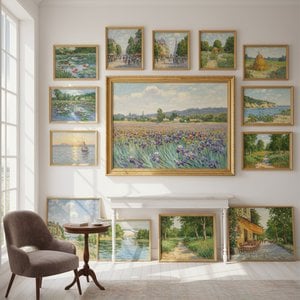
Impressionist Landscapes: 10 Masterpieces for Your Home | ArtsDot
Journey through 10 iconic Impressionist landscapes by Monet, Renoir & Degas. Explore the history, techniques & emotions behind these masterpieces. Find museum-quality reproductions for your home at ArtsDot.com – where art comes to life! Discover all masterpieces on ArtsDot.com

Impressionism's Legacy: 10 Masterpieces That Transformed Art & Decor
Journey through Impressionism's radiant world! Explore 10 masterpieces by Monet, Renoir & Degas that revolutionized art. Discover the stories behind these iconic paintings and find museum-quality reproductions for your home at .

Renoir's Masterpieces: Explore 25 Iconic Paintings & Bring Art Home | ArtsDot
Explore 25 iconic Pierre-Auguste Renoir paintings! Discover the stories behind Impressionist masterpieces like 'Dance at Le Moulin de la Galette' & 'Luncheon of the Boating Party'. Find museum-quality art reproductions and elevate your home decor with ArtsDot.com.

Impressionism's Finest: 10 Masterpieces That Revolutionized Art | ArtsDot
Journey through Impressionism's golden age! Explore 10 masterpieces by Monet, Renoir & Degas that redefined art. Discover the stories behind these iconic paintings and find museum-quality reproductions to elevate your home decor on ArtsDot.com.


