


The picture follows your choices: , .
Collectible Description
Discover this expressive Flemish Baroque still life of foxes by boel pieter (boule), capturing naturalistic beauty; bring home a piece of 17th-century Dutch mastery.
 Read More
Artist Biography
Explore the still lifes of Boel Pieter (Boule), a 17th-century Antwerp artist renowned for his detailed animal & vanitas scenes. Discover Dutch Golden Age mastery!
Hand Made Oil Reproduction
Hand-painted oil on canvas in your size and frame, made to order by our artists. ( Switch to Print Switch to Digital Image)
More about this painting
 Preview
 Send
Send Share
Share
 Details
 Guide
Guide

 Download
 Similars
 X-Ray
X-Ray Diaporama
 Q&A
Q&A Stats
StatsOrder your painting in four simple steps
Take your time. You can change any answer; the price in your order card follows each choice.
1 Step one of four
Which size would you like?
These sizes keep the proportions of the original painting. The drawing shows your choice on a wall, above a two-metre sofa.
Or give your own measurements
Pick from our preset sizes that match the artwork's original proportions.

Type the width and the height you need, to fit your frame or your wall. This is hand-painted, so for a size with a different shape the artist can paint a bit more around the picture, or cut a bit — you choose. We send you a digital mockup to approve before the painting starts. The picture shown on this page does not show the real result — only the mockup does.
2 Step two of four
How should it be prepared: rolled, stretched or framed?
The prices below are for the size you chose in step one.
Choose the edges of the stretched canvas
Choose your frame

White $1

Blurside $1

Extended $1

P118B $10

P118H $10

P118W $10

P438Z $10

P508JH $12

P508YH $12

P805H $10

P805Z $10

P919BZ $10

P919G $10

P919XJ $10

P959ZH $10

P968JZ $12

W106C $8

W218G $10

W218JH $8

W218Y $10

W307PJ $10

W316G $10

W316PJ $8

W316Y $10

W398PJ $8

W4111J $10

W500HY $15

W500JH $15

W692G $12

W849H $8

W940BG $15

W953PJ $8

H24-GOLD $30

H24-SILVER $30

H36-GOLD $45

H36-SILVER $45
Framed
Moulding: . Overall size with the frame: .
3 Step three of four
Would you like anything changed in the painting?
Most people answer no. Because each painting is made by hand, our artist can also adapt it for you.
After order, ArtsDot.com team will email client for instructions and provide a mockup preview
4 Step four of four
A few finishing options
All of them are optional. The answers already selected cost nothing extra.
Who paints it?
Worldwide Delivery () in 3/4 weeks instead of standard 5 weeks. (3 November). No compromise on quality.
A nameplate, as in a museum?
Engraved Bronze Plaque Details
This elegant plaque features the artist's name and the title of the artwork, finely engraved for a timeless presentation.
It is made from bronze with a refined, elegant finish. The text is precisely laser-engraved for a sharp and permanent result. Measuring 9x2 cm, the plaque is compact yet easy to read. It's built to be durable and scratch-resistant, offering a professional, museum-quality look. Mounting is simple thanks to the included adhesive backing.
Transparent Acrylic Plaque Details
The plaque includes essential engraved details such as the artist's name, the title of the artwork, the date it was created, the type of media used-like oil on canvas or watercolor-a brief description of the piece, and a QR code that links to the complete artwork information.
It is crafted from clear acrylic, offering a sleek, modern appearance. The text is UV-engraved in black to ensure strong visual contrast. With a size of 10x15 cm, it ensures optimal readability. It comes equipped with two metal hooks for secure wall mounting. The plaque is designed to be weather-resistant, making it suitable for various environments, and it includes interactive features that work seamlessly with smartphone scanning.
Black Acrylic Plaque Details
This elegant plaque includes engraved information such as the artist's name, the title of the artwork, the date it was created, the type of media used (like oil on canvas or watercolor), a short description of the artwork, and a QR code for quick access to more information.
The plaque itself is made from refined black acrylic with a premium finish. The text is laser-engraved in white for high contrast and readability. Its size is 10x15 cm, designed to be easy to read. It comes with two metal hooks for professional mounting. The design is sleek and fits any interior style. It is also weather-resistant and durable, with built-in digital integration for mobile compatibility.
A protective varnish?
When do you need it?
✓ Check and order
Your painting, as you ordered it

RENARDS
Reproduction Medium
Reproduction Size
-

Elite Senior Artist
More detail, finesse, and extra production time
-

Reproduction Frame
-
-
For artworks or reproductions larger than 105 cm (approximately 41 inches) on any side, the frame will be shipped as a kit, disassembled. This method ensures safe delivery and prevents damage during transport.
Professional assembly required - this is not a DIY product.
The kit must be assembled and the canvas stretched by an experienced professional framer, using wood glue (not supplied), a canvas stretching plier and clamps to hold the bars square while the glue dries. Incorrect assembly or uneven canvas tension can permanently damage the artwork and is not covered by our warranty.
 For artworks or reproductions larger than 105 cm (approximately 41 inches) on any side, the frame will be shipped as a kit, disassembled. This method ensures safe delivery and prevents damage during transport.
All solid wood bars are included, precisely cut to size.
Assembled with the screws provided, plus wood glue for the corner joints, which is not supplied and must be sourced by your framer.
Professional tools are required and not included: a canvas stretching plier (tensioner) and clamps to hold the bars square while the glue dries.
Important:
The corner joints require wood glue, the bars must be held with clamps until the glue is fully dry, and tightening the canvas on the assembled frame requires a canvas stretching plier. None of these are included in the kit. Please arrange an experienced professional framer before ordering this size.

Nameplate
-
-

Protective Varnish
Glossy Varnish (enhances colors, protects against light/moisture)
-

Customize My Artwork
Examples of what can be changed: Replace face with customer photo; Add pet (e.g., replace cat with dog); Include hidden message in background; Change background landscape or elements.
-

Urgent
Worldwide Delivery () in 3/4 weeks instead of standard 5 weeks. (3 November). No compromise on quality.
-
Express Shipping
Worldwide Delivery () in 5 weeks. (10 November).
Included
Total Price
$ 388
Glass option is only available in size under 110 CM
Included with every order
- Free Worldwide Express Shipping
- High-Quality Linen Canvas
- Full Shipping Insurance
- Customs Tax Refund Guarantee
- True Color Matching Guarantee
- 100-Day Return Policy (Defects Only)
- 100% Money-Back Guarantee
- Bulk Discount Offer


The Allure of the Wild: A Study in Flemish Naturalism
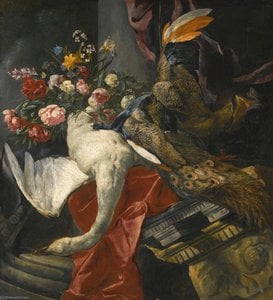
To gaze upon "RENARDS" by boel pieter (boule) is to step into a quiet, damp corner of the natural world, rendered with the masterful intimacy of a 17th-century Dutch or Flemish master. This painting is not merely a depiction of animals; it is an immersive study in texture, repose, and the subtle drama of life observed at its most unguarded moment. The composition centers around a gathering of six foxes, their forms clustered together as if caught mid-pause by an unseen observer. The artist has achieved a remarkable sense of immediacy, drawing us into the shallow pool that serves as both setting and unifying element for this vibrant, yet subdued, tableau.
Technique and Tactile Realism
Boel pieter’s handling of oil paint here speaks volumes about his technical prowess. The surface is alive with varied brushwork; one can almost feel the slick coolness of the mottled water beneath their paws and the varying nap of the foxes' coats. The artist employs a palette dominated by earthy tones—rich browns, muted ochres, and cool grays—punctuated only by strategic highlights that catch the light on wet fur or alert ears. This is naturalism elevated to an art form; the rendering moves beyond mere representation into something almost tactile. The soft, diffused lighting bathes the scene in a gentle glow, allowing shadows to deepen the sense of depth while simultaneously defining the exquisite contours of each animal’s musculature and resting posture.
Symbolism and the Spirit of the Fox
The fox itself has held a potent place in European folklore for centuries. It embodies a complex duality: the wild spirit, yes, but also the cunning intellect and the elusive nature of humanity's own desires. In this grouping, the collective presence of the foxes suggests themes of community within wilderness—a momentary truce among creatures of instinct. For the collector or decorator, owning such a piece is acquiring more than just decoration; it is an infusion of narrative depth, inviting contemplation on intelligence, survival, and the beauty found in untamed life.
A Touch of Flemish Baroque Emotion
While rooted in meticulous observation, the painting avoids the coldness of pure documentation. There is a palpable emotional resonance—a quiet melancholy or perhaps just profound contentment—that permeates the grouping. This characteristic blend of detailed naturalism with an underlying sense of feeling is so typical of the Flemish Baroque period, where masters often sought to imbue their subjects with narrative weight. Whether placed in a grand hall or a richly appointed study, "RENARDS" serves as a sophisticated focal point, whispering tales of the wild while anchoring any interior space with its timeless, earthy elegance.
Questions & Answers
How much light do the colors of "RENARDS" appear to reflect?
The luminance recorded for "RENARDS" by Boel Pieter (Boule) is gentle luminance.
What subject and atmosphere does "RENARDS" by Boel Pieter (Boule) combine?
"RENARDS" shows still life, foxes, animal study, flemish art, nature scene, baroque style, and its recorded mood is earthy.
What underlying hue runs through "RENARDS" by Boel Pieter (Boule)?
"RENARDS" leans toward an ochre to sepia tone.
Related Artworks


Boel Pieter (Boule)
1622 - 1680, Belgium
Artist Biography
Boel Pieter (1622–1674): A Master of Flemish Still Life and Animal Studies
Pieter Boel, a name perhaps less familiar than his contemporaries Frans Snyders or Jan Fyt, nevertheless stands as a significant figure in the vibrant world of 17th-century Flemish art. Born in Antwerp in 1622 into an artistic family – his grandfather a painter registered with the Guild of Saint Luke and his father an engraver – Boel’s early life was steeped in the traditions of visual representation, laying the groundwork for his own distinctive style. While details about his formative years remain somewhat sparse, it's clear that he benefited from exposure to established artistic practices, absorbing influences from both his family lineage and the broader Antwerp art scene.
Boel’s career unfolded across two key locations: Antwerp, where he initially honed his skills, and Paris, where he ultimately found a prestigious position within the royal tapestry workshops. His journey began in Antwerp, likely under the tutelage of Jan Fijt, a renowned master known for his dynamic animal paintings and elaborate still lifes. This apprenticeship provided Boel with a solid foundation in composition, technique, and the depiction of natural subjects – skills that would later inform his own work. Crucially, he also benefited from connections within the artistic community through his family ties; his uncle, Cornelis de Wael, was an established art dealer and painter who had spent considerable time in Genoa, fostering relationships with other artists and expanding Boel’s horizons.
The Evolution of a Style: From Flemish Tradition to Parisian Innovation
Boel's artistic development is marked by a fascinating interplay between traditional Flemish techniques and emerging stylistic trends. Initially influenced by the dramatic realism and theatrical compositions of Frans Snyders, he gradually developed his own distinct approach – one characterized by an exceptional attention to detail, particularly in the rendering of animal anatomy and textures. Unlike many of his contemporaries who relied heavily on studio assistants for background elements or complex details, Boel famously insisted on working directly from live animals, a revolutionary practice at the time. This commitment to direct observation resulted in remarkably lifelike depictions of birds, game, and other creatures, capturing their movements, expressions, and individual characteristics with astonishing accuracy.
His Parisian period proved pivotal. Appointed *peintre ordinaire* (ordinary painter) to King Louis XIV in 1674, Boel found himself at the heart of a thriving artistic environment within the Gobelins tapestry workshops. This appointment afforded him access to royal collections and provided opportunities to create works for the court, including elaborate still lifes featuring exotic animals – a testament to the king’s fascination with the natural world. The atmosphere in Paris fostered experimentation and innovation, allowing Boel to refine his techniques and explore new compositional possibilities. He collaborated closely with other prominent artists of the era, such as Adam Frans van der Meulen and Gerard Scotin, exchanging ideas and contributing to a dynamic artistic dialogue.
A World of Symbolism: Vanitas and Animal Studies
Boel’s paintings are not merely representations of nature; they are imbued with layers of symbolic meaning. His still lifes frequently incorporate elements of *vanitas*, a genre that emphasizes the transience of life, the futility of earthly pursuits, and the inevitability of death. These compositions often feature objects such as skulls, decaying fruit, extinguished candles, and hourglasses – potent reminders of mortality and the fleeting nature of beauty. Alongside these *vanitas* paintings, Boel produced a significant body of work dedicated to animal studies. These meticulously rendered depictions of birds, mammals, reptiles, and fish were not simply exercises in observation; they served as models for tapestry design and provided valuable insights into the anatomy and behavior of animals.
The symbolism within his animal paintings is particularly rich. The presence of a porcupine, for example, held significant cultural resonance in France, evoking associations with chivalry, strength, and invincibility – qualities highly valued by King Louis XIV. Boel’s ability to capture the essence of these animals through careful observation and skillful rendering cemented his reputation as one of the most accomplished animal painters of his time.
Legacy and Influence
Despite his relatively short career, Pieter Boel left a lasting impact on the development of Flemish still life painting. His innovative approach to depicting animals – his insistence on working directly from live subjects – challenged conventional artistic practices and paved the way for future generations of artists. His meticulous attention to detail, combined with his masterful use of color and light, produced works of exceptional beauty and technical virtuosity. While many of his paintings were lost or damaged over the centuries, a significant number survive today, offering valuable insights into the artistic world of 17th-century Antwerp and Paris. Boel’s legacy endures through his influence on subsequent artists and the continued appreciation of his remarkable still lifes and animal studies – testaments to the enduring power of observation, skill, and symbolic representation.




Related Articles

Baroque Drama: Bringing Opulence & Emotion into Contemporary Interiors
Explore the opulent world of Baroque interior design! Discover key elements, modern applications & how to bring dramatic elegance into your home with ArtsDot.com's authentic reproductions.

Baroque Masterpieces: 10 Paintings That Defined an Era |
Journey through the drama & grandeur of Baroque art! Explore 10 masterpieces by Caravaggio, Rembrandt, Rubens & more. Discover stunning oil paintings, rich colors & timeless stories. Find museum-quality reproductions at .

From Classical Still Life to Contemporary Abstraction: Elevating Villa Entertaining Spaces Through Artful Reproduction
Explore the history of still life painting & discover how artful reproductions elevate villa entertaining spaces. Expert guidance, museum-quality prints & custom artwork at ArtsDot.com.