Send
Send Share
Share
 Details
 Guide
Guide

 Download
 Similars
 Diaporama
 Stats
StatsSpring
 Bronze
- Sculpture
- Modern Sculpture
 1966
1966 76.0 x 58.0 cm
 The Hepworth Wakefield
 Read More
The artwork displayed on this page is protected by copyright law, which means we cannot legally create or sell an identical reproduction. This protection is enforced under international agreements such as the Berne Convention and by national laws, including those outlined by the U.S. Copyright Law - Title 17.
As a respectful and legal alternative, we offer custom, hand-painted artworks inspired by the original. Our skilled and professional artists carefully study the original's style, mood, and artistic essence to create a new, unique piece that evokes the same feeling - while remaining an original creation in its own right.
This method fully complies with copyright regulations because it does not involve copying or duplicating the protected artwork. Instead, it is a creative reinterpretation - a new painting that is influenced by the original but not identical to it.
Hand Made Oil Reproduction
Hand-painted oil on canvas in your size and frame, made to order by our artists. ( Switch to Print Switch to Digital Image)




































Pick from our preset sizes that match the artwork's original proportions.

Type the width and the height you need, to fit your frame or your wall. This is hand-painted, so for a size with a different shape the artist can paint a bit more around the picture, or cut a bit — you choose. We send you a digital mockup to approve before the painting starts. The picture shown on this page does not show the real result — only the mockup does.
After order, ArtsDot.com team will email client for instructions and provide a mockup preview
Worldwide Delivery () in 3/4 weeks instead of standard 5 weeks. (19 October). No compromise on quality.

Free Worldwide Express Shipping

High-Quality Linen Canvas

Full Shipping Insurance

Customs Tax Refund Guarantee

True Color Matching Guarantee

100-Day Return Policy (Defects Only)

100% Money-Back Guarantee

Bulk Discount Offer
 Glass option is only available in size under 110 CM

Spring
Reproduction Medium
Reproduction Size
-


Total Price
$ 263
Barbara Hepworth’s “Spring”: A Meditation on Form and Silence
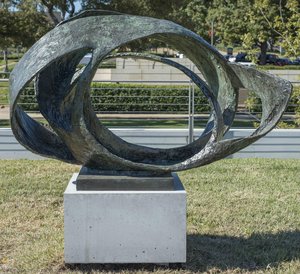
Dame Jocelyn Barbara Hepworth (1903–1975) stands as one of the most influential sculptors of the mid-20th century, a figure whose work profoundly shaped the trajectory of British Modernism. Her oeuvre is characterized by an uncompromising exploration of geometric abstraction, yet imbued with a palpable sensitivity to organic forms—particularly those found in nature. “Spring,” created in 1966, exemplifies this duality perfectly, embodying Hepworth’s enduring fascination with the interplay between solidity and emptiness, presence and absence.- Subject Matter: The sculpture depicts two interlocking circles – one larger, predominantly white marble or alabaster, and a smaller, darker wood sphere nestled within it. This pairing immediately evokes imagery of blossoming buds emerging from dormant earth, mirroring the cyclical rhythms of seasonal renewal. Hepworth herself described her intention as “to find a way to express the idea of spring—the emergence of life from stillness.”
- Style & Technique: Hepworth’s approach was rooted in Minimalism and Constructivism, prioritizing pure form over ornamentation. The circles are meticulously crafted using subtractive carving techniques – removing material from blocks of stone or wood to reveal the underlying structure. This method emphasizes precision and control, resulting in surfaces that appear deceptively smooth despite their complex internal geometry.
- Historical Context: Hepworth’s work emerged during a period of significant artistic experimentation following World War II. The British sculptural landscape was undergoing a dramatic transformation, moving away from representational art towards abstraction as artists sought to grapple with the anxieties and uncertainties of the postwar era. Hepworth's embrace of geometric forms aligned with broader trends in European sculpture, reflecting a desire for clarity and intellectual rigor.
- Symbolism: The circles themselves are laden with symbolic significance. Traditionally, circles represent wholeness, unity, and eternity—concepts that resonate powerfully within Hepworth’s artistic vision. The juxtaposition of the larger, luminous marble sphere and the smaller, darker wood sphere suggests a tension between permanence and vulnerability, mirroring the delicate balance between life and death inherent in springtime.
- Emotional Impact: Despite its apparent simplicity, “Spring” possesses an arresting emotional resonance. Hepworth’s masterful manipulation of material creates a palpable sense of stillness—a meditative invitation to contemplate the fundamental forces shaping our existence. The sculpture's serene beauty speaks to a deeper yearning for harmony and contemplation, capturing the essence of springtime’s transformative power.
Questions & Answers
What underlying hue runs through "Spring" by Barbara Hepworth?
A green to violet spectrum hue runs through "Spring" by Barbara Hepworth.
What is the dominant color of "Spring" by Barbara Hepworth?
rosy brown (#b0aca7) is the leading color of "Spring" by Barbara Hepworth.
Is "Spring" by Barbara Hepworth in the public domain, and why?
The copyright status of "Spring" - still protected by copyright - follows from the artist's death in 1975.
Related Artworks


Artist Biography
early life and education
dame barbara hepworth, a renowned english artist and sculptor, was born on january 10, 1903, in wakefield, yorkshire. she attended the leeds school of art from 1920 and later won a county scholarship to study at the royal college of art (rca) in london from 1921 until she was awarded the diploma in 1924.artistic career
- dame barbara hepworth's work exemplifies modernism, particularly modern sculpture. she was one of the few female artists to achieve international prominence.
- in 1933, she co-founded the unit one art movement with ben nicholson, paul nash, and others, seeking to unite surrealism and abstraction in british art.
- hepworth's early work was characterized by abstraction and her involvement with the paris-based art movement, abstraction-création.
notable works and exhibitions
- oval form (trezion), a bronze sculpture, is part of the kimbell art museum collection in fort worth, united states. (view on ArtsDot)
- two forms, a sculpture, is exhibited at the hepworth wakefield in wakefield, united kingdom. (view on ArtsDot)
- totem, a marble sculpture, is also part of the collection at the hepworth wakefield. (view on ArtsDot)
legacy and museum collections
barbara hepworth's work is widely recognized, with her sculptures and paintings forming part of various museum collections worldwide. the hepworth wakefield, named after the artist, houses numerous masterpieces from renowned artists, including hepworth's own works. (discover more about the hepworth wakefield on ArtsDot)conclusion
dame barbara hepworth's pioneering work in modern british sculpture has left an indelible mark on the art world. her legacy continues to inspire artists and art enthusiasts alike, with her works remaining a testament to her innovative spirit and artistic genius. more about barbara hepworth on wikipedia
Barbara Hepworth
1903 - 1975 , United Kingdom
Quick Facts
- Full Name: Barbara Hepworth
- Nationality: British
- Date Of Birth: 1903
- Date Of Death: 1975
- Place Of Birth: Wakefield, United Kingdom
- Notable Artworks:
- Oval Form (Trezion)
- Two Forms
- Totem
- Artistic Movement Or Style: Modernism, Abstraction
- Artists Who Influenced This Artist:
- Henry Moore
- Ben Nicholson
- Artists Or Movements Influenced By This Artist:
- Abstraction-Création
- Unit One
Related Articles

Bronze Age to Modern Masters: 10 Sculptures That Redefined Art | ArtsDot
Journey through art history with 10 legendary bronze sculptures – from Michelangelo's David to Rodin’s Thinker. Explore the stories, techniques & timeless beauty of these masterpieces. Find museum-quality reproductions & elevate your home decor on ArtsDot.com.

Bronze Sculptures That Defined Art History | ArtsDot
Journey through art history with our Top 10 bronze sculptures! Explore masterpieces by Rodin, Michelangelo & more. Discover stories behind iconic statues and find museum-quality reproductions for your home decor at ArtsDot.com.

Geometric Abstraction's 10 Defining Masterpieces | Art for Your Home - ArtsDot
Explore 10 defining masterpieces of Geometric Abstraction! Discover Kandinsky, Mondrian & Malevich’s iconic works. Find museum-quality art reproductions and curated decor ideas to elevate your home at ArtsDot.com.

Barbara Hepworth: A Sculptural Dialogue with Form, Space & the Human Condition
Explore the profound world of Barbara Hepworth's sculpture. Discover her artistic evolution, iconic forms, and lasting influence on modern art. A guide for collectors & enthusiasts.

The Enduring Legacy of Bronze: A Historical & Artistic Exploration for the Collector
Explore the rich history & enduring appeal of bronze sculpture with expert insights for collectors at ArtsDot. Learn about casting techniques, iconic artists, collecting tips & contemporary interpretations.