Send
Send Share
Share
 Details
 Guide
Guide

 Download
 Similars
 Diaporama
 Stats
StatsPrototype for


 Read More
The artwork displayed on this page is protected by copyright law, which means we cannot legally create or sell an identical reproduction. This protection is enforced under international agreements such as the Berne Convention and by national laws, including those outlined by the U.S. Copyright Law - Title 17.
This method fully complies with copyright regulations because it does not involve copying or duplicating the protected artwork. Instead, it is a creative reinterpretation - a new painting that is influenced by the original but not identical to it.
Giclée / Art Print
Museum-quality giclée or canvas print with fast production and flexible finish options. ( Buy Hand Made Painting Switch to Digital Image)




































Pick from our preset sizes that match the artwork's original proportions.

Type the width and the height you need, to fit your frame or your wall. A print can only be cut, never made bigger than the picture, so a size with a different shape loses a part of the image. We send you a digital mockup to approve before we print anything. The picture shown on this page does not show the real cut — only the mockup does.
Worldwide Delivery () in 2 weeks instead of standard 4/5 weeks. (22 October)

Free Worldwide Express Shipping

High-Quality Linen Canvas

Full Shipping Insurance

Customs Tax Refund Guarantee

True Color Matching Guarantee

100-Day Return Policy (Defects Only)

100% Money-Back Guarantee

Bulk Discount Offer
 Glass option is only available in size under 110 CM

Prototype for
Giclée / Art Print
Reproduction Size
-


Total Price
$ 63
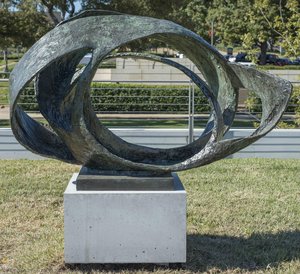
A Pioneer's Vision: Examining Barbara Hepworth’s Prototype for ‘Winged Figure’
Barbara Hepworth (1903–1975), a transformative figure in British sculpture and art history, stands as an emblem of modernist innovation. Born in Wakefield, Yorkshire, her journey began with formative studies at Leeds School of Art before culminating in a prestigious scholarship to the Royal College of Art, where she honed her craft alongside contemporaries like Ben Nicholson and Paul Nash – artists united by a fervent desire to forge a new path for British art amidst the burgeoning Surrealist movement. Hepworth’s artistic trajectory wasn't merely about replicating reality; it was about distilling emotion and concept into tangible form, prioritizing abstraction as a vehicle for conveying profound ideas.The Birth of Form: Conceptual Sculpture and Early Experimentation
Hepworth’s groundbreaking approach to sculpture emerged from the Unit One Art Movement she co-founded in 1933. This collective sought to synthesize Surrealist principles with abstract expressionism, rejecting representational art altogether in favor of exploring the subconscious and conveying inner states through geometric shapes and textures. The “Prototype for ‘Winged Figure’” exemplifies this ethos perfectly—a testament to Hepworth’s unwavering commitment to conceptual exploration before translating it into physical sculpture. Created between 1961 and 1962, this piece represents a crucial step in Hepworth's artistic evolution, demonstrating her meticulous process of refining ideas through preliminary models.Technique and Materiality: Exploring Texture and Negative Space
Hepworth’s distinctive technique involved carving wood – primarily elm – using pneumatic chisels to create hollow forms that emphasized negative space as much as positive mass. This method allowed her to sculpt shapes that seemed to defy gravity, capturing the essence of movement and dynamism while simultaneously conveying a sense of stillness and contemplation. The resulting sculptures possessed an extraordinary tactile quality—smooth surfaces juxtaposed with rough-hewn textures—creating visual and sensory experiences that resonated deeply with viewers. Examining the “Prototype” reveals the precision required to achieve this remarkable effect, highlighting Hepworth’s mastery of material manipulation.Symbolism and Emotion: Representing Flight and Spiritual Resonance
The "Winged Figure" sculpture isn't merely an aesthetically pleasing form; it carries significant symbolic weight. Hepworth herself described her work as “a way of trying to express the feeling of being alive,” reflecting a broader preoccupation with capturing the spiritual dimension of existence within abstract art. The wing-like protrusions—characteristic of Hepworth’s oeuvre—suggest upward movement, aspiration, and liberation from earthly constraints. Moreover, the hollow interior embodies emptiness and openness, inviting contemplation on themes of transcendence and inner harmony. This piece speaks to an enduring fascination with exploring profound emotional truths through visual language.Legacy and Influence: Shaping Modern Sculpture
Barbara Hepworth’s influence extends far beyond her own lifetime, shaping the course of modern sculpture and inspiring generations of artists. Her pioneering exploration of abstraction—coupled with her unwavering dedication to conceptual rigor—established a paradigm for sculptural practice in the mid-20th century. The “Prototype for ‘Winged Figure’” stands as an enduring reminder of Hepworth’s visionary spirit and her profound contribution to artistic innovation, securing her place among the most celebrated sculptors of her era. Its continued presence within collections like The Hepworth Wakefield ensures that Hepworth's groundbreaking aesthetic continues to captivate audiences worldwide.Questions & Answers
Who is the artist behind "Prototype for"?
The artist behind "Prototype for" is Barbara Hepworth. The work is catalogued under Barbara Hepworth's name.
What orientation does "Prototype for" by Barbara Hepworth have?
"Prototype for" by Barbara Hepworth is a landscape composition. The proportions are worth checking before choosing a print size.
What mood would "Prototype for" bring to a space?
The calm atmosphere of "Prototype for" by Barbara Hepworth matches its recommended space: a living room.
Related Artworks


Artist Biography
early life and education
dame barbara hepworth, a renowned english artist and sculptor, was born on january 10, 1903, in wakefield, yorkshire. she attended the leeds school of art from 1920 and later won a county scholarship to study at the royal college of art (rca) in london from 1921 until she was awarded the diploma in 1924.artistic career
- dame barbara hepworth's work exemplifies modernism, particularly modern sculpture. she was one of the few female artists to achieve international prominence.
- in 1933, she co-founded the unit one art movement with ben nicholson, paul nash, and others, seeking to unite surrealism and abstraction in british art.
- hepworth's early work was characterized by abstraction and her involvement with the paris-based art movement, abstraction-création.
notable works and exhibitions
- oval form (trezion), a bronze sculpture, is part of the kimbell art museum collection in fort worth, united states. (view on ArtsDot)
- two forms, a sculpture, is exhibited at the hepworth wakefield in wakefield, united kingdom. (view on ArtsDot)
- totem, a marble sculpture, is also part of the collection at the hepworth wakefield. (view on ArtsDot)
legacy and museum collections
barbara hepworth's work is widely recognized, with her sculptures and paintings forming part of various museum collections worldwide. the hepworth wakefield, named after the artist, houses numerous masterpieces from renowned artists, including hepworth's own works. (discover more about the hepworth wakefield on ArtsDot)conclusion
dame barbara hepworth's pioneering work in modern british sculpture has left an indelible mark on the art world. her legacy continues to inspire artists and art enthusiasts alike, with her works remaining a testament to her innovative spirit and artistic genius. more about barbara hepworth on wikipedia
Barbara Hepworth
1903 - 1975 , United Kingdom
Quick Facts
- Full Name: Barbara Hepworth
- Nationality: British
- Date Of Birth: 1903
- Date Of Death: 1975
- Place Of Birth: Wakefield, United Kingdom
- Notable Artworks:
- Oval Form (Trezion)
- Two Forms
- Totem
- Artistic Movement Or Style: Modernism, Abstraction
- Artists Who Influenced This Artist:
- Henry Moore
- Ben Nicholson
- Artists Or Movements Influenced By This Artist:
- Abstraction-Création
- Unit One
Related Articles

Bronze Age to Modern Masters: 10 Sculptures That Redefined Art | ArtsDot
Journey through art history with 10 legendary bronze sculptures – from Michelangelo's David to Rodin’s Thinker. Explore the stories, techniques & timeless beauty of these masterpieces. Find museum-quality reproductions & elevate your home decor on ArtsDot.com.

Bronze Sculptures That Defined Art History | ArtsDot
Journey through art history with our Top 10 bronze sculptures! Explore masterpieces by Rodin, Michelangelo & more. Discover stories behind iconic statues and find museum-quality reproductions for your home decor at ArtsDot.com.

Barbara Hepworth: A Sculptural Dialogue with Form, Space & the Human Condition
Explore the profound world of Barbara Hepworth's sculpture. Discover her artistic evolution, iconic forms, and lasting influence on modern art. A guide for collectors & enthusiasts.

The Enduring Form: Sculpture Across History, Technique & Emotional Resonance
Explore the rich history of sculpture with ArtsDot. Discover key techniques, influential artists & investment potential for discerning collectors. Expert insights into valuing and collecting timeless masterpieces.

The Enduring Form: Exploring Themes & Techniques in Sculpture Across Historical Periods
Explore the rich history of sculpture from ancient masterpieces to contemporary innovations. Discover key techniques, influential artists & investment potential for discerning art collectors.