Send
Send Share
Share
 Details
 Guide
Guide

 Download
 Similars
 Diaporama
 Stats
StatsOval Sculpture


 Read More
Hand Made Oil Reproduction
Hand-painted oil on canvas in your size and frame, made to order by our artists. ( Switch to Print Switch to Digital Image)




































Pick from our preset sizes that match the artwork's original proportions.

You may enter your own dimensions to fit a specific frame or space. If your selected size does not match the original image's proportions, we will either crop the artwork or extend the painting with additional hand-painted elements. A digital mockup will be sent for your approval before production begins.
Please note that the on-screen preview does not reflect the actual cropping or extension. Only the mockup will accurately show the final composition.
While custom sizes are available, we recommend selecting a dimension from the predefined list to preserve the original proportions.
After order, ArtsDot.com team will email client for instructions and provide a mockup preview
Worldwide Delivery () in 3/4 weeks instead of standard 5 weeks. (22 September). No compromise on quality.

Free Worldwide Express Shipping

High-Quality Linen Canvas

Full Shipping Insurance

Customs Tax Refund Guarantee

True Color Matching Guarantee

100-Day Return Policy (Defects Only)

100% Money-Back Guarantee

Bulk Discount Offer
 Glass option is only available in size under 110 CM

Oval Sculpture
Reproduction Medium
Reproduction Size
-


Total Price
$ 263
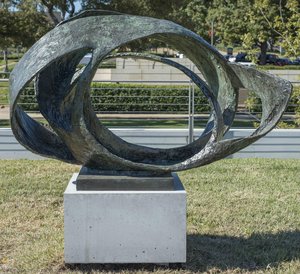
Oval Sculpture: A Meditation on Form and Space by Barbara Hepworth
Dame Barbara Hepworth’s “Oval Sculpture,” created in 1943, stands as a testament to the profound influence of modernist sculpture on British art during its formative years. This deceptively simple piece—a cast bronze version produced in 1958—captures an essence of geometric abstraction that transcends mere visual representation.
The sculpture’s core is comprised of two interlocking bowls crafted from wood, positioned vertically atop one another. At first glance, the arrangement might appear straightforward; however, Hepworth skillfully employs a technique rooted in illusionism to generate a mesmerizing effect. The subtle curvature and hollow interior of each bowl create an optical paradox—a suggestion of a larger form contained within, prompting viewers to contemplate the relationship between solid and void.
Hepworth’s artistic journey began at Leeds School of Art in 1920, where she honed her skills before securing a prestigious scholarship to study at the Royal College of Art. Her involvement with the Unit One art movement—a collaborative effort uniting Surrealism and Abstraction—established her reputation as a trailblazer within British modernism.
- Style: Hepworth’s work embodies the principles of geometric abstraction, prioritizing form and space over traditional depiction.
- Technique: The sculpture utilizes wood carving combined with bronze casting – a masterful fusion that emphasizes texture and materiality.
- Historical Context: Produced during World War II, “Oval Sculpture” reflects the anxieties and aspirations of its time—a desire to explore new aesthetic languages amidst global upheaval.
Beyond its formal qualities, "Oval Sculpture" resonates with deeper symbolic meanings. The bowl form itself has been associated with containment and receptivity – concepts that align with Hepworth’s broader exploration of the human condition. Its stillness invites contemplation, encouraging viewers to consider the interplay between internal experience and external perception.
The sculpture's placement within the Kimbell Art Museum collection underscores its enduring significance as a cornerstone of modern art history. It serves as an inspiration for interior designers seeking to infuse spaces with elegance and intellectual depth—a reminder that beauty can reside in understated geometric forms and thoughtful artistic expression.
Related Artworks


Artist Biography
early life and education
dame barbara hepworth, a renowned english artist and sculptor, was born on january 10, 1903, in wakefield, yorkshire. she attended the leeds school of art from 1920 and later won a county scholarship to study at the royal college of art (rca) in london from 1921 until she was awarded the diploma in 1924.artistic career
- dame barbara hepworth's work exemplifies modernism, particularly modern sculpture. she was one of the few female artists to achieve international prominence.
- in 1933, she co-founded the unit one art movement with ben nicholson, paul nash, and others, seeking to unite surrealism and abstraction in british art.
- hepworth's early work was characterized by abstraction and her involvement with the paris-based art movement, abstraction-création.
notable works and exhibitions
- oval form (trezion), a bronze sculpture, is part of the kimbell art museum collection in fort worth, united states. (view on ArtsDot)
- two forms, a sculpture, is exhibited at the hepworth wakefield in wakefield, united kingdom. (view on ArtsDot)
- totem, a marble sculpture, is also part of the collection at the hepworth wakefield. (view on ArtsDot)
legacy and museum collections
barbara hepworth's work is widely recognized, with her sculptures and paintings forming part of various museum collections worldwide. the hepworth wakefield, named after the artist, houses numerous masterpieces from renowned artists, including hepworth's own works. (discover more about the hepworth wakefield on ArtsDot)conclusion
dame barbara hepworth's pioneering work in modern british sculpture has left an indelible mark on the art world. her legacy continues to inspire artists and art enthusiasts alike, with her works remaining a testament to her innovative spirit and artistic genius. more about barbara hepworth on wikipedia
Barbara Hepworth
1903 - 1975 , United Kingdom
Quick Facts
- Artistic Movement Or Style: Modernism, Abstraction
- Artists Or Movements Influenced By This Artist:
- Abstraction-Création
- Unit One
- Artists Who Influenced This Artist:
- Henry Moore
- Ben Nicholson
- Date Of Birth: 1903-01-10
- Date Of Death: 1975-05-20
- Full Name: Barbara Hepworth
- Nationality: British
- Notable Artworks:
- Oval Form (Trezion)
- Two Forms
- Totem
- Place Of Birth: Wakefield, UK
Related Articles

Abstract Expressionism's 10 Defining Masterpieces |
Explore 10 defining Abstract Expressionism masterpieces by Pollock, Rothko & de Kooning. Discover the stories behind these iconic paintings and find museum-quality art reproductions to elevate your home decor on .

White on Canvas: 10 Masterpieces & Timeless Elegance for Your Home Decor
Explore 10 iconic white paintings by Monet, Whistler & Rothko! Discover the stories behind these serene masterpieces and their impact on art history. Find museum-quality reproductions for your home decor at .

Barbara Hepworth: A Sculptural Dialogue with Form, Space & the Human Condition
Explore the profound world of Barbara Hepworth's sculpture. Discover her artistic evolution, iconic forms, and lasting influence on modern art. A guide for collectors & enthusiasts.

Bronze Sculptures That Defined Art History | ArtsDot
Journey through art history with our Top 10 bronze sculptures! Explore masterpieces by Rodin, Michelangelo & more. Discover stories behind iconic statues and find museum-quality reproductions for your home decor at ArtsDot.com.

The Enduring Form: Exploring Themes & Techniques in Sculpture Across Historical Periods
Explore the rich history of sculpture from ancient masterpieces to contemporary innovations. Discover key techniques, influential artists & investment potential for discerning art collectors.