Send
Send Share
Share
 Details
 Guide
Guide

 Download
 Similars
 Diaporama
 Stats
StatsOval Form (Trezion)
 Bronze
- Sculpture
- Modernism
 1962
1962 93.0 x 146.0 cm
 Kimbell Art Museum
 Read More
Giclée / Art Print
Museum-quality giclée or canvas print with fast production and flexible finish options. ( Buy Hand Made Painting Switch to Digital Image)




































Pick from our preset sizes that match the artwork's original proportions.

You may enter your own dimensions to fit a specific frame or space. If your selected size does not match the original image's proportions, we will either crop the artwork or extend the image with a mirrored or solid-fill edge. A digital mockup will be sent for your approval before production begins.
Please note that the on-screen preview does not reflect the actual cropping or extension. Only the mockup will accurately show the final composition.
While custom sizes are available, we recommend selecting a dimension from the predefined list to preserve the original proportions.
Worldwide Delivery () in 2 weeks instead of standard 4/5 weeks. (25 September)

Free Worldwide Express Shipping

High-Quality Linen Canvas

Full Shipping Insurance

Customs Tax Refund Guarantee

True Color Matching Guarantee

100-Day Return Policy (Defects Only)

100% Money-Back Guarantee

Bulk Discount Offer
 Glass option is only available in size under 110 CM

Oval Form (Trezion)
Giclée / Art Print
Reproduction Size
-


Total Price
$ 63
Oval Form (Trezion): A Dance of Light and Stone
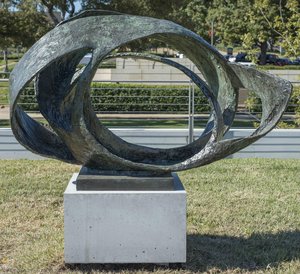
Barbara Hepworth’s “Oval Form (Trezion),” created in 1962, isn't merely a sculpture; it’s an invitation to contemplate the very essence of form, space, and the profound connection between human experience and the natural world. This monumental bronze, currently residing within the esteemed collection of the Kimbell Art Museum in Fort Worth, Texas, stands as a testament to Hepworth’s pioneering approach to abstract sculpture – one that moved beyond representational imagery to explore pure geometric relationships and tactile sensations.
At first glance, the piece presents a deceptively simple form: a vast, gently curving oval bisected by a deep, resonant hollow. However, prolonged observation reveals an intricate interplay of textures and surfaces. The exterior is deliberately rough, bearing the marks of the casting process – evidence of the sculptor’s hand shaping the molten metal. This contrasts dramatically with the smooth, polished interior, creating a dynamic tension between solidity and void, presence and absence. The subtle shifts in color, ranging from warm browns to muted greens, further enhance this visual dialogue, evoking the shifting light and shadows found on weathered stone or the surface of water.
A Cornish Inspiration: Echoes of Landscape
Hepworth’s relationship with Cornwall is inextricably linked to “Oval Form (Trezion).” Following a pivotal shift in her artistic practice during World War II, she sought refuge and inspiration from the rugged coastline of St Ives. The dramatic cliffs, crashing waves, and intricate rock formations profoundly influenced her work during this period, leading to a renewed focus on capturing the essence of landscape through abstract forms. “Trezion,” named after Hepworth’s beloved Cornish home, embodies this connection – it's a distillation of the coastline’s power and beauty, translated into a singular, enduring form.
The sculpture’s genesis can be traced back to her exploration of Neolithic standing stones found at Chûn Castle hillfort. These ancient monoliths, weathered by centuries of exposure to the elements, served as a visual catalyst for Hepworth's creative process. She sought to capture their monumental presence and inherent energy, translating them into a contemporary language of form and space. The deep recesses within “Oval Form” are reminiscent of caves and hollows found in the Cornish landscape, further reinforcing this connection.
The Language of Sculpture: Materiality and Movement
Hepworth’s mastery lies not just in her conceptual approach but also in her technical skill. She skillfully employed the lost-wax casting process, allowing for a remarkable degree of control over the final form. The bronze itself was carefully selected – its inherent qualities of density, reflectivity, and malleability were crucial to achieving the desired effect. Hepworth’s technique involved building up layers of plaster on an armature, carving away excess material to reveal the underlying form. This subtractive process created a dynamic tension between mass and void, contributing to the sculpture's sense of movement and depth.
The deliberate roughness of the exterior surface is particularly noteworthy. Hepworth intentionally left visible traces of the casting process – tool marks, imperfections, and variations in color – as a reminder of the human hand that shaped the piece. This engagement with materiality elevates “Oval Form (Trezion)” beyond mere abstraction, imbuing it with a sense of history and authenticity.
A Legacy of Modernism: Resonance Today
“Oval Form (Trezion)” stands as a cornerstone of Hepworth’s oeuvre and a defining example of British modern sculpture. Its influence can be seen in the work of countless artists who followed, demonstrating her enduring legacy as a pioneer of abstract form. The sculpture's exploration of space, texture, and material remains profoundly relevant today, inviting viewers to engage with its complex interplay of visual elements and contemplate the timeless relationship between art and nature. Reproductions of this iconic piece offer a remarkable opportunity to bring Hepworth’s vision into any setting, adding a touch of sophisticated elegance and contemplative depth.
Related Artworks


Artist Biography
early life and education
dame barbara hepworth, a renowned english artist and sculptor, was born on january 10, 1903, in wakefield, yorkshire. she attended the leeds school of art from 1920 and later won a county scholarship to study at the royal college of art (rca) in london from 1921 until she was awarded the diploma in 1924.artistic career
- dame barbara hepworth's work exemplifies modernism, particularly modern sculpture. she was one of the few female artists to achieve international prominence.
- in 1933, she co-founded the unit one art movement with ben nicholson, paul nash, and others, seeking to unite surrealism and abstraction in british art.
- hepworth's early work was characterized by abstraction and her involvement with the paris-based art movement, abstraction-création.
notable works and exhibitions
- oval form (trezion), a bronze sculpture, is part of the kimbell art museum collection in fort worth, united states. (view on ArtsDot)
- two forms, a sculpture, is exhibited at the hepworth wakefield in wakefield, united kingdom. (view on ArtsDot)
- totem, a marble sculpture, is also part of the collection at the hepworth wakefield. (view on ArtsDot)
legacy and museum collections
barbara hepworth's work is widely recognized, with her sculptures and paintings forming part of various museum collections worldwide. the hepworth wakefield, named after the artist, houses numerous masterpieces from renowned artists, including hepworth's own works. (discover more about the hepworth wakefield on ArtsDot)conclusion
dame barbara hepworth's pioneering work in modern british sculpture has left an indelible mark on the art world. her legacy continues to inspire artists and art enthusiasts alike, with her works remaining a testament to her innovative spirit and artistic genius. more about barbara hepworth on wikipedia
Barbara Hepworth
1903 - 1975 , United Kingdom
Quick Facts
- Artistic Movement Or Style: Modernism, Abstraction
- Artists Or Movements Influenced By This Artist:
- Abstraction-Création
- Unit One
- Artists Who Influenced This Artist:
- Henry Moore
- Ben Nicholson
- Date Of Birth: 1903-01-10
- Date Of Death: 1975-05-20
- Full Name: Barbara Hepworth
- Nationality: British
- Notable Artworks:
- Oval Form (Trezion)
- Two Forms
- Totem
- Place Of Birth: Wakefield, UK
Related Articles

The Enduring Legacy of Bronze: A Historical & Artistic Exploration for the Collector
Explore the rich history & enduring appeal of bronze sculpture with expert insights for collectors at ArtsDot. Learn about casting techniques, iconic artists, collecting tips & contemporary interpretations.

Bronze Sculptures That Defined Art History | ArtsDot
Journey through art history with our Top 10 bronze sculptures! Explore masterpieces by Rodin, Michelangelo & more. Discover stories behind iconic statues and find museum-quality reproductions for your home decor at ArtsDot.com.

Barbara Hepworth: A Sculptural Dialogue with Form, Space & the Human Condition
Explore the profound world of Barbara Hepworth's sculpture. Discover her artistic evolution, iconic forms, and lasting influence on modern art. A guide for collectors & enthusiasts.

The Enduring Legacy of Bronze Sculpture: A Collector's Guide to Form & Cultural Significance
Explore the rich history & enduring appeal of bronze sculpture with expert insights for collectors at ArtsDot. Learn about casting techniques, iconic artists, and collecting tips to build a discerning art collection.

Bronze Age to Modern Masters: 10 Sculptures That Redefined Art | ArtsDot
Journey through art history with 10 legendary bronze sculptures – from Michelangelo's David to Rodin’s Thinker. Explore the stories, techniques & timeless beauty of these masterpieces. Find museum-quality reproductions & elevate your home decor on ArtsDot.com.