Send
Send Share
Share
 Details
 Guide
Guide

 Download
 Similars
 Diaporama
 Stats
StatsCurved Form (Pavan)


 Read More
Giclée / Art Print
Museum-quality giclée or canvas print with fast production and flexible finish options. ( Buy Hand Made Painting Switch to Digital Image)




































Pick from our preset sizes that match the artwork's original proportions.

You may enter your own dimensions to fit a specific frame or space. If your selected size does not match the original image's proportions, we will either crop the artwork or extend the image with a mirrored or solid-fill edge. A digital mockup will be sent for your approval before production begins.
Please note that the on-screen preview does not reflect the actual cropping or extension. Only the mockup will accurately show the final composition.
While custom sizes are available, we recommend selecting a dimension from the predefined list to preserve the original proportions.
Worldwide Delivery () in 2 weeks instead of standard 4/5 weeks. (25 September)

Free Worldwide Express Shipping

High-Quality Linen Canvas

Full Shipping Insurance

Customs Tax Refund Guarantee

True Color Matching Guarantee

100-Day Return Policy (Defects Only)

100% Money-Back Guarantee

Bulk Discount Offer
 Glass option is only available in size under 110 CM

Curved Form (Pavan)
Giclée / Art Print
Reproduction Size
-


Total Price
$ 63
Curved Forms (Pavan): A Dialogue Between Stone and Fluidity
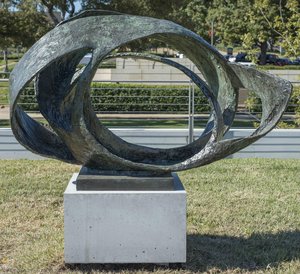
Barbara Hepworth’s *Curved Form (Pavan)*, created in 1956, stands as a testament to Hepworth's pioneering approach to sculpture—a deliberate rejection of traditional modeling techniques in favor of embracing the inherent resistance of stone. This remarkable piece resides within The Hepworth Wakefield’s permanent collection and embodies Hepworth’s unwavering fascination with dance and music, reflected in its title itself – *Pavan*, a stately court dance originating from the sixteenth century. Examining this sculpture reveals not merely an aesthetically pleasing form but also a profound exploration of artistic process and conceptual ideas.- Material & Technique: Crafted from impregnated plaster, meticulously applied onto an aluminum armature, *Curved Form (Pavan)* exemplifies Hepworth’s innovative method. Unlike her earlier works predominantly featuring carved stone, she consciously opted for metallization—a technique that simulates the appearance of bronze—allowing her to capture the “qualities of molten material,” as she herself described it. This process underscored her belief in a dynamic relationship between artist and sculpture, mirroring the movement inherent in dance.
- Form & Composition: The sculpture presents three interconnected ovoids – pale gray forms that intertwine gracefully—creating an illusion of flowing movement despite their solid materiality. Hepworth’s careful consideration for balance and spatial arrangement contributes to the piece's serene beauty, resisting gravity with a palpable sense of vitality.
- Historical Context: Hepworth’s work emerged during the height of Modernism, coinciding with the rise of abstraction and Surrealism in British art. Her involvement with the Unit One Art Movement alongside figures like Ben Nicholson and Paul Nash signaled a desire to synthesize these influential artistic currents. This sculpture reflects the broader movement toward exploring non-representational forms and conveying emotional resonance through pure visual language.
- Symbolic Resonance: The title *Pavan* carries significant symbolic weight, referencing a formal dance tradition that prioritized elegance and restraint. Hepworth’s selection of this term suggests an intention to imbue the sculpture with qualities of grace and composure—a deliberate contrast to the perceived violence of stone carving itself.
- Emotional Impact: Viewing *Curved Form (Pavan)* evokes contemplation and invites viewers to consider the interplay between form, space, and human experience. Hepworth’s masterful manipulation of material and technique achieves a remarkable feat – conveying profound emotional depth through seemingly simple geometric shapes.
Related Artworks


Artist Biography
early life and education
dame barbara hepworth, a renowned english artist and sculptor, was born on january 10, 1903, in wakefield, yorkshire. she attended the leeds school of art from 1920 and later won a county scholarship to study at the royal college of art (rca) in london from 1921 until she was awarded the diploma in 1924.artistic career
- dame barbara hepworth's work exemplifies modernism, particularly modern sculpture. she was one of the few female artists to achieve international prominence.
- in 1933, she co-founded the unit one art movement with ben nicholson, paul nash, and others, seeking to unite surrealism and abstraction in british art.
- hepworth's early work was characterized by abstraction and her involvement with the paris-based art movement, abstraction-création.
notable works and exhibitions
- oval form (trezion), a bronze sculpture, is part of the kimbell art museum collection in fort worth, united states. (view on ArtsDot)
- two forms, a sculpture, is exhibited at the hepworth wakefield in wakefield, united kingdom. (view on ArtsDot)
- totem, a marble sculpture, is also part of the collection at the hepworth wakefield. (view on ArtsDot)
legacy and museum collections
barbara hepworth's work is widely recognized, with her sculptures and paintings forming part of various museum collections worldwide. the hepworth wakefield, named after the artist, houses numerous masterpieces from renowned artists, including hepworth's own works. (discover more about the hepworth wakefield on ArtsDot)conclusion
dame barbara hepworth's pioneering work in modern british sculpture has left an indelible mark on the art world. her legacy continues to inspire artists and art enthusiasts alike, with her works remaining a testament to her innovative spirit and artistic genius. more about barbara hepworth on wikipedia
Barbara Hepworth
1903 - 1975 , United Kingdom
Quick Facts
- Artistic Movement Or Style: Modernism, Abstraction
- Artists Or Movements Influenced By This Artist:
- Abstraction-Création
- Unit One
- Artists Who Influenced This Artist:
- Henry Moore
- Ben Nicholson
- Date Of Birth: 1903-01-10
- Date Of Death: 1975-05-20
- Full Name: Barbara Hepworth
- Nationality: British
- Notable Artworks:
- Oval Form (Trezion)
- Two Forms
- Totem
- Place Of Birth: Wakefield, UK
Related Articles

Barbara Hepworth: A Sculptural Dialogue with Form, Space & the Human Condition
Explore the profound world of Barbara Hepworth's sculpture. Discover her artistic evolution, iconic forms, and lasting influence on modern art. A guide for collectors & enthusiasts.

Bronze Sculptures That Defined Art History | ArtsDot
Journey through art history with our Top 10 bronze sculptures! Explore masterpieces by Rodin, Michelangelo & more. Discover stories behind iconic statues and find museum-quality reproductions for your home decor at ArtsDot.com.

The Enduring Form: Exploring Themes & Techniques in Sculpture Across Historical Periods
Explore the rich history of sculpture from ancient masterpieces to contemporary innovations. Discover key techniques, influential artists & investment potential for discerning art collectors.

Bronze Age to Modern Masters: 10 Sculptures That Redefined Art | ArtsDot
Journey through art history with 10 legendary bronze sculptures – from Michelangelo's David to Rodin’s Thinker. Explore the stories, techniques & timeless beauty of these masterpieces. Find museum-quality reproductions & elevate your home decor on ArtsDot.com.

The Enduring Form: Sculpture Across History, Technique & Emotional Resonance
Explore the rich history of sculpture with ArtsDot. Discover key techniques, influential artists & investment potential for discerning collectors. Expert insights into valuing and collecting timeless masterpieces.