Preview
 Send
Send Share
Share
 Details
 Guide
Guide

 Download
 Similars
 X-Ray
X-Ray Diaporama
 Q&A
Q&A Stats
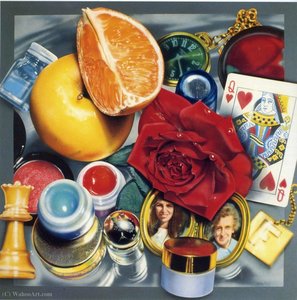
StatsUntitled (972)

 Read More
The artwork displayed on this page is protected by copyright law, which means we cannot legally create or sell an identical reproduction. This protection is enforced under international agreements such as the Berne Convention and by national laws, including those outlined by the U.S. Copyright Law - Title 17.
This method fully complies with copyright regulations because it does not involve copying or duplicating the protected artwork. Instead, it is a creative reinterpretation - a new painting that is influenced by the original but not identical to it.
Giclée / Art Print
Museum-quality giclée or canvas print with fast production and flexible finish options. ( Buy Hand Made Painting Switch to Digital Image)




































Pick from our preset sizes that match the artwork's original proportions.

Type the width and the height you need, to fit your frame or your wall. A print can only be cut, never made bigger than the picture, so a size with a different shape loses a part of the image. We send you a digital mockup to approve before we print anything. The picture shown on this page does not show the real cut — only the mockup does.
Worldwide Delivery () in 2 weeks instead of standard 4/5 weeks. (18 November)

Free Worldwide Express Shipping

High-Quality Linen Canvas

Full Shipping Insurance

Customs Tax Refund Guarantee

True Color Matching Guarantee

100-Day Return Policy (Defects Only)

100% Money-Back Guarantee

Bulk Discount Offer
 Glass option is only available in size under 110 CM

Untitled (972)
Giclée / Art Print
Reproduction Size
-


Total Price
$ 63
Related Artworks


Artist Biography
A Pioneer of Photorealism and Beyond: The Life and Art of Audrey Flack
Audrey Flack, born in New York City on May 30, 1931, and recently passing on June 28, 2024, was a transformative figure in American art. Her journey reflects a restless spirit constantly seeking new ways to engage with the world and challenge artistic conventions. Initially drawn to the expressive freedom of Abstract Expressionism in the 1950s – influenced by masters like Franz Kline – Flack quickly realized that this path didn’t fully satisfy her desire for direct communication with viewers. She yearned for a style that could bridge the gap between personal vision and shared experience, leading her toward a revolutionary shift in the 1960s: photorealism. This wasn't merely a technical exercise; it was a deliberate choice to confront reality head-on, meticulously recreating the world around her with an almost unsettling precision. Flack’s early education at institutions like Cooper Union and Yale University – where she studied under Josef Albers – provided a strong foundation in artistic principles, but it was her willingness to break from established norms that truly defined her career.From Photorealism to Vanitas: Exploring Themes of Mortality and Desire
Flack’s emergence as a leading photorealist painter coincided with a period of significant cultural change. Her large-scale paintings, based on photographs, weren't simply replications of reality; they were carefully constructed narratives filled with symbolic weight. A pivotal work from this era, Kennedy Motorcade, November 22, 1963, stands as a powerful testament to her ability to capture both historical events and the collective emotions surrounding them. However, Flack’s artistic exploration didn't stop at mere representation. In the late 1970s, she embarked on a series of vanitas paintings – compositions steeped in symbolism referencing mortality and the fleeting nature of life. Marilyn, for example, is a poignant meditation on fame, beauty, and the inevitable passage of time, drawing parallels between the iconic image of Marilyn Monroe and traditional still-life motifs representing transience. This series demonstrated Flack’s profound engagement with art history, revitalizing a genre that had largely fallen out of favor while imbuing it with contemporary relevance. She wasn't simply painting objects; she was constructing visual allegories about the human condition.Sculptural Visions and a “Post Pop Baroque” Renaissance
The 1980s marked another significant turning point in Flack’s artistic trajectory as she transitioned to sculpture. Rejecting the two-dimensional constraints of painting, she began creating bronze figures of goddesses and heroic women, often drawing inspiration from mythology and Egyptian iconography. These sculptures weren't merely representations of female forms; they were powerful statements about feminine strength, resilience, and empowerment. Flack sought to reclaim narratives traditionally dominated by male figures, offering alternative visions of heroism and beauty. This exploration continued into the 2010s with a return to painting, which she termed her “Post Pop Baroque” period. In these works, historical references seamlessly blended with contemporary imagery, creating a dynamic interplay between past and present. It was a synthesis of all her previous explorations – photorealism’s meticulous detail, vanitas’ symbolic depth, and sculpture’s monumental presence – resulting in paintings that were both visually stunning and intellectually stimulating.Legacy and Influence: A Lasting Impact on American Art
Audrey Flack's contributions to the art world are undeniable. She was one of the first photorealist painters to be included in the collection of the Museum of Modern Art (MoMA), a landmark achievement that solidified her place in art history. Her work has been exhibited in numerous prestigious museums, including the Metropolitan Museum of Art, the Whitney Museum of American Art, and the Guggenheim Museum, demonstrating its enduring appeal and critical acclaim. Beyond her artistic achievements, Flack was also a dedicated educator, holding visiting professorships at institutions like the University of Pennsylvania and sharing her knowledge with generations of aspiring artists. She authored Art & Soul: Notes on Creating (1986), offering insights into her creative process and artistic philosophy. Her influence extends far beyond her immediate circle, inspiring countless American and international artists to explore new possibilities in representation, symbolism, and the intersection of art and life. Flack’s fearless experimentation, coupled with her unwavering commitment to feminist themes, has left an indelible mark on the landscape of contemporary art, ensuring her legacy will continue to resonate for years to come.Recognition and Achievements
Throughout her illustrious career, Audrey Flack received numerous accolades recognizing her significant contributions to the arts. These include a St. Gaudens Medal from Cooper Union and an Honorary Albert Dome Professorship from Bridgeport University. She was also featured in H.W. Janson’s influential History of Art, cementing her status as a major figure in the canon of Western art. Her work continues to be celebrated for its technical brilliance, intellectual depth, and enduring relevance, solidifying her position as a true pioneer and visionary artist.- St. Gaudens Medal from Cooper Union
- Honorary Albert Dome Professorship from Bridgeport University
- Visiting Professor at the University of Pennsylvania
- Featured in H.W. Janson’s *History of Art*
- Doctorate from Clark University (2015)

Audrey Flack
1931 - 2024 , United States
Quick Facts
- Full Name: Audrey Flack
- Nationality: American
- Date Of Birth: 1931
- Date Of Death: June 28, 2024
- Place Of Birth: New York, United States of America
- Notable Artworks:
- Kennedy Motorcade
- Marilyn
- Untitled (213)
- Artistic Movement Or Style:
- Photorealism
- Vanitas
- Sculpture
- Artists Who Influenced This Artist:
- Franz Kline
- Josef Albers
- Artists Or Movements Influenced By This Artist:
- Photorealism
- Feminist Art
Related Articles

Masterpieces of Georges Braque: The Top 25 Essential Artworks
Explore the top 25 masterpieces of Georges Braque, from Cubism to Fauvism. Discover the full collection online at ArtsDot.com.

Defining Art Now: Top 10 Masterpieces of '08-Contemporary & Beyond | ArtsDot
Explore 10 defining masterpieces of contemporary art – from Jeff Koons to Yayoi Kusama. Discover the stories behind iconic paintings & sculptures, and find museum-quality reproductions for your home at ArtsDot.com. Explore the full collection online!

10 Masterpieces That Defined Contemporary Art: A Curated Selection
Explore iconic contemporary art from Cindy Sherman to Niki de Saint Phalle. Discover museum-quality masterpieces on ArtsDot.com.

Arturo Souto: A Study in Abstract Expressionism & Emotional Resonance
Explore the captivating world of Arturo Souto's abstract expressionism. Discover his unique style, emotional depth, and investment potential – a guide for discerning art collectors.
Contemporary Realism: 10 Masterpieces & Artists That Redefined Art |
Explore 10 defining masterpieces of Contemporary Realism! Discover Lucian Freud, Chuck Close & more. Uncover stories behind iconic paintings and find museum-quality art reproductions to elevate your home decor on .