Preview
 Send
Send Share
Share
 Details
 Guide
Guide

 Download
 Similars
 X-Ray
X-Ray Diaporama
 Stats
StatsHoneymoon
 Oil On Canvas
- WallArt
- Romanticism
 1890
1890- 19th Century
 72.0 x 52.0 cm
 Städel Museum
 Read More
Giclée / Art Print
Museum-quality giclée or canvas print with fast production and flexible finish options. ( Buy Hand Made Painting Switch to Digital Image)




P118B $10

P118H $10

P118W $10

P438Z $10

P508JH $12

P508YH $12

P805H $10

P805Z $10

P919BZ $10

P919G $10

P919XJ $10

P959ZH $10

P968JZ $12

W106C $8

W218G $10

W218JH $8

W218Y $10

W307PJ $10

W316G $10

W316PJ $8

W316Y $10

W398PJ $8

W4111J $10

W500HY $15

W500JH $15

W692G $12

W849H $8

W940BG $15

W953PJ $8




Pick from our preset sizes that match the artwork's original proportions.

Type the width and the height you need, to fit your frame or your wall. A print can only be cut, never made bigger than the picture, so a size with a different shape loses a part of the image. We send you a digital mockup to approve before we print anything. The picture shown on this page does not show the real cut — only the mockup does.
Worldwide Delivery () in 2 weeks instead of standard 4/5 weeks. (22 October)

Free Worldwide Express Shipping

High-Quality Linen Canvas

Full Shipping Insurance

Customs Tax Refund Guarantee

True Color Matching Guarantee

100-Day Return Policy (Defects Only)

100% Money-Back Guarantee

Bulk Discount Offer
 Glass option is only available in size under 110 CM

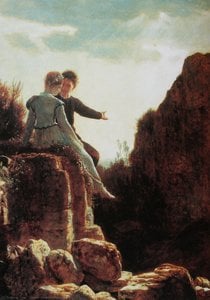
Honeymoon
Giclée / Art Print
Reproduction Size
-


Total Price
$ 63
A Moment of Sublime Romance: Arnold Böcklin’s “Honeymoon”
Arnold Böcklin's "Honeymoon," painted in 1890, is more than just a picturesque landscape; it’s a carefully constructed meditation on love, aspiration, and the profound connection between humanity and nature. Measuring 72 x 52 cm, this oil-on-canvas work exemplifies Böcklin's signature style within the Symbolist movement – a style characterized by its evocative mood, symbolic resonance, and meticulous attention to detail. The scene depicts a young couple perched atop a rugged rock formation, overlooking a vast, hazy expanse that speaks of both beauty and mystery. It’s a tableau designed not merely to represent a romantic encounter but to evoke a deeply felt emotion within the viewer.
Romanticism's Embrace: Composition and Technique
- Compositional Strength: The figures, centrally placed yet subtly distanced, draw the eye immediately, establishing a powerful focal point. The horizontal thrust of the rocky outcrop anchors the scene while simultaneously directing the gaze towards the distant landscape. This deliberate arrangement creates a sense of depth and stability, crucial elements within Böcklin’s approach.
- Meticulous Brushwork: Böcklin's technique is immediately apparent in the incredibly detailed brushwork. Layer upon layer of oil paint has been skillfully applied to build up the textures of the stone – rough, weathered, and undeniably ancient – as well as the flowing drapery of the woman’s dress and the delicate strands of her hair. This painstaking process imbues the painting with a remarkable tactile quality.
- Atmospheric Perspective: The use of atmospheric perspective—the subtle blurring of details in the background to suggest distance—further enhances the illusion of depth, transporting the viewer into this serene, almost dreamlike setting.
Symbolic Layers: Interpretation and Meaning
“Honeymoon” is rich with symbolic meaning, reflecting Böcklin’s fascination with themes of mortality, mythology, and the human condition. The elevated position of the figures on the rocky outcrop can be interpreted as a representation of aspiration – a desire to reach for something beyond the mundane. The vast landscape behind them symbolizes the immensity of emotion or experience, suggesting that love is both intensely personal and profoundly connected to the wider world. The muted color palette—browns, ochres, and greens—contributes to the painting’s melancholic yet hopeful mood, reminiscent of Romanticism's exploration of intense feelings and the sublime.
A Masterpiece of the Symbolist Era
Painted in 1890, “Honeymoon” stands as a testament to Arnold Böcklin’s mastery of the Symbolist style. His ability to capture not just visual beauty but also profound emotional and symbolic resonance is evident in every detail. This artwork offers a glimpse into the heart of the Symbolist movement – a movement that sought to express ideas and emotions through evocative imagery, rather than literal representation. A hand-painted reproduction of “Honeymoon” would bring this timeless piece into any interior space, offering a touch of Romantic elegance and contemplative beauty.
Questions & Answers
Is a high-resolution download of "Honeymoon" available?
"Honeymoon" is available as a high-resolution digital image download, purchased directly on its Digital Image page.
What colors dominate "Honeymoon" by Arnold Böcklin?
"Honeymoon" is defined by an earthy palette led by putty (#cfd1c5).
What space matches the colors of "Honeymoon" by Arnold Böcklin?
With its earthy palette, "Honeymoon" by Arnold Böcklin is recommended for a living room. The colors are part of the reason for this suggestion.
Related Artworks


Artist Biography
early life and training
arnold böcklin, a swiss symbolist painter, was born on october 16, 1827, in basel, switzerland. his father, christian frederick böcklin, descended from an old family of schaffhausen and engaged in the silk trade. arnold's mother, ursula lippe, was a native of the same city. he studied at the düsseldorf academy under schirmer, becoming a friend of anselm feuerbach. böcklin is associated with the düsseldorf school of painting.artistic career and symbolism
böcklin's artistic journey took him to various cities, including paris, where he worked at the louvre, and rome, where he was influenced by its sights. his work often featured allegorical and mythological figures in settings involving classical architecture, exploring themes of death and mortality.- great park, one of his earliest works, showcased ancient mythology.
- nymph and satyr (1858) and sappho (1859) were notable works from this period.
- böcklin's portrait of myself, with death playing a violin (1872) exemplified his unique style.
legacy and influence
böcklin is best known for his five versions of the isle of the dead (1880-1886), which evoked the english cemetery in florence, where his daughter was buried. his work influenced younger artists like hans thoma and inspired several late-romantic composers.- clement greenberg described böcklin's work as "one of the most consummate expressions" of its time.
- böcklin's style overlapped with the pre-raphaelites, emphasizing the world of dreams and mysticism.
museums and collections
böcklin's work can be found in various museums, including:- öffentliche kunstsammlung (basel, switzerland)
- kunstmuseum basel (switzerland)
- museum kunsthaus zürich (zürich, switzerland)

Arnold Böcklin
1827 - 1901 , Switzerland
Quick Facts
- Full Name: Arnold Böcklin
- Nationality: Swiss
- Date Of Birth: 1827
- Date Of Death: 1901
- Place Of Birth: Basel, Switzerland
- Notable Artworks:
- Isle of the Dead
- Nymph and Satyr
- Sappho
- Portrait of Myself
- Artistic Movement Or Style: Symbolism
- Artists Who Influenced This Artist:
- Schirmer
- Feuerbach
- Artists Or Movements Influenced By This Artist:
- Hans Thoma
- Pre-Raphaelites
Related Articles

Romantic Landscapes: 10 Masterpieces for Your Home | ArtsDot
Journey through 10 Romantic landscape masterpieces by Friedrich, Turner & Cole. Explore emotional art, sublime nature scenes & iconic 19th-century paintings. Find museum-quality reproductions for your home at ArtsDot.com – discover the full collection online!

Evoking Nature's Sublime: A Comprehensive Exploration of 19th-Century Landscape Painting
Explore the captivating world of 19th-century landscape painting! Discover renowned artists like Friedrich & Monet, key movements, and find the perfect artwork to bring nature's serenity into your home. Expert insights at ArtsDot.

The Sublime and the Picturesque: Exploring Emotion & Nature in Romantic Landscape Painting
Explore the emotional power of Romantic landscape painting! Discover the sublime & picturesque traditions, key artists like Friedrich & Cole, and find your perfect artwork at ArtsDot.

Evocations of Place: A Historical Journey Through Landscape Art
Explore the rich history of landscape art with ArtsDot. Discover renowned artists, movements like Impressionism & tonalism, and expert guidance for collecting timeless pieces. Find your perfect serene escape today!

Evocations of Place: A Historical Journey Through Landscape Art
Explore the rich history of landscape art with ArtsDot. Discover renowned artists, movements like Impressionism & Romanticism, and expert guidance for collecting timeless pieces. Find your perfect serene escape today!