
 Acrylic On Canvas
- WallArt
- Contemporary Realism
 1931
1931 38.0 x 31.0 cm
 Museu do Oriente

The picture follows your choices: , .
Collectible Description
António Xavier Trindade 1931 Yet another depiction of a true place of confluence, the Godavari River is an important site of pilgrimage to all major religions present in the Subcontinent. The banks of the river Godavari are a buzzing place where daily life and its religious rituals take place. Depicted in this work, the surroundings of Sri Sundar Narayan Mandir, build in 1756 and dedicated to Lo
 Read More
Artist Biography
Discover António Xavier Trindade (1870-1935), a prominent Goan painter of the Bombay School, celebrated as the 'Rembrandt of the East'. Explore his realistic portraits, landscapes & still lifes blending Indian culture with Western styles.
Hand Made Oil Reproduction
Hand-painted oil on canvas in your size and frame, made to order by our artists. ( Switch to Print Switch to Digital Image)
More about this painting
 Preview
 Send
Send Share
Share
 Details
 Guide
Guide

 Download
 Similars
 X-Ray
X-Ray Diaporama
 Q&A
Q&A Stats
StatsOrder your painting in four simple steps
Take your time. You can change any answer; the price in your order card follows each choice.
1 Step one of four
Which size would you like?
These sizes keep the proportions of the original painting. The drawing shows your choice on a wall, above a two-metre sofa.
Or give your own measurements
Pick from our preset sizes that match the artwork's original proportions.

Type the width and the height you need, to fit your frame or your wall. This is hand-painted, so for a size with a different shape the artist can paint a bit more around the picture, or cut a bit — you choose. We send you a digital mockup to approve before the painting starts. The picture shown on this page does not show the real result — only the mockup does.
2 Step two of four
How should it be prepared: rolled, stretched or framed?
The prices below are for the size you chose in step one.
Choose the edges of the stretched canvas
Choose your frame

White $1

Blurside $1

Extended $1

P118B $10

P118H $10

P118W $10

P438Z $10

P508JH $12

P508YH $12

P805H $10

P805Z $10

P919BZ $10

P919G $10

P919XJ $10

P959ZH $10

P968JZ $12

W106C $8

W218G $10

W218JH $8

W218Y $10

W307PJ $10

W316G $10

W316PJ $8

W316Y $10

W398PJ $8

W4111J $10

W500HY $15

W500JH $15

W692G $12

W849H $8

W940BG $15

W953PJ $8

H24-GOLD $30

H24-SILVER $30

H36-GOLD $45

H36-SILVER $45
Framed
Moulding: . Overall size with the frame: .
3 Step three of four
Would you like anything changed in the painting?
Most people answer no. Because each painting is made by hand, our artist can also adapt it for you.
After order, ArtsDot.com team will email client for instructions and provide a mockup preview
4 Step four of four
A few finishing options
All of them are optional. The answers already selected cost nothing extra.
Who paints it?
Worldwide Delivery () in 3/4 weeks instead of standard 5 weeks. (29 October). No compromise on quality.
A nameplate, as in a museum?
Engraved Bronze Plaque Details
This elegant plaque features the artist's name and the title of the artwork, finely engraved for a timeless presentation.
It is made from bronze with a refined, elegant finish. The text is precisely laser-engraved for a sharp and permanent result. Measuring 9x2 cm, the plaque is compact yet easy to read. It's built to be durable and scratch-resistant, offering a professional, museum-quality look. Mounting is simple thanks to the included adhesive backing.
Transparent Acrylic Plaque Details
The plaque includes essential engraved details such as the artist's name, the title of the artwork, the date it was created, the type of media used-like oil on canvas or watercolor-a brief description of the piece, and a QR code that links to the complete artwork information.
It is crafted from clear acrylic, offering a sleek, modern appearance. The text is UV-engraved in black to ensure strong visual contrast. With a size of 10x15 cm, it ensures optimal readability. It comes equipped with two metal hooks for secure wall mounting. The plaque is designed to be weather-resistant, making it suitable for various environments, and it includes interactive features that work seamlessly with smartphone scanning.
Black Acrylic Plaque Details
This elegant plaque includes engraved information such as the artist's name, the title of the artwork, the date it was created, the type of media used (like oil on canvas or watercolor), a short description of the artwork, and a QR code for quick access to more information.
The plaque itself is made from refined black acrylic with a premium finish. The text is laser-engraved in white for high contrast and readability. Its size is 10x15 cm, designed to be easy to read. It comes with two metal hooks for professional mounting. The design is sleek and fits any interior style. It is also weather-resistant and durable, with built-in digital integration for mobile compatibility.
A protective varnish?
When do you need it?
✓ Check and order
Your painting, as you ordered it

Temple
Reproduction Medium
Reproduction Size
-

Elite Senior Artist
More detail, finesse, and extra production time
-

Reproduction Frame
-
-
For artworks or reproductions larger than 105 cm (approximately 41 inches) on any side, the frame will be shipped as a kit, disassembled. This method ensures safe delivery and prevents damage during transport.
Professional assembly required - this is not a DIY product.
The kit must be assembled and the canvas stretched by an experienced professional framer, using wood glue (not supplied), a canvas stretching plier and clamps to hold the bars square while the glue dries. Incorrect assembly or uneven canvas tension can permanently damage the artwork and is not covered by our warranty.
 For artworks or reproductions larger than 105 cm (approximately 41 inches) on any side, the frame will be shipped as a kit, disassembled. This method ensures safe delivery and prevents damage during transport.
All solid wood bars are included, precisely cut to size.
Assembled with the screws provided, plus wood glue for the corner joints, which is not supplied and must be sourced by your framer.
Professional tools are required and not included: a canvas stretching plier (tensioner) and clamps to hold the bars square while the glue dries.
Important:
The corner joints require wood glue, the bars must be held with clamps until the glue is fully dry, and tightening the canvas on the assembled frame requires a canvas stretching plier. None of these are included in the kit. Please arrange an experienced professional framer before ordering this size.

Nameplate
-
-

Protective Varnish
Glossy Varnish (enhances colors, protects against light/moisture)
-

Customize My Artwork
Examples of what can be changed: Replace face with customer photo; Add pet (e.g., replace cat with dog); Include hidden message in background; Change background landscape or elements.
-

Urgent
Worldwide Delivery () in 3/4 weeks instead of standard 5 weeks. (29 October). No compromise on quality.
-
Express Shipping
Worldwide Delivery () in 5 weeks. (5 November).
Included
Total Price
$ 263
Glass option is only available in size under 110 CM
Included with every order
- Free Worldwide Express Shipping
- High-Quality Linen Canvas
- Full Shipping Insurance
- Customs Tax Refund Guarantee
- True Color Matching Guarantee
- 100-Day Return Policy (Defects Only)
- 100% Money-Back Guarantee
- Bulk Discount Offer


A Window Into Goa’s Spiritual Heart: António Xavier Trindade's Temple
António Xavier Trindade (1870 – 1935) stands as a singular figure in the panorama of Indian art, an artist who transcended mere representation to embody the spirit of his time—a confluence of European academic rigor and profound engagement with indigenous traditions. Born in Sanguem, Goa, during Portuguese colonial rule, Trindade’s formative years instilled within him a sensitivity to both Western artistic ideals and the vibrant pulse of Hindu culture, resulting in an oeuvre characterized by remarkable subtlety and luminous observation. His journey toward artistic mastery began at Sir Jamsetjee Jeejeebhoy School of Art in Bombay, where he absorbed the precepts of naturalism championed by luminaries like Frederic Leighton, yet simultaneously nurtured a burgeoning fascination with Indian iconography and daily life—a duality that would become the cornerstone of his distinctive style. The award of the Mayo Silver Medal for artistic merit in 1892 cemented his reputation as a prodigious talent, marking him as one of the foremost artists emerging from Bombay’s burgeoning art scene.- Subject Matter: Trindade's focus consistently centered on capturing scenes of Hindu temples and rituals—particularly those associated with Lord Vishnu—demonstrating an unwavering devotion to portraying sacred spaces and practices.
- Style: His artistic approach leaned heavily toward naturalism, mirroring the stylistic trends prevalent in European painting during his era. However, unlike many artists of his time who merely replicated Western forms, Trindade infused them with a distinctly Indian sensibility.
Technique and Material Considerations
Trindade’s mastery lay not only in capturing visual impressions but also in executing them with exceptional technical finesse. Primarily utilizing watercolor—a medium favored for its luminosity and ability to convey nuanced tonal variations—he achieved breathtaking realism through meticulous layering of washes and subtle blending strokes. References to scholarly sources like Shihandi, Marcella et al., Tavares Cristina Azevedo et al., Gracias Fátima confirm the importance of Trindade’s work in documenting Goa's cultural heritage. The Museo Nazionale Etrusco Tiberino and Fondazione Oriente corroborate his influence on subsequent generations of Indian artists. His technique—characterized by rapid brushstrokes yet imbued with a remarkable degree of precision—allowed him to convey both the immediacy of observation and the contemplative atmosphere inherent in religious devotion.- Watercolor Medium: Trindade’s preference for watercolor ensured that his paintings retained an ethereal quality, capturing the diffused light and warmth characteristic of temple interiors.
- Brushstrokes: The artist's distinctive brushwork—described as “quick and light”—created a sense of movement and dynamism while simultaneously conveying serenity and reverence.
Symbolism and Emotional Resonance
Beyond mere depiction, Trindade’s paintings resonate with deeper symbolic meanings. The temple itself serves as a focal point for representing faith and spirituality—a space dedicated to divine worship where devotees engage in rituals of purification and devotion. The inclusion of worshippers preparing for prayer underscores the importance of ritual observance within Hindu tradition. Furthermore, the warm palette employed by Trindade—as evidenced in reproductions like “Nasik Scene with Temples II” and “Temple”—effectively communicates the spiritual ambiance of the depicted site. As Gracias Fátima eloquently observes in “Faces of Colonial India,” Trindade’s work embodies a profound engagement with Indian culture, reflecting its multifaceted expressions of faith and artistic creativity.Concluding Reflections
António Xavier Trindade's "Temple" stands as an enduring testament to the transformative power of artistic vision—a painting that transcends time and place to convey not only visual beauty but also a palpable sense of spiritual contemplation. Its meticulous technique, informed by European naturalism yet rooted in Indian cultural traditions, continues to inspire artists and collectors alike. Reproductions like “Nasik Scene with Bathers” and “Temple” allow viewers to experience the luminous quality of Trindade’s watercolor style and appreciate his contribution to the canon of Indian art history.Questions & Answers
Is "Temple" one of António Xavier Trindade's most popular works?
"Temple" by António Xavier Trindade has a recognized popularity level. This classification reflects how widely the work is recognized.
What emotion does the Contemporary Realism work "Temple" convey?
The spiritual emotion of "Temple" accompanies its Contemporary Realism style.
How can I view "Temple" by António Xavier Trindade as a slideshow?
A slideshow is available: the Diaporama page of "Temple" by António Xavier Trindade.
Related Artworks


António Xavier Trindade
1870 - 1935, India
Artist Biography
A Life Etched in Light: The World of António Xavier Trindade
António Xavier Trindade, a name resonating with quiet power within the annals of Indian art history, was more than just a painter; he was a cultural bridge. Born in Sanguem, Goa, in 1870 to Catholic parents, his journey began amidst the lush landscapes and complex colonial tapestry of Portuguese India. This formative environment would indelibly shape his artistic vision, fostering a unique blend of Western academic training with an intrinsic understanding of Indian life and character. Trindade’s early promise led him to the prestigious Sir Jamsetjee Jeejeebhoy School of Art in Bombay, a pivotal institution that exposed him to European naturalism while simultaneously nurturing a growing generation of Indian artists. It was here, within those hallowed halls, that he honed his skills, mastering techniques that would later define his signature style and earn him accolades like the Mayo Silver Medal for artistic merit in 1892—a testament to his burgeoning talent.The Bombay School and a Rising Star
Trindade’s ascent within the Bombay art scene was swift and assured. Appointed as a teacher of drawing and painting at the Sir J.J. School of Art in 1898, he not only contributed to the education of future generations but also solidified his position as a leading figure in the burgeoning Bombay School. Later, assuming the role of Superintendent of the Reay Workshop of Art from 1914 to 1926, he further influenced artistic production and pedagogy. However, it wasn’t merely institutional recognition that marked his success; it was the captivating quality of his work itself. While initially embracing traditional portraiture and landscapes, Trindade gradually developed a style characterized by its realism, sensitivity to light, and an ability to capture the psychological depth of his subjects. He became known for portraying Indian women with a dignity and intimacy rarely seen in colonial-era art, offering glimpses into their lives beyond the confines of societal expectations. This earned him the affectionate title “Rembrandt of the East,” acknowledging both his technical mastery and his profound understanding of human emotion.Themes and Techniques: A Synthesis of Worlds
The 1920s witnessed a maturation in Trindade’s artistic expression, marked by an increasing focus on portraits, landscapes, and still lifes. His canvases became windows into the lives of his contemporaries—wealthy patrons, family members, and everyday individuals—each rendered with meticulous detail and a subtle yet powerful emotional resonance. Dolce Far Niente (Flora or Mother Reclining), awarded the Bombay Art Society’s gold medal in 1920, exemplifies this period; it is not merely a depiction of a woman at rest but an exploration of motherhood, serenity, and the quiet beauty of domestic life. Similarly, New Year’s Song (1928) and Hindu Girl (1930), recipients of the Governor’s prize, showcase his ability to capture cultural nuances and individual personalities with remarkable sensitivity. Trindade's technique was rooted in Western academic principles—a mastery of chiaroscuro, precise draftsmanship, and a sophisticated understanding of color theory—but he infused these elements with an Indian sensibility, creating a unique visual language that transcended stylistic boundaries. He wasn’t simply replicating what he had learned; he was transforming it, imbuing it with the spirit of his homeland.Legacy and Enduring Influence
Despite facing personal challenges—including declining health and eventual blindness in later life—Trindade continued to paint, supported by his daughter Ângela Trindade, herself a talented artist who carried on her father’s legacy. His work gained further recognition with an exhibition at the Festival of the Empire in Wembley, London, in 1934, bringing his art to an international audience. Today, António Xavier Trindade's paintings are treasured possessions of museums and private collectors alike, most notably represented by a significant collection held at the Fundação Oriente in Goa. The permanent exhibitions established there—including a dedicated showcase celebrating his 150th birthday in 2021—ensure that his artistic vision continues to inspire and captivate audiences for generations to come. His influence extends beyond mere aesthetic appreciation; he represents a pivotal moment in Indian art history, a time when artists began to forge their own identities, blending tradition with modernity and challenging the prevailing colonial gaze. Trindade’s life and work stand as a testament to the power of artistic expression to transcend cultural boundaries and illuminate the shared human experience.Notable Works
- Dolce Far Niente (Flora or Mother Reclining) – Bombay Art Society Gold Medal, 1920.
- New Year’s Song – Governor’s Prize, 1928.
- Hindu Girl – Governor’s Prize, 1930.
- Girl with a Vase - National Gallery of Modern Art, New Delhi.
- Self-portrait in Green- Fundação Oriente.


Related Articles

Ephemeral Visions: Exploring the History & Emotional Resonance of Watercolor Painting
Explore the captivating history of watercolor painting, from ancient techniques to modern masters like Kandinsky & Blake. Discover essential artists, collecting tips & the emotional power of this luminous medium. Expert insights for art enthusiasts.
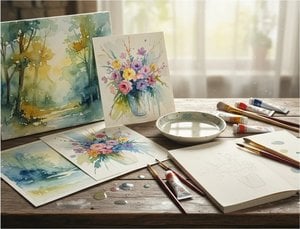
Ephemeral Visions: Exploring the Artistic Legacy & Nuances of Watercolor Painting
Explore the captivating world of watercolor painting! Discover its rich history, essential techniques, influential artists & collecting tips from art experts. A comprehensive guide for enthusiasts.

Watercolor Wonders: 10 Masterpieces That Redefined Art History | ArtsDot
Journey through 10 legendary watercolor masterpieces by Sargent, Turner & Homer! Explore iconic landscapes, portraits & floral art that redefined history. Find museum-quality reproductions and curated decor ideas at ArtsDot.com.